A practical luxury buyer’s guide to reading finish schedules with discipline, from brand specificity and substitutions to allowances, mockups, lighting, hardware, and the questions to ask before signing.
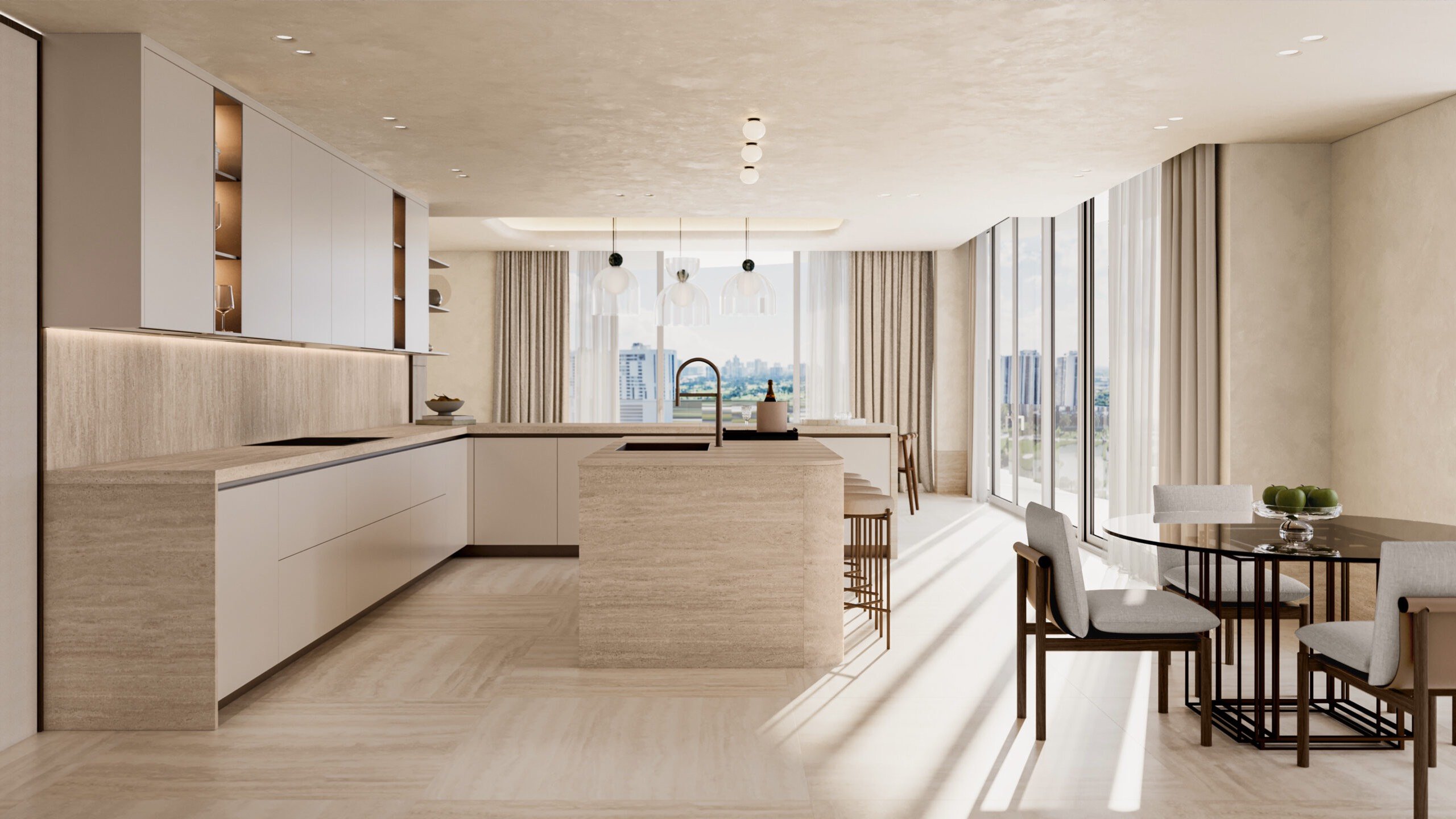
A beautiful rendering can make almost any residence feel inevitable. The finish schedule is where that romance becomes tangible. It identifies what is planned for the floors, walls, countertops, cabinetry, appliances, plumbing fixtures, lighting, doors, hardware, terraces, and sometimes the closets, laundry areas, and secondary baths that receive less attention in a sales gallery.
Luxury buyers in South Florida should treat this document as a design passport. It is not merely a list of materials. It is a map of what will touch your hands, what will catch the afternoon light, what will age gracefully in salt air, and what may become a negotiation point before contract. Whether the search is in Brickell, Surfside, or Aventura, the discipline is the same: read for specificity, not mood.
A tourist reads “imported stone” and imagines permanence. A serious buyer asks which stone, which finish, which slab selection process, which edge profile, and where it is used. That is the difference between admiring luxury and underwriting it.
The most important words in a finish schedule are often not poetic. They are brand names, model numbers, series names, dimensions, thicknesses, colors, finish codes, and performance categories. “European cabinetry” may sound elevated, but it is less useful than a cabinet system identified by manufacturer, door style, veneer, lacquer finish, hinge type, interior drawer material, and hardware.
The same discipline applies to appliances and fixtures. “Premium appliance package” is an invitation to ask for the manufacturer, model, panel-ready details, refrigeration configuration, wine storage, cooktop type, ventilation, and warranty path. “Designer plumbing fixtures” should prompt questions about faucet finish, shower valve brand, trim kit, hand shower, rain head, drain placement, and whether the powder room receives the same level of specification as the primary bath.
For a penthouse buyer, vague language becomes even more consequential because the expectation is not just quality, but continuity. A top-floor residence should not feel like a larger version of a standard unit with a few cosmetic upgrades. The schedule should show where the residence is genuinely elevated.
The phrase “or equal” can be reasonable in construction. Supply chains, discontinuations, and field conditions exist. But in a luxury contract, that phrase should never pass unnoticed. Equal to whom? Equal by price, appearance, durability, country of origin, brand prestige, technical performance, or availability?
A careful buyer asks how substitutions are approved, who makes the decision, whether notice is required, and whether the buyer has review rights. If a specified stone becomes unavailable, the replacement should be evaluated for visual character, porosity, finish, maintenance, and compatibility with adjoining materials. If a fixture changes, the issue may not be purely aesthetic. Rough-in dimensions, water flow, wall depth, and serviceability can all matter.
The most polished buyers do not object to every substitution. They make sure the substitution process is not one-sided. The goal is not to micromanage construction. It is to protect the level of residence you believed you were buying.
An allowance is not the same as an inclusion. An inclusion means the item is provided as specified. An allowance sets a budget for an item, and the final selection may cost more. In luxury real estate, allowances can be useful when buyers want flexibility, but they should be read with precision.
Ask what the allowance covers: material only, fabrication, delivery, installation, taxes, accessories, design coordination, and change-order administration. A stone allowance that excludes fabrication and installation is very different from one that includes the complete installed surface. A lighting allowance may sound generous until decorative fixtures, dimming systems, controls, and specialty installation are separated.
For new-construction and pre-construction purchases, allowances should be reviewed early, while changes are still feasible. Waiting until the residence is nearly complete can reduce options, increase costs, and limit the ability to coordinate finishes gracefully.
Luxury is often won or lost at transitions. A finish schedule may identify flooring, but the refined buyer also asks about baseboards, thresholds, stair nosings, shower curbs, balcony door tracks, grout joints, expansion joints, and where one material meets another. These are the details that determine whether a residence feels seamless or assembled.
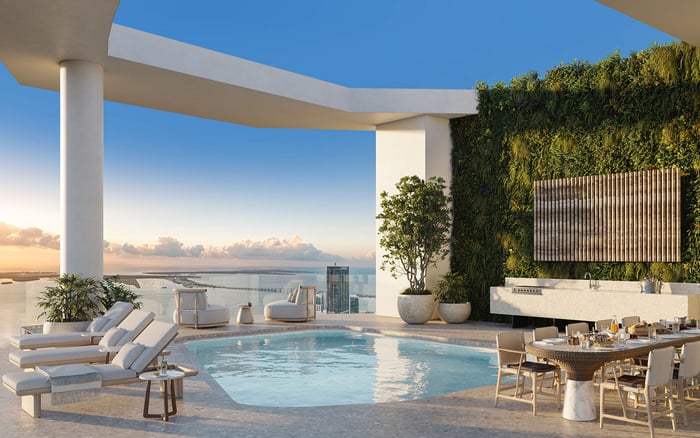
A balcony finish deserves special attention in coastal South Florida. Ask about the walking surface, drainage, railing interface, door sill, and maintenance expectations. A terrace should be read not only as outdoor square footage, but as a material environment exposed to heat, rain, wind, furniture movement, and entertaining wear.
Interior transitions matter just as much. If wood flooring meets stone in a gallery or primary suite, ask how the change is handled. If large-format porcelain is used in bathrooms, ask about layout, cuts, grout color, and niche detailing. If wallcovering is included, ask which rooms, which substrate, and whether humidity-sensitive areas are excluded.
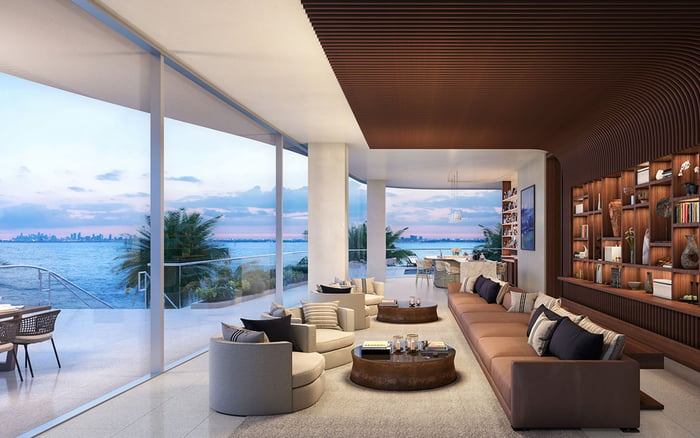
Renderings are mood instruments. Finish schedules are contractual instruments, or at minimum, closer to the operational truth. If a rendering shows book-matched stone, fluted millwork, integrated lighting, specialty mirrors, or dramatic ceiling treatments, ask whether those items are included, optional, upgraded, or purely illustrative.
Sales galleries can also create assumptions. A model kitchen may include upgraded appliances, styled shelving, enhanced lighting, or furniture-grade millwork. The schedule should clarify what transfers to the delivered residence. If a buyer is comparing several buildings, this is where surface impressions become disciplined analysis.
The most useful question is simple: “Where, exactly, is this shown in the schedule?” If the answer is not clear, the item should be clarified before expectations harden.
Materials behave differently in person. Stone may vary by slab. Wood may read warmer under natural light. Metal finishes can shift from champagne to brass depending on surrounding surfaces. Matte surfaces may conceal fingerprints beautifully or reveal oils quickly. High-gloss lacquer may look exceptional in a gallery and require more careful daily handling.
Ask to see physical samples when available. If possible, view them in daylight and under the lighting temperature planned for the residence. Ask whether sample variation is expected and how final selections are controlled. For stone, the question is not simply whether it is beautiful. It is whether the buyer can review slabs, approve layouts, and understand sealing or care requirements.
Maintenance is part of luxury. A residence that requires constant worry is not effortless. The finish schedule should lead naturally into questions about cleaning protocols, replacement parts, warranty channels, and who services specialized systems after closing.
Before signing, the strongest buyers create a concise finish review. Which items are fixed? Which are allowances? Which are upgrade options? Which are subject to substitution? Which are shown in renderings but not specified? Which selections can the buyer influence, and by what deadline?
Ask for the latest finish schedule, not a preliminary version if a later document exists. Ask whether there are differences by line, stack, floor, or residence type. Ask whether closets, laundry rooms, secondary baths, powder rooms, terraces, and service areas follow the same finish level as the headline spaces.
This is not skepticism. It is connoisseurship. In a high-value purchase, beauty should be legible in writing before it is celebrated in person.
What is a finish schedule in a luxury residence? It is the document that identifies planned materials, fixtures, appliances, surfaces, and related finish details for the residence.
Why do model numbers matter? Model numbers reduce ambiguity and help a buyer understand the exact appliance, fixture, hardware, or system being proposed.
Is “or equal” always a problem? No. It can be practical, but the buyer should understand who decides what qualifies as equal and how substitutions are approved.
What is the difference between an allowance and an inclusion? An inclusion is provided as specified, while an allowance sets a budget that may or may not cover the buyer’s final selection.
Should I rely on renderings? Renderings are useful for atmosphere, but the finish schedule is a better guide to what is intended for delivery.
What should I ask about stone surfaces? Ask about stone type, finish, thickness, edge profile, slab review, sealing, maintenance, and where the material is used.
Do outdoor finishes require special review? Yes. Outdoor surfaces should be considered for drainage, exposure, maintenance, furniture use, and transitions at doors and railings.
Can finish schedules vary within one building? They can. Buyers should ask whether finishes differ by residence type, floor, line, package, or upgrade selection.
When should I review the finish schedule? Review it before signing, then revisit it before selection deadlines, construction changes, and closing walk-throughs.
Who should help review a finish schedule? A knowledgeable real estate advisor, designer, attorney, or construction professional can help translate vague language into practical questions.
To compare the best-fit options with clarity, connect with MILLION.
If branded residences are on your mind — as a home or as an allocation — we would be glad to share what we are seeing, privately.
Begin a quiet conversation