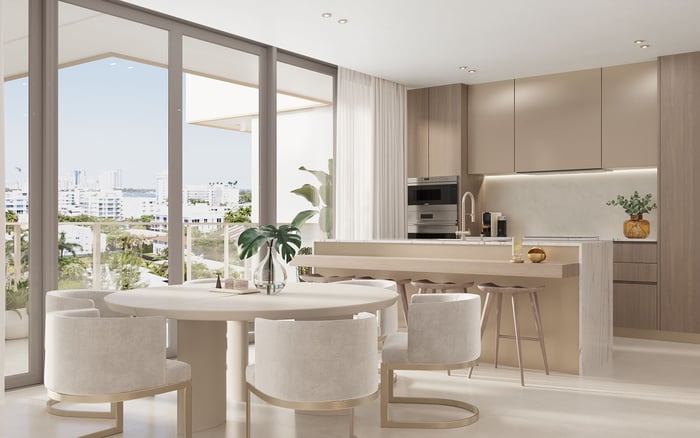
A discreet buyer’s framework for examining security, privacy, governance, and resale durability in Bal Harbour luxury residences.

In Bal Harbour, security should be evaluated as a complete operating system, not a collection of visible devices. Cameras, controlled doors, staffed desks, and private elevators may contribute to protection, but buyers should focus on how these elements work together through everyday routines and unexpected events.
Begin with the full journey from curb to residence. Consider vehicle arrival, guest verification, deliveries, service personnel, amenity access, parking, and after-hours entry. Every transition should have a clear protocol, a responsible party, and a sensible fallback if technology fails or staffing is interrupted. The best systems feel discreet to residents while remaining difficult for an unverified visitor to navigate.
This Buyer's Guide approach is especially useful in a market where privacy is integral to the luxury proposition. It also maintains investment discipline: an elaborate system has limited value if it is confusing, inconsistently enforced, or costly to maintain.
Privacy begins before the front door. Examine sightlines on arrival, exposure within the lobby, elevator circulation, shared corridors, amenity traffic, and the separation of resident, guest, vendor, and staff routes. In a waterfront building, privacy should also be assessed anywhere an additional arrival or service point may exist.
Ask for a demonstration rather than relying on broad descriptions. Walk through how a family member, recurring guest, contractor, delivery, or household employee would be admitted. Determine who can authorize access, when permissions expire, and whether residents can review or revoke them. A well-designed protocol should support hospitality without turning the residence into a public-facing environment.
When examining Oceana Bal Harbour or Rivage Bal Harbour, apply the same sequence of questions. The objective is not to assume equivalence, but to establish a consistent comparison across ownership options.
Technology matters, but human execution determines whether a protocol remains credible. Ask how access credentials are issued, replaced, and deactivated; whether resident and staff permissions differ; and how management handles lost devices or mistaken approvals. Avoid requesting sensitive technical specifications. The goal is to understand governance, redundancy, and accountability without creating unnecessary exposure.
Staffing deserves equal scrutiny. Ask who supervises front-of-house and security functions, what occurs during shift changes, and how incidents are escalated. Review whether written procedures address medical events, fire alarms, severe weather, power interruptions, unauthorized entry, and resident notification. Consistency matters more than theatrical visibility.
For buyers accustomed to a gated community, a condominium requires a different lens. Protection depends not only on perimeter control, but also on shared circulation, building operations, vendor management, and the conduct of residents and guests.
Security quality can change after closing, making governance central to due diligence. Review association materials, current policies, relevant meeting records, budgets, insurance information, vendor arrangements, and any disclosed plans affecting access control or staffing. Have qualified legal, insurance, and technical advisers interpret the documents and identify obligations specific to the residence.
Look for clear lines of responsibility. Who approves system changes? How are resident concerns documented? Are recurring operating costs transparent? Can policies be updated without compromising convenience or privacy? A sophisticated building should be able to adapt while maintaining disciplined oversight.
Owners should also understand how personal information is handled. Ask what resident, guest, vehicle, image, and access data may be collected; why it is retained; who can access it; and how deletion or correction requests are managed. The desired answer is a coherent policy, not a promise of perfect protection.
Resale strength depends partly on how easily a future buyer can understand and value the ownership experience. Security that is discreet, intuitive, well governed, and financially supportable can reinforce confidence. By contrast, intrusive procedures, unreliable systems, excessive friction, or opaque operating costs may narrow appeal, even when the underlying intent is sound.
Evaluate whether protocols accommodate several likely ownership patterns, including full-time residence, seasonal use, family occupancy, and staff-supported living. Future purchasers may follow different routines, but they will still value controlled access, privacy, responsive management, and graceful guest handling.
A useful market comparison can extend beyond Bal Harbour. Review the resident journey at nearby alternatives such as The Surf Club Four Seasons Surfside and The Ritz-Carlton Residences® Miami Beach. Compare process, governance, and ease of use rather than assuming branding or architecture alone determines protection.
Before committing, create a concise decision file that covers access routes, staffing, technology, emergency response, data handling, operating costs, and governance. Record which answers were demonstrated, which were documented, and which remain subject to further review. Include observations from daytime and evening visits while respecting resident privacy.
The final judgment should balance protection with livability. A residence that manages security calmly, limits unnecessary exposure, and supports effortless daily movement is more likely to remain appealing when the next buyer applies the same scrutiny.
What is the first security question a Bal Harbour buyer should ask? Ask management to explain the complete resident and guest journey from arrival to the private residence.
Are cameras enough to establish strong building security? No. Cameras should be considered alongside staffing, access control, escalation procedures, and operational oversight.
How can a buyer evaluate privacy during a tour? Observe sightlines, circulation, guest handling, elevator access, amenity traffic, and the separation of service routes.
Should buyers request detailed technical security plans? Focus on governance, redundancy, and accountability rather than sensitive specifications that could create risk.
Why do association documents matter? They can help qualified advisers assess policies, responsibilities, costs, contracts, and proposed operational changes.
How should guest access be tested? Ask about authorization, identity verification, permission duration, revocation, and after-hours arrival.
What privacy questions apply to resident data? Ask what is collected, why it is retained, who may access it, and how corrections or deletions are handled.
Can strict security weaken resale appeal? It can if procedures feel intrusive, unreliable, confusing, or disproportionately expensive for future owners.
What supports long-term buyer confidence? Clear governance, consistent staffing, sensible technology, documented response plans, and an intuitive resident experience.
Should independent advisers review security-related materials? Yes. Legal, insurance, and technical professionals can evaluate obligations and risks within their respective areas of expertise.
When you're ready to tour or underwrite the options, connect with MILLION.
If branded residences are on your mind — as a home or as an allocation — we would be glad to share what we are seeing, privately.
Begin a quiet conversation