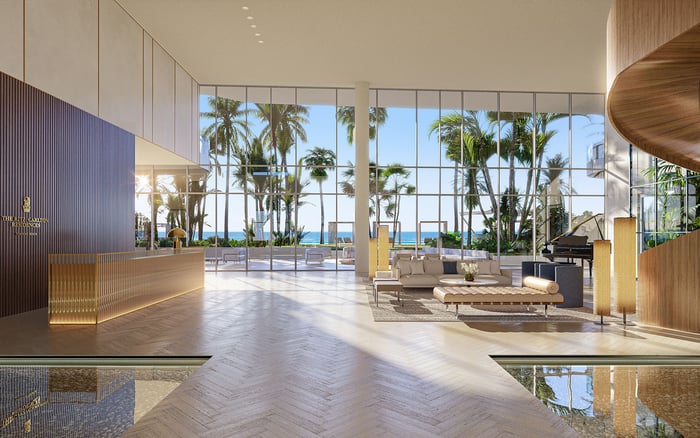
Amenity access at Waldorf Astoria Residences Pompano Beach warrants careful review. Families should seek written clarification about eligibility, guest registration, children, caregivers, tenants, reservations, fees, and the documents governing each space.

For families considering Waldorf Astoria Residences Pompano Beach, the practical issue is not merely which amenities appear in marketing materials. Buyers should determine who may use each space, under what conditions, and according to which written terms.
That review can matter when children use an amenity with a caregiver, relatives visit without the owner, houseguests stay overnight, or a tenant occupies the residence. Rather than assume that ownership extends identical privileges to everyone connected with a household, buyers can request specific answers for each expected user.
Access rules may need to be evaluated venue by venue. Buyers can ask separately about pools, fitness facilities, wellness spaces, resident lounges, dining areas, and other shared spaces identified in the project's current materials and documents.
Useful questions include whether reservations are required, whether a resident must accompany guests, whether age or supervision conditions apply, and whether management may impose capacity controls. Buyers should also ask if fees, cancellation terms, or peak-period restrictions could affect use.
Dining or hospitality-oriented areas should not automatically be treated as equivalent to private residential amenities. The applicable materials should clarify who operates each venue and what access, if any, accompanies residence ownership.
A household can prepare a simple list covering owners, spouses or partners, children, adult children, grandparents, caregivers, domestic staff, overnight guests, short-term visitors, and tenants. For each person, request the applicable definition, credential requirements, registration process, and accompaniment rules.
Families with children can ask about minimum ages, adult supervision, unaccompanied use, and caregiver authorization. Households expecting extended family visits can clarify whether the length of a stay affects registration or access. Owners contemplating a lease can ask whether privileges transfer to a tenant and whether any owner privileges change during the tenancy.
General questions can produce general answers. Scenario-based questions are more useful: Can an adult child arrive before the owner? Can a caregiver accompany a child to the pool? May grandparents use an amenity while the owner is away? Can an overnight guest make a reservation? What access would a tenant receive?
Buyers can also ask how guest registration works, whether identification or credentials are required, how many visitors may accompany a residence, and whether different rules could apply during busy periods. Any response important to the purchase decision should be checked against the applicable written materials.
Local comparisons can help buyers refine their questions. Other Pompano Beach projects include Armani Casa Residences Pompano Beach, The Ritz-Carlton Residences® Pompano Beach, and W Pompano Beach Hotel & Residences.
These links provide project-level navigation, not evidence that the developments share the same rules. Each property's current documents and policies require separate review. A useful comparison focuses on how an operating model fits the household's expected use rather than on the length of an amenity list.
A family planning multigenerational visits may prioritize guest and accompaniment terms. A household with younger children may focus on age and supervision provisions. A buyer considering leasing may give greater weight to tenant eligibility and any effect a tenancy has on owner access.
Buyers can request the current documents addressing amenity access, guest use, rentals, reservations, fees, enforcement, and the process for changing rules. They should identify which entity controls each space and which written materials govern if descriptions or representations differ.
Because the appropriate documents and their legal effect depend on the transaction, material questions should be reviewed with qualified counsel. The goal is to understand the access framework before treating any amenity as part of the household's expected routine.
A disciplined review maps each likely user to each relevant space. It then records any registration, age, supervision, accompaniment, reservation, fee, capacity, or tenancy condition requiring clarification.
This approach does not presume what the rules at Waldorf Astoria Residences Pompano Beach are. It gives families a practical way to ask precise questions and evaluate written answers without relying on assumptions.
Are all amenities automatically available to every owner and guest? That should not be assumed. Buyers should verify eligibility for each space in the applicable written materials.
Which user definitions should a buyer request? Ask how owner, resident, family member, guest, caregiver, domestic staff member, tenant, and authorized user are defined.
Should pool access be reviewed separately? Yes. Ask about guest registration, accompaniment, age or supervision terms, reservations, fees, and capacity controls.
Can children use fitness or wellness spaces? The answer should be confirmed in writing, including any minimum age or adult-supervision requirements.
May relatives use amenities without the owner present? Buyers should ask whether unaccompanied family members qualify for access and whether advance authorization is required.
How should caregiver access be evaluated? Confirm whether a caregiver needs separate registration or credentials and which spaces the caregiver may enter with a child.
Could guest rules differ during busy periods? Ask whether capacity limits, reservation priorities, blackout periods, or other peak-period controls may apply.
Do tenants receive the same access as owners? Do not assume they do. Request the current rental and amenity terms, including any effect a tenancy may have on owner privileges.
Are dining areas necessarily resident-only? Not necessarily. Buyers should verify the operating model and access terms for each dining or hospitality-oriented venue.
What should buyers do when amenity descriptions and written terms appear inconsistent? They should identify the applicable controlling materials and review any material discrepancy with qualified counsel.
If you'd like a private walkthrough and a curated shortlist, connect with MILLION.
If branded residences are on your mind — as a home or as an allocation — we would be glad to share what we are seeing, privately.
Begin a quiet conversation