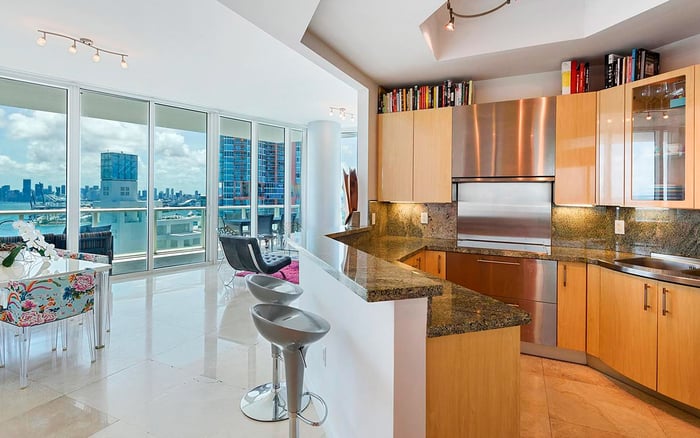
A disciplined framework for assessing seasonal staffing, storm preparation, recurring costs, governance, and the resale story of a Miami luxury residence.

For a seasonal buyer, the quality of a Miami residence is revealed as clearly during an absence as it is upon arrival. Design, privacy, views, and hospitality set the emotional tone, but disciplined staffing and storm lock-up planning determine whether the ownership experience remains composed while the home is unoccupied.
The inquiry should be practical: Who enters the residence? Who authorizes work? How are issues escalated? What documentation reaches the owner? A polished answer is not enough. Buyers should look for a repeatable operating structure that can be understood before closing and monitored afterward.
This is particularly important when comparing distinct settings. A The Residences at 1428 Brickell prospect may approach absence management differently from a buyer considering The Perigon Miami Beach. The right choice depends less on a label than on how closely the building's procedures align with the owner's habits.
Begin with roles, not head count. Ask who receives an owner's departure notice, performs residence checks, coordinates approved vendors, and communicates after an inspection. Clarify whether these responsibilities belong to building staff, an outside residence manager, the owner's household team, or some combination.
Next, examine coverage. Buyers should understand normal availability, after-hours escalation, backup responsibility, and the process followed when a key person is unavailable. Request sample communications or blank forms when offered. The objective is to determine whether the service can be tracked rather than merely promised.
Access control deserves equal scrutiny. Establish how keys, credentials, vendor permissions, and arrival instructions are managed. Ask whether the owner can set limits by person, purpose, and period. For second-home ownership, a concise written authority matrix can reduce ambiguity among the owner, management, household staff, and contractors.
A useful storm lock-up review begins with scope. Ask what the building handles in common areas and what remains the owner's responsibility within the residence. Then identify the trigger for action, the person authorized to act, the deadline for owner instructions, and the procedure if the owner cannot be reached.
The in-residence checklist should reflect the home's actual contents and configuration. Questions may cover terraces, movable objects, doors, windows, utilities, appliances, valuables, vehicles, and any owner-installed systems. Do not assume a general building plan includes every private item.
Communication is integral to preparedness. Request the intended sequence of pre-event notices, confirmation that assigned work was completed, and post-event reporting. Ask what form the record takes and whether photographs, timestamps, work orders, or inspection notes may be available. The goal is not paperwork for its own sake, but a clear chain of responsibility.
Owners comparing a waterfront tower such as Bentley Residences Sunny Isles with a lower-density proposition such as Onda Bay Harbor should apply the same core questions, then adapt them to each residence's access, outdoor areas, storage, and staffing model.
Translate service language into a simple cost map. Identify what is included in regular ownership charges, what is billed upon use, and what requires a separate vendor. Ask how emergency work is approved and whether spending thresholds can be established in advance.
Review recurring and event-driven expenses together. A service may appear modest in isolation yet become material when layered with residence management, housekeeping, vendor supervision, storage, and repeated preparation. Conversely, a higher fixed charge may suit an owner who values centralized coordination. The relevant measure is not the lowest cost, but the clearest relationship among price, responsibility, and use.
Resale begins with the questions a future buyer is likely to ask. Is the residence straightforward to leave, monitor, reopen, and maintain? Are the procedures clear? Can an owner obtain records? Does the service structure feel dependable without becoming unnecessarily complex?
Operational clarity can strengthen the presentation of a carefully maintained home. Keep owner approvals, inspection summaries, invoices, repair records, and relevant correspondence in an orderly archive. These materials should support-not replace-the formal disclosures and professional reviews appropriate to a future transaction.
Consider transferability as well. A highly personalized staffing arrangement may work beautifully for one household while offering little value to the next. A repeatable framework with room for private customization is easier to explain. That distinction matters across Brickell, Miami Beach, and other luxury submarkets, where buyers may compare lifestyle, convenience, and stewardship simultaneously.
For MILLION Buyer's Guides, the most useful lens is disciplined rather than dramatic: evaluate current service, likely absence patterns, financial tolerance, and the future resale conversation as one connected ownership decision.
Create a concise file for every serious candidate. Include staffing roles, access rules, emergency contacts, the storm checklist, owner deadlines, estimated optional expenses, and unresolved questions. Add the relevant governing documents and proposed service agreements for review by qualified advisers.
Then score each property against the same criteria: clarity, responsiveness, documentation, cost visibility, and alignment with the household's travel pattern. This prevents architecture or branding from obscuring operational differences. The best result is not a theoretical promise of effortless ownership. It is confidence that the home can be cared for consistently-and that its stewardship can later be described with precision.
What is the first seasonal staffing question to ask? Ask who is accountable for the residence from departure through return, including backup coverage.
Should buyers request a written storm lock-up checklist? Yes. A written checklist helps define scope, timing, authorization, and confirmation.
What if the building and owner divide responsibilities? Put the division in writing and identify who coordinates any gap between the two.
How should vendor access be evaluated? Review credential controls, approval limits, supervision, entry records, and owner notifications.
Are photographs useful after a residence check? They can provide context when paired with dated notes and a clearly defined inspection scope.
How can an owner prepare for being unreachable? Establish alternate contacts, written authority, spending limits, and escalation instructions in advance.
What costs deserve special attention? Separate included services, recurring private staffing, per-visit charges, and emergency vendor expenses.
How does staffing affect a future sale? Clear procedures and organized maintenance records can make the ownership story easier to explain.
Should every seasonal owner use the same service model? No. The appropriate model depends on travel, privacy preferences, residence complexity, and desired oversight.
Who should review the final operating plan? The buyer should coordinate relevant property, legal, insurance, and management advisers before relying on it.
For a discreet conversation and a curated building-by-building shortlist, connect with MILLION.
If branded residences are on your mind — as a home or as an allocation — we would be glad to share what we are seeing, privately.
Begin a quiet conversation