For principals, founders, and board-level executives, a South Florida residence now has to perform beyond leisure. It must host confidential calls, support polished in-person meetings, and allow arrivals that feel seamless rather than exposed. The most effective evaluation starts with three filters: whether the home contains true boardroom-capable space, whether privacy is defensible across the site and interior plan, and whether guests, staff, and family can move through the property without friction.

A luxury residence intended for remote leadership should be evaluated less like a retreat and more like a headquarters annex. For many buyers, the first mistake is mistaking a beautiful study for a truly functional command space. An executive home office should feel removed from household activity, support long video calls without acoustic compromise, and offer lighting that flatters both the room and the person on screen.
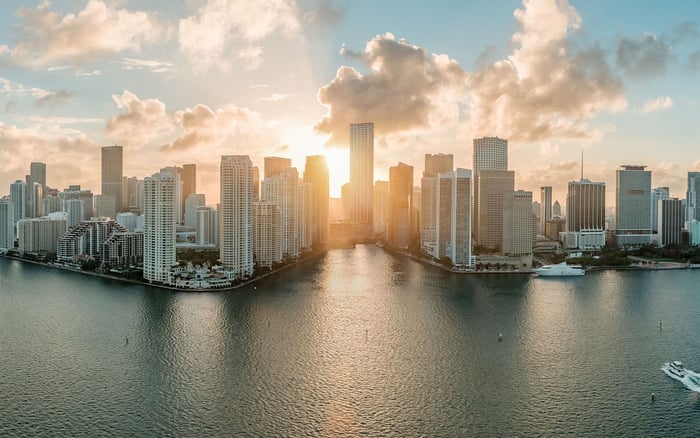
In practice, this means asking whether the office is buffered from kitchens, children’s suites, pool activity, and service corridors. It also means assessing whether the room can accommodate more than a desk: a small conference table, guest seating, concealed storage, integrated screens, and camera-ready sight lines. In projects such as The Residences at 1428 Brickell, buyers are often drawn to the larger question of how a full-service urban residence can support a highly structured workday without sacrificing refinement.
The strongest homes for this use case typically create at least two working zones: a primary office for confidential calls and focused work, plus a secondary salon, library, or den that can absorb overflow meetings. That distinction matters because leadership from home rarely happens in a single room. It unfolds across formal meetings, private debriefs, document review, and brief arrivals by counsel, staff, or investors.
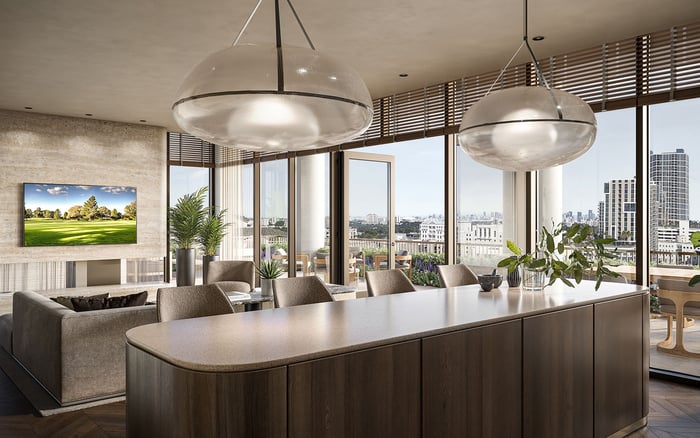
Boardroom space is not defined by square footage alone. It is defined by planning. The room should support acoustics suitable for calls, ergonomic seating for extended sessions, and enough separation from family life to keep confidential conversations contained. Strong natural light is useful, but controllable light is better. Automated shading, layered fixtures, and integrated AV allow a residence to move from daylight calls to evening strategy sessions without improvisation.
Smart-home infrastructure deserves the same scrutiny as millwork or stone. Robust networking, built-in audiovisual systems, automated climate control, and lighting scenes are increasingly part of the executive-use standard in high-end residences. In older homes and resales, buyers should budget for structured wiring, Wi-Fi design, and backup-power integration if those systems are not already in place.
This is where South Florida product types begin to diverge. In Brickell, a residence may offer unmatched proximity to business activity, but the buyer should test whether tower living also provides sufficient acoustic insulation and private receiving space for in-person meetings. In a more residential setting such as Ponce Park Coral Gables, the appeal may lie in a calmer urban rhythm and a stronger sense of separation from the commercial core.
A simple test is helpful: can the office host a four-person working session at 10 a.m., a confidential video conference at 1 p.m., and still feel like part of a residence at 8 p.m.? If the answer is no, the room is an office nook, not a boardroom-capable space.
Privacy should be evaluated at three levels: neighborhood, site, and interior plan. A beautiful room quickly loses value if neighboring upper floors look directly into it, if the driveway exposes guests to the street, or if every visitor must pass through family space to reach the office.
At the neighborhood level, there is an important contrast between dense, highly connected districts and more controlled or secluded enclaves. Brickell delivers immediacy to downtown commerce, but that convenience can come with heavier traffic patterns, more visual exposure, and a livelier public realm. By contrast, settings associated with controlled access, such as Fisher Island, can reduce unplanned traffic and create a more discreet threshold from the outset. A project like The Residences at Six Fisher Island naturally enters the conversation when a buyer prioritizes exclusivity and controlled arrival over urban immediacy.
At the site level, buyers should study sight lines from roads, neighboring lots, upper stories, waterfront approaches, and even service entries. Landscaping helps, but geometry matters just as much. A deep setback, a protected court, or a carefully angled façade can do more for privacy than ornamental planting alone.
Inside the residence, the ideal plan allows a guest to arrive, meet, and leave with minimal exposure to private family zones. That is why a vestibule, gallery, or den adjacent to the office can matter more than one additional decorative room elsewhere.
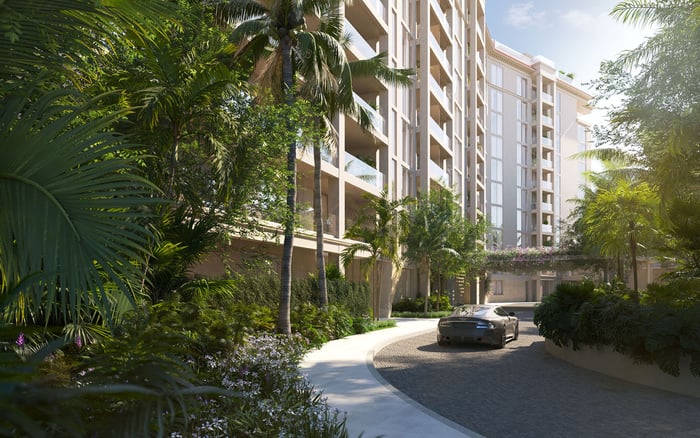
Arrival ease sounds soft, but it is operational. For remote leaders who still host occasional in-person meetings, the quality of arrival sets the tone before any conversation begins. Buyers should look beyond simple distance to an airport. The better question is whether the route from curb to conference feels controlled, gracious, and efficient.
A residence performs well when driveway security is clear, drop-off is intuitive, entry is weather-protected, parking is discreet, and service traffic can be separated from family circulation. In West Palm Beach, this may mean weighing how neighborhood planning and traffic patterns affect client arrivals at different times of day. In a waterfront urban address such as Alba West Palm Beach, the conversation may extend to both business convenience and the choreography of guest access.
For executives who split time among Miami, Palm Beach, and other markets, proximity to airports, marinas, and business districts remains relevant. But ease is about more than geography. It is also about whether the home receives guests with calm precision rather than visible effort.
In Coconut Grove, a project such as Park Grove Coconut Grove suggests a different balance: more residential texture, more greenery, and often a gentler pace of arrival than denser urban districts, while still remaining connected to the city’s business framework.
Technology is the first nonnegotiable. Check broadband availability by address, confirm which providers serve the property, and determine whether there is meaningful redundancy. A residence that looks perfect in photographs but relies on fragile connectivity is not ready for enterprise-style remote leadership.
Second, review local planning, zoning, and design controls before closing, not after. In tightly governed neighborhoods, setbacks, lot planning, walls, gates, landscaping changes, access points, and detached office additions may all be regulated. A buyer may assume that privacy upgrades can be added later, only to discover that approvals will affect cost, timeline, and feasibility.
Third, examine community and HOA rules with unusual care. In some environments, restrictions may affect visitors, deliveries, visible business activity, or the practical use of a residence for repeated professional meetings. Quietly elegant executive use is often possible, but assumptions are expensive.
Finally, benchmark the home against the true local standard. Features such as a dedicated office suite, gated access, dockage, parking configuration, and integrated smart-home systems may be exceptional in one submarket and ordinary in another. Sophisticated buying requires understanding that difference.
The best residences for remote leadership do not merely accommodate work. They preserve authority, calm, and discretion throughout the day. The office must function like a private executive suite. The property must defend privacy from the street, the water, and neighboring vantage points. And arrival must feel polished for guests while remaining nearly invisible to family life.
For South Florida buyers, that often means choosing among distinct lifestyle trade-offs rather than chasing a generic checklist. Brickell offers business adjacency and energy. Coral Gables can offer architectural dignity and stronger residential separation. Fisher Island emphasizes controlled access and privacy. West Palm Beach may appeal to those seeking a different rhythm of arrival and neighborhood character. The right answer depends on how leadership is practiced day to day.
The most valuable question is also the simplest: can this residence support decisions, confidentiality, and hospitality at the highest level without requiring the owner to compensate for the property’s shortcomings? If it can, the home is not just luxurious. It is strategically well chosen.
What makes a home office executive-grade? It should be separated from household activity and designed for acoustics, lighting, ergonomics, and extended video conferencing.
Is a den enough for remote leadership? Usually not. A den may look attractive, but leadership-level use often requires a dedicated office plus secondary meeting space.
Why is broadband due diligence so important? Reliable high-speed service is essential, and buyers should confirm address-specific provider options and redundancy before closing.
What does privacy evaluation include beyond gates? It includes sight lines from roads, neighbors, upper floors, waterfront approaches, and how guests move through the interior plan.
How should buyers think about arrival ease? Focus on security, drop-off clarity, weather-protected entry, discreet parking, and separation of guest and service circulation.
Are urban business districts always best for remote leadership? Not always. They offer connectivity, but may involve trade-offs on traffic, exposure, and overall privacy.
Can zoning affect a future office addition? Yes. Local rules may limit setbacks, walls, access points, detached structures, and other privacy-oriented improvements.
Do HOA rules matter for executive use of a residence? Absolutely. Restrictions can affect visitors, deliveries, and how visibly business-related activity can occur on site.
Should buyers budget for technology upgrades in older homes? Yes. Structured wiring, Wi-Fi design, AV integration, shading controls, and backup power may all need modernization.
What is the clearest sign a residence is well suited to remote leadership? It supports confidential work, polished hosting, and seamless arrivals without disrupting the owner’s private living environment.
If you'd like a private walkthrough and a curated shortlist, connect with MILLION Luxury.
If branded residences are on your mind — as a home or as an allocation — we would be glad to share what we are seeing, privately.
Begin a quiet conversation