A buyer-focused guide to evaluating humidity control in South Florida luxury residences, from oceanfront envelope stress to city-tower ventilation, HVAC sizing, dehumidification, and away-mode performance.
In South Florida, a residence can feel cool during a showing and still be poorly controlled for humidity. For luxury buyers comparing beachfront and city residences, the question is not simply whether the air conditioning is powerful. It is whether the home can keep moisture stable through changing weather, occupancy patterns, ventilation settings, and storm exposure.
The most useful comparison starts with two measurements: indoor relative humidity and dew point. Relative humidity shifts as temperature changes, so it can appear better or worse depending on how aggressively the interior has been cooled. Dew point gives a clearer view of the actual moisture content in the air. Together, they reveal whether a residence is genuinely dry and stable or merely cold in the moment.
In a high-end home, humidity control is not only about comfort. It helps protect wood floors, millwork, closets, art, leather goods, fabrics, and the quiet sense of refinement buyers expect in a South Florida residence.
Beachfront homes face a more demanding moisture environment. Wind-driven rain, salt-laden air, high winds, flooding exposure, and corrosion risks can place added stress on the building envelope. The closer the residence is to open water, the more carefully buyers should study the façade, balcony doors, window walls, exterior sealants, waterproofing history, and visible maintenance culture.
That does not mean every beachfront residence is riskier than every city residence. It means the due diligence must be sharper. Salt exposure can affect metal connectors, fasteners, railings, mechanical equipment, and exterior assemblies. Corrosion may begin as a maintenance issue, but in a luxury context it can become a moisture-control signal, especially around exterior hardware, window perimeters, mechanical rooms, and balcony thresholds.
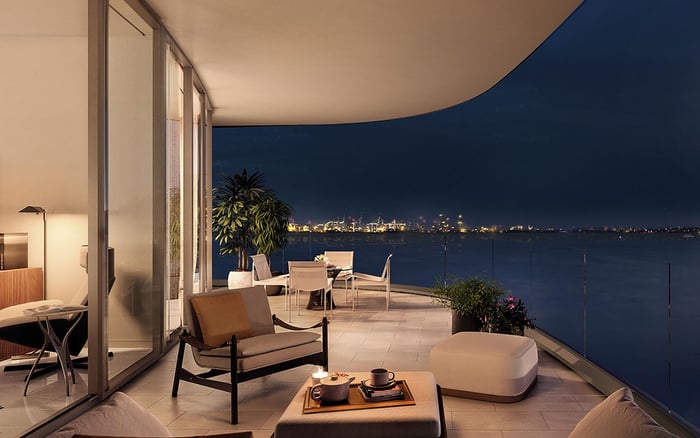
Balconies and terraces deserve particular attention. A beautiful outdoor room can also become a leakage pathway if doors are poorly sealed, misaligned, or exposed to wind-driven rain. Buyers should look beyond glass size and view quality and ask how openings perform over time.
City towers can feel more protected because they sit away from direct surf exposure, but urban luxury buildings still face humidity challenges. Outdoor-air loads, pressurization issues, oversized HVAC systems, and poorly balanced ventilation can all lead to elevated indoor moisture. A high-floor city residence may also experience different wind pressures than a low-rise home, especially around operable doors, terraces, and shared ventilation systems.
In a buyer’s comparison matrix, labels such as Oceanfront, Brickell, Miami Beach, Sunny Isles, Balcony, and Second Home should matter less than measured conditions. A city residence with short-cycling air conditioning may cool quickly but fail to remove enough moisture. A beachfront residence with strong air sealing, controlled ventilation, and dedicated dehumidification may perform beautifully. Geography matters, but execution matters more.
The best city comparison includes mechanical-room condition, thermostat history, supply diffuser staining, window-wall quality, corridor air movement, and the relationship between building ventilation and in-unit controls. Do not assume newer glass, higher floors, or a prestigious address automatically delivers better humidity performance.
A single humidity reading during a showing is not enough. Ask for recent trend logs from thermostats, in-unit sensors, or building automation systems where available. The goal is to see how the residence behaves across days and settings, not merely how it felt after being pre-cooled for a visit.
During inspections, review closets, baseboards, supply diffusers, window perimeters, balcony doors, HVAC closets, and areas behind large furniture. Look for condensation, staining, corrosion, swelling, musty odors, or uneven cooling. Moisture problems depend on available moisture, so the review should include leaks, condensation, water intrusion, and ventilation quality rather than HVAC alone.
Exterior walls should be assessed for water-resistive barriers, flashing, sealants, and drainage. In practical terms, buyers should ask how bulk water is kept out, how incidental water is drained, and how interior air is protected from humid outdoor infiltration. Air leakage in hot-humid climates is not only an energy issue. It can carry moisture into cooled interiors, where condensation and material stress may follow.
Standard air conditioning removes moisture only while it is running. If a system is oversized, it may satisfy the temperature setting quickly and then shut off before removing sufficient latent moisture. The residence feels cool, but humidity remains high. This is one reason a luxury home can have impressive equipment and still feel clammy in closets, bedrooms, or lightly used rooms.
Dedicated or supplemental dehumidification can be important when sensible cooling demand is low but the moisture load remains high. That condition is common in shoulder seasons, rainy periods, shaded exposures, and residences kept at moderate temperatures while owners are away. Buyers should review dehumidifier capacity, drainage, maintenance access, and control settings. A dehumidifier that cannot drain properly or be serviced easily is not a premium solution.
Ventilation should also be deliberate. Bringing in outdoor air without conditioning can raise indoor humidity in a humid climate. Energy recovery ventilation can reduce the penalty by transferring heat and moisture between outgoing and incoming air streams, but the design still needs to be properly balanced and maintained. The most resilient homes coordinate bulk-water management, air sealing, insulation, vapor control, HVAC operation, and controlled ventilation.
Many South Florida luxury residences are not occupied year-round. For seasonal owners, the most important humidity test may occur when no one is home. Away-mode settings should keep the residence dry enough to protect finishes while avoiding unnecessarily aggressive cooling. If cooling, ventilation, or dehumidification is reduced too far, moisture problems can develop quietly in closets, behind furniture, around diffusers, or near exterior openings.
Before closing, ask how the residence performs during extended absence. Review whether the thermostat can maintain humidity targets, whether supplemental dehumidification is integrated, and whether alerts are available when indoor humidity rises above the desired range. A polished residence should be able to care for itself with measured consistency, not only when staff or owners are present.
When comparing beachfront and city residences, create a simple matrix. First, record indoor relative humidity and dew point over time. Second, evaluate envelope exposure: façade orientation, wind direction, balcony or terrace doors, window-wall assemblies, and visible exterior maintenance. Third, inspect mechanical systems: HVAC sizing behavior, runtime, dehumidification, drainage, filter access, and serviceability.
Fourth, review ventilation. Is outside air controlled, conditioned, and balanced, or does it enter unpredictably through leakage and pressure differences? Fifth, examine finish sensitivity. Residences with extensive wood flooring, lacquered millwork, custom closets, art storage, wine displays, and leather furnishings deserve narrower humidity swings. Finally, test the away-mode plan. A second home that only performs when occupied is not fully prepared for South Florida ownership.
The most desirable residences make humidity control feel invisible. Air is cool but not cold, dry but not harsh, and consistent from the entry gallery to the primary closet. For sophisticated buyers, that quiet stability is part of the luxury itself.
What humidity range should I look for in a South Florida residence? Look for stable, moderate readings over time rather than relying on how cool the home feels during a showing.
Why should I compare dew point as well as relative humidity? Relative humidity changes with temperature, while dew point better reflects the actual moisture content of the air.
Are beachfront residences always harder to keep dry? They can face greater envelope stress from wind-driven rain, salt air, flooding exposure, and corrosion risk, so the review should be especially careful.
Can a Brickell tower still have humidity problems? Yes. City towers can have outdoor-air loads, pressurization issues, oversized HVAC, or poorly balanced ventilation.
What should I inspect around balcony doors? Look for condensation, staining, misalignment, damaged seals, corrosion, musty odors, and evidence of water intrusion.
Does stronger air conditioning solve humidity by itself? Not necessarily. Oversized systems may cool quickly but run too briefly to remove enough moisture.
When is dedicated dehumidification useful? It can help when indoor moisture remains high even though the home does not need much cooling.
Why is ventilation part of humidity control? Outdoor air must be controlled and conditioned, because unconditioned intake can raise indoor humidity in a humid climate.
How should seasonal owners evaluate moisture risk? They should test away-mode settings, review sensor logs, and confirm that humidity remains stable during absence.
What is the best way to shortlist comparable options for touring? Start with location fit, delivery status, and daily lifestyle priorities, then compare stacks and elevations to validate views and privacy.
To compare the best-fit options with clarity, connect with MILLION.
If branded residences are on your mind — as a home or as an allocation — we would be glad to share what we are seeing, privately.
Begin a quiet conversation