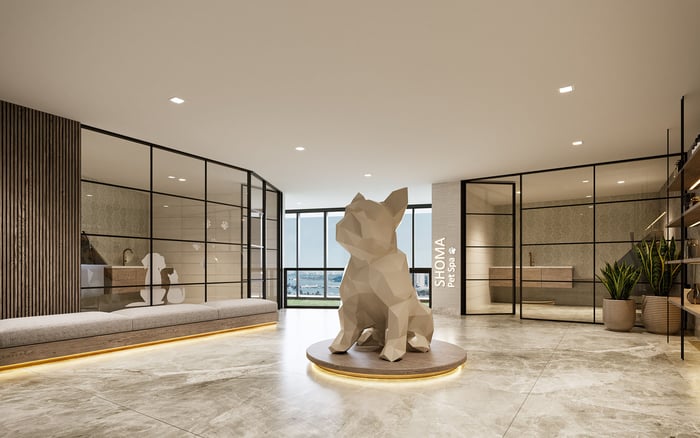
For frequent travelers in South Florida, a refined pet policy is less about whether dogs are permitted and more about whether daily care can function smoothly in the owner’s absence. The most useful comparison points are legal restrictions, assistance-animal exceptions, walker authorization, common-area access, liability requirements, relief-area practicality, and emergency backup planning.

For buyers who travel frequently, a building’s dog policy should be evaluated as an operating system, not as a courtesy note tucked into the house rules. The question is not simply whether a residence allows dogs. The more consequential question is whether your dog can be cared for seamlessly when you are in New York for meetings, in Aspen for the season, or abroad for several weeks.
In South Florida, the first point of comparison is legal hierarchy. Review the condominium or rental policy alongside the relevant municipal animal regulations, because the stricter rule will shape daily life. If a dog has any bite or attack history, that review becomes even more important. Florida requires dogs classified as dangerous to be registered with local animal control, and some municipalities impose additional obligations. In Miami Beach, for example, dangerous-dog registration includes proof of at least $100,000 in liability insurance. A building may also add its own restrictions before approving occupancy.
For a buyer considering a polished coastal address such as 57 Ocean Miami Beach or The Perigon Miami Beach, that means the elegance of the setting should never distract from the practical review: city rule, association rule, and enforcement procedure.
For owners who rely on household staff, concierge coordination, or a trusted outside walker, access control may matter more than the written pet rule itself. A nominally dog-friendly building can still be operationally difficult if management has rigid rules governing unit entry, key release, elevator access, or approved vendors.
The right questions are precise. Can regular dog walkers be pre-authorized? Can management keep standing instructions on file for recurring visits? Must walkers be licensed or insured? Do they need to appear on an approved vendor list? Will staff grant access when the owner is traveling internationally and unreachable for several hours? Can a pet sitter enter independently, or must a resident contact be present?
These details are especially relevant in service-driven towers where staffing is part of the appeal, from St. Regis® Residences Brickell to Una Residences Brickell. Sophisticated buyers should ask management to describe the actual workflow, not the idealized version. A strong answer sounds procedural. A weak one sounds improvised.
Many buyers focus on breed limits or pet counts and overlook the more practical constraint: circulation through the building. If a dog walker cannot move easily from the lobby to the elevator to an outdoor relief area without the owner present, the policy is less workable than it appears.
Ask whether dogs may pass through lobbies, elevators, and shared outdoor spaces with a walker rather than the owner. Clarify whether any time-of-day restrictions apply. Determine whether the route to the nearest outdoor area is direct, shaded, and manageable in the summer heat. If there is a designated pet-relief area on site, ask where it is located and how quickly staff or walkers can reach it from the residence.
This is where neighborhood and site planning begin to matter. In a walkable area such as Coconut Grove, a buyer at Park Grove Coconut Grove may want to understand how readily caregivers can move from the residence to nearby outdoor space. In denser urban settings, that path may depend more heavily on elevator timing, front-desk procedures, and building-specific circulation rules.
Not every animal in a luxury residence is governed in the same way. Assistance animals can fall under a different framework from standard pets, and standard restrictions may not apply in the same way to service animals or emotional support animals. That distinction matters if you expect front-desk staff, valet, or building personnel to interact with the animal during routine care.
The comparison point here is not whether a building is generally pet-friendly. It is whether management understands the distinction between a pet policy and a reasonable-accommodation framework, and whether its documentation procedures are clear. When the disability or disability-related need is not obvious, housing providers may request reliable documentation for an emotional support animal. Buyers should therefore ask how requests are processed, who reviews them, and how approved arrangements are communicated to staff.
In higher-touch buildings, consistency matters. You do not want a properly documented accommodation handled smoothly by management but misunderstood at the desk on a Sunday evening when your walker arrives.
Luxury buyers often assume the association’s insurance architecture covers most operational risk. With dogs, that assumption can be costly. Liability for an incident is often the owner’s responsibility, particularly if the event occurs in a common area or while a walker is handling the dog.
Ask whether the building requires separate pet liability coverage as a condition of approval. Then confirm that your own homeowners or renters policy addresses dog-related incidents involving common areas, staff interactions, or third-party walkers. If your dog falls into any legally sensitive category, verify whether the city or municipality requires additional insurance beyond the building’s own paperwork.
This is one area where a discreet, well-managed residence should still be approached with legal rigor. A refined address does not replace personal risk planning.
For frequent travelers, true pet-friendliness reveals itself during disruption. South Florida’s heat, storms, and hurricane season make backup planning essential. Buyers should ask what happens if a scheduled walker misses a visit, if elevators are limited during a storm protocol, or if building access changes while the owner is out of town.
A well-run building may not advertise this in glossy materials, but management should still be able to explain what is expected of residents with pets during building emergencies. Ask whether there is a written protocol for pet-related evacuation, temporary access restrictions, or caregiver coordination during hurricanes. Also ask whether staff can communicate quickly with your designated local contact if travel delays prevent your return.
At waterfront and coastal properties such as Alba West Palm Beach, storm-readiness questions are part of prudent ownership, not pessimism. The same holds for any Miami Beach or Brickell residence where vertical living depends on access systems functioning without interruption.
Before closing or lease execution, request the complete written pet policy, all related house rules, and any amendments that address access, vendors, enforcement, and common-area use. Important details are often placed outside the headline purchase documents.
Your review checklist should include whether dogs with special legal classifications face extra approval steps, whether walkers can be pre-authorized, whether pet sitters need insurance or vendor approval, whether dogs may move through common areas without the owner present, whether designated relief areas are practical in real time, whether assistance-animal procedures are clearly documented, and whether there is a realistic hurricane backup plan.
For MILLION readers, this is the distinction between a building that merely permits dogs and one that supports a polished, low-friction lifestyle. The most successful purchase decisions come from treating the dog policy as a service protocol with legal consequences, not as a footnote.
Why is a dog policy more important for frequent travelers? Because the real issue is not permission to own a dog, but whether staff, walkers, and sitters can care for the animal smoothly when you are away.
Should I review city rules as well as the building policy? Yes. The stricter rule will govern day-to-day use, and municipal requirements can add registration or insurance obligations.
What if my dog has a bite or attack history? Ask about any dangerous-dog restrictions immediately, since Florida law and some cities impose added registration and insurance requirements.
Can buildings require insurance related to my dog? Yes. Some buildings may require separate liability coverage, and your own policy should also be checked for dog-related incidents.
Why does walker access matter so much? A dog-friendly policy is far less useful if your walker cannot enter the building, access the unit, or move through common areas efficiently.
Should I ask if dog walkers need to be licensed or insured? Absolutely. Some buildings use approved vendor lists or require credentials before staff will grant access.
Are service animals and emotional support animals treated the same as pets? Not always. Assistance animals can fall under a different framework, so management’s accommodation process should be reviewed carefully.
What makes a relief area practical in a high-rise? Speed and ease of access. The route should be manageable for caregivers, especially in summer heat or tight scheduling windows.
How should I compare buildings during hurricane season? Focus on backup care, communication, access continuity, and whether management has a clear pet-related emergency protocol.
What documents should I request before signing? Request the full written pet policy, house rules, and any amendments covering walkers, access, common areas, and enforcement.
If you'd like a private walkthrough and a curated shortlist, connect with MILLION.
If branded residences are on your mind — as a home or as an allocation — we would be glad to share what we are seeing, privately.
Begin a quiet conversation