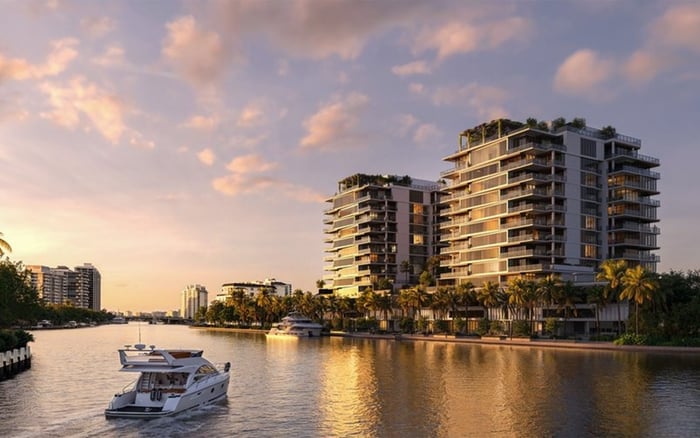
For privacy-minded buyers comparing branded residences in Fort Lauderdale, the central questions concern arrival, circulation, service boundaries, access, and the separation of residential life from shared activity. A disciplined 2026 review should rely on current plans, ownership documents, and verified operating details rather than brand recognition alone.

For Fort Lauderdale buyers in 2026, residential hospitality can be assessed by more than an amenity list. The more revealing questions concern how a property handles arrival, the transition into a private residence, requests for service, and movement through shared spaces.
Privacy in this context is not limited to security. It also involves discretion, intuitive circulation, controlled access, and the ability to use hospitality services without unnecessary exposure to public or shared activity.
A comparison of The Ritz-Carlton Residences® Fort Lauderdale and St. Regis® Residences Bahia Mar Fort Lauderdale should therefore begin with verified plans and operating details. Buyers should examine how each property intends to separate residential routines from other activity and how those arrangements match their priorities.
A recognizable hospitality name may help buyers frame expectations, but it does not answer project-specific questions about access, staffing, circulation, or service delivery. Those elements should be evaluated individually through current documents and direct confirmation.
The practical review begins with daily routines. Buyers can map the expected journey from vehicle to residence, from residence to amenities, and from private areas to any shared spaces. They should also ask how guests, deliveries, staff, and service requests will be managed.
This approach keeps the comparison focused on lived experience. Rather than assuming that two branded residences operate alike, buyers can identify where privacy depends on physical design and where it depends on policies or management.
Privacy is experienced through transitions. A residence may feel exposed if owners must repeatedly cross busy shared zones or rely on routes that do not distinguish residential movement. Thoughtful circulation, by contrast, can make a larger environment feel composed and personal.
Buyers should request clear explanations of entrances, elevators, parking routes, guest access, delivery procedures, and movement to amenities. Any assumptions about dedicated or shared paths should be checked against current project materials.
For broader local comparison, buyers may also review Four Seasons Hotel & Private Residences Fort Lauderdale. The purpose is not to assume equivalence, but to sharpen the questions applied to each Fort Lauderdale property.
A privacy-minded purchaser should examine a residence as an operating system. Start with arrival and ask which routes are residential, which are shared, and how guests, deliveries, staff, vehicles, and service requests are directed. The objective is controlled engagement on the owner’s terms.
Next, study the proposed service model. Buyers should clarify which functions are dedicated to residents, how requests are prioritized, and where service activity may intersect with owner-only or shared spaces.
Access also deserves scrutiny. Buyers should determine how they would move between the residence and the parts of Fort Lauderdale relevant to their routines. Any representations about waterfront, beach, marina, or amenity access should be verified in current plans and governing documents.
Finally, confirm current availability, pricing, timing, residence count, ownership documents, access arrangements, and amenity plans before making a decision. These items should not be inferred from branding or preliminary impressions.
The most suitable residence depends on how an owner expects to use Fort Lauderdale. One buyer may prioritize a quiet arrival and direct movement to a private home, while another may place greater weight on convenient access to services, shared amenities, or the waterfront.
Neither interpretation makes privacy synonymous with withdrawal. In a well-considered residential-hospitality model, service can remain accessible without becoming intrusive, shared spaces can feel intentional, and movement can be managed without feeling restrictive.
The final comparison should therefore be personal and document-based. Buyers can rank their priorities, test each proposed routine against available plans, and seek clarification wherever physical design or operating policy remains uncertain.
What does residential hospitality mean for a private owner? It generally refers to hospitality-informed service within a residential ownership setting, subject to the property’s specific documents and operating model.
Why is privacy more than a security feature? Privacy can also involve circulation, discretion, service delivery, guest management, and control over interactions in shared spaces.
How should buyers compare these two Fort Lauderdale residences? Buyers should compare current plans, access routes, service boundaries, ownership documents, and the fit with their daily routines.
Does a hospitality brand guarantee a particular level of privacy? No. Buyers should verify the physical planning and operating procedures of the individual property.
Why should arrival routes be reviewed? Arrival routes can reveal how residents, guests, staff, deliveries, and vehicles may interact before reaching private areas.
Which circulation details deserve attention? Entrances, elevators, parking access, guest routes, delivery procedures, amenity paths, and shared transition areas all merit review.
How should buyers evaluate service boundaries? They should ask which services are resident-focused, how requests are handled, and where staff or shared activity may enter residential areas.
What should waterfront-oriented buyers confirm? They should verify any claimed access arrangements, routes, restrictions, and operating procedures in current plans and documents.
Which details require confirmation before purchase? Confirm current availability, pricing, timing, residence count, ownership documents, access arrangements, and amenity plans.
What is the best way to make a final choice? Rank privacy priorities, map expected daily movements, compare verified project materials, and resolve unanswered operational questions.
When you're ready to tour or underwrite the options, connect with MILLION.
If branded residences are on your mind — as a home or as an allocation — we would be glad to share what we are seeing, privately.
Begin a quiet conversation