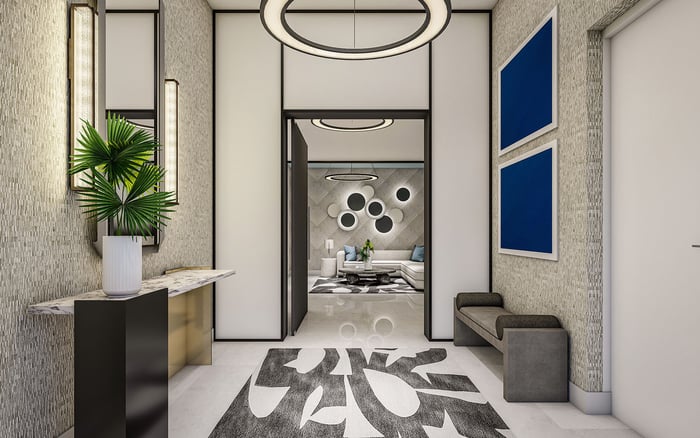
A discreet look at why staff-entry design is not a secondary detail in South Florida luxury residences, but a practical driver of privacy, renovation exposure, daily staffing efficiency, and long-term ownership cost.

In South Florida’s upper tier, the question is rarely whether a residence can accommodate staff. The more revealing question is how gracefully it does so. A staff-ready home is not defined by an extra bedroom, a service kitchen, or a secondary door alone. Its real value lives in circulation, privacy, acoustics, storage, and the choreography of daily life.
For a buyer moving from a large single-family estate into a waterfront condominium, or from a part-time pied-à-terre into a more permanent residence, staff-entry design can reshape the true cost of ownership. A home that appears expansive on a floor plan may become expensive in practice if housekeepers, chefs, drivers, dog walkers, vendors, and deliveries all pass through the same formal threshold used by family and guests.
That friction is not merely aesthetic. It affects payroll efficiency, renovation demands, building fit, and resale confidence. In Brickell, where vertical living often compresses movement into elevator banks and corridors, buyers looking at residences such as 2200 Brickell should ask how everyday service access supports the life they intend to run, not only the view they intend to enjoy.
A poorly considered staff path creates small inefficiencies that repeat daily. Groceries arrive through the wrong door. A private chef crosses formal entertaining space to reach the kitchen. Housekeeping carts compete with guests. Maintenance work becomes visible at precisely the wrong moment. None of these issues may appear in a glossy presentation, yet each can add time, awkwardness, or labor.
The strongest layouts create a secondary rhythm. Service movement should be discreet, but not punitive. Staff should be able to enter, store supplies, access laundry, reach the kitchen, manage refuse, and exit without interrupting family privacy. At the same time, back-of-house areas should not feel like an afterthought. The best luxury homes understand that gracious living depends on dignified work spaces.
This is where real cost becomes nuanced. A residence with weak service circulation may require custom millwork to conceal clutter, additional sound treatment, revised appliance placement, extra storage solutions, or a more complicated staffing schedule. The price paid at closing is only one figure. The price of making the home function properly can be another.
Security systems matter, but privacy begins with plan logic. Who can see into the residence when a service door opens? Does a secondary entry lead into a mudroom, staff vestibule, kitchen zone, or directly into a principal corridor? Can a team member move from the laundry area to the bedroom wing without crossing the living room? Can an overnight staff member come and go without disturbing the household?
In Miami Beach residences, where entertaining, wellness routines, and seasonal occupancy often overlap, the separation between public, private, and service zones becomes especially important. Buyers considering a coastal property such as The Perigon Miami Beach may be drawn first to architecture and setting, yet the daily luxury may be found in whether a dinner party can unfold while service remains nearly invisible.
The same principle applies to families with children, pets, and multi-generational guests. A staff entry is not only for employees. It can also become the practical route for beach gear, flowers, wardrobe deliveries, luggage, catering, art handlers, and wellness practitioners. When designed well, it protects the emotional calm of the home.
In high-rise residences, staff-entry design is inseparable from elevator strategy. A private elevator foyer can be glamorous, but it may not solve service access. Buyers should understand whether the building’s service elevators, loading areas, and internal routes align with the residence’s own back-of-house plan.
This matters in Sunny Isles, where large-format condominiums often function more like sky estates than conventional apartments. A buyer evaluating The Ritz-Carlton Residences® Sunny Isles should look beyond the drama of arrival and ask how a typical week operates. Where do groceries stage? How does housekeeping enter? Can vendors access the home without creating bottlenecks? Is there adequate space near the kitchen or laundry for items that should never migrate into the formal rooms?
When those answers are unclear, owners may compensate with more staff hours, tighter scheduling, or frequent reorganization. In a large residence, the wrong route can make the home feel smaller than its square footage suggests.
Staff circulation is difficult to correct after closing. Moving a door, shifting a kitchen function, adding acoustic separation, or reworking laundry access can be more complicated than changing finishes. Wet walls, structural elements, common-area rules, elevator locations, and mechanical systems all limit what can be adjusted.
That is why new-construction buyers should examine staff-entry logic early, before customization windows close. A beautiful floor plan may still need practical refinement. The goal is not to overbuild back-of-house areas, but to make them proportionate to the owner’s real pattern of living.
In Coconut Grove, where buyers often prize a softer domestic atmosphere and a sense of retreat, projects such as Four Seasons Residences Coconut Grove invite a more residential question: can the home absorb help quietly, or will the household feel constantly in motion? The answer can shape everything from morning routines to weekend hosting.
A staff-ready residence deserves a staff-readiness audit. Start with the arrival sequence. Identify every person who may need access, including housekeepers, chefs, nannies, drivers, trainers, assistants, dog walkers, maintenance vendors, florists, caterers, and art installers. Then trace their path on the plan.
Next, study adjacency. The most useful staff entry usually relates to the kitchen, laundry, service storage, or a flexible staff room. If it opens into a decorative gallery or near principal bedrooms, privacy may be compromised. If it sits too far from the actual work zones, labor becomes less efficient.
Storage deserves particular attention. Luxury residences often understate operational storage because it is less photogenic than a terrace or dressing room. Yet the absence of storage can create visible clutter and recurring deliveries. A staff-ready home needs room for cleaning supplies, linens, luggage, seasonal entertaining pieces, pantry overflow, and pet necessities.
Finally, consider sound. Service doors, laundry rooms, staff baths, and prep areas should not transmit noise into formal living areas or bedroom suites. In a penthouse, where entertaining and privacy carry heightened expectations, acoustic discretion can be as valuable as a panoramic view.
Future buyers may not articulate staff-entry design at first glance, but they feel its absence quickly. A residence that supports household operations calmly tends to show better, host better, and live better. The more expensive the home, the less tolerance there is for operational compromise.
This is particularly true for buyers who maintain multiple residences. They often rely on staff to prepare a home before arrival and restore it after departure. In that context, the service entry becomes part of the owner’s freedom. It allows the residence to be active without feeling occupied, maintained without feeling invaded, and ready without visible effort.
In South Florida, where the best properties must accommodate entertaining, wellness, family, travel, and seasonal shifts, the staff entry is not a side door. It is a financial detail disguised as a design detail.
Why does staff-entry design matter in a luxury residence? It shapes privacy, efficiency, and the daily experience of being served at home. A poor service route can create recurring friction that finishes alone cannot solve.
Is a staff entry only important for full-time staff? No. It also supports deliveries, chefs, trainers, dog walkers, maintenance vendors, caterers, and household managers.
What is the biggest mistake buyers make? They focus on formal arrival and overlook how groceries, laundry, supplies, and vendors move through the residence.
Can staff circulation be fixed after purchase? Sometimes, but it can be costly or limited by structure, mechanical systems, common areas, and building rules.
Should staff entry connect directly to the kitchen? Often yes, although the ideal arrangement depends on the home. The key is proximity to real work zones without compromising privacy.
Does this matter more in condos or single-family homes? It matters in both. In condos, elevator and corridor strategy can make service circulation especially important.
How does staff-entry design affect resale? It can make a residence feel more effortless to operate, which is valuable to buyers who expect discretion and function.
What should buyers ask during a showing? Ask where staff enter, how deliveries arrive, where supplies are stored, and whether service movement crosses formal spaces.
Is a separate staff room enough? Not by itself. Staff readiness depends on circulation, storage, acoustics, access, and the relationship between work areas.
What is the best way to shortlist comparable options for touring? Start with location fit, delivery status, and daily lifestyle priorities, then compare stacks and elevations to validate views and privacy.
When you're ready to tour or underwrite the options, connect with MILLION.
If branded residences are on your mind — as a home or as an allocation — we would be glad to share what we are seeing, privately.
Begin a quiet conversation