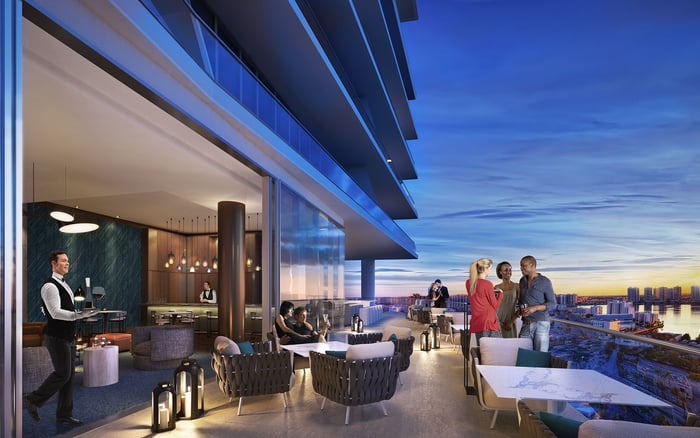
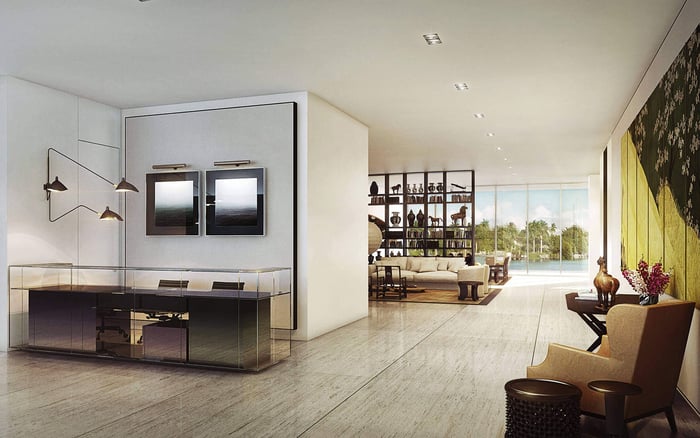
Private elevator access control can transform the economics of a boutique South Florida residence by affecting construction, staffing, reserves, privacy and perceived value.
In South Florida’s boutique luxury market, private elevator access control is often framed in lifestyle terms: a quiet arrival, a direct-entry foyer, a sense of separation from the shared corridor. Its real significance, however, is financial as much as experiential. The choice to make elevators private, semi-private or tightly controlled can shape a building’s structure, mechanical planning, staffing model, association budget and long-term reserve obligations.
For a buyer, the question is not whether a private elevator feels luxurious. It does. The sharper question is how much of the purchase price, monthly carrying cost and future maintenance exposure is tied to that privacy. In a boutique residence, where a small ownership group shares major fixed costs, the answer can be meaningful.
A large condominium tower can spread elevator systems, lobby staffing and maintenance contracts across many residences. A boutique building cannot. With fewer homes, every additional shaft, access-control layer and service protocol becomes more visible in the per-residence economics.
That is why private elevator access control carries different weight in Surfside, Miami Beach, Brickell or Sunny Isles Beach than it might in a high-density rental tower. On prized coastal and near-coastal sites, the developer is often balancing land efficiency against the promise of privacy. A direct-entry elevator can reduce conventional corridor space, but it may also require more careful core planning, more sophisticated controls and a more expensive operational program.
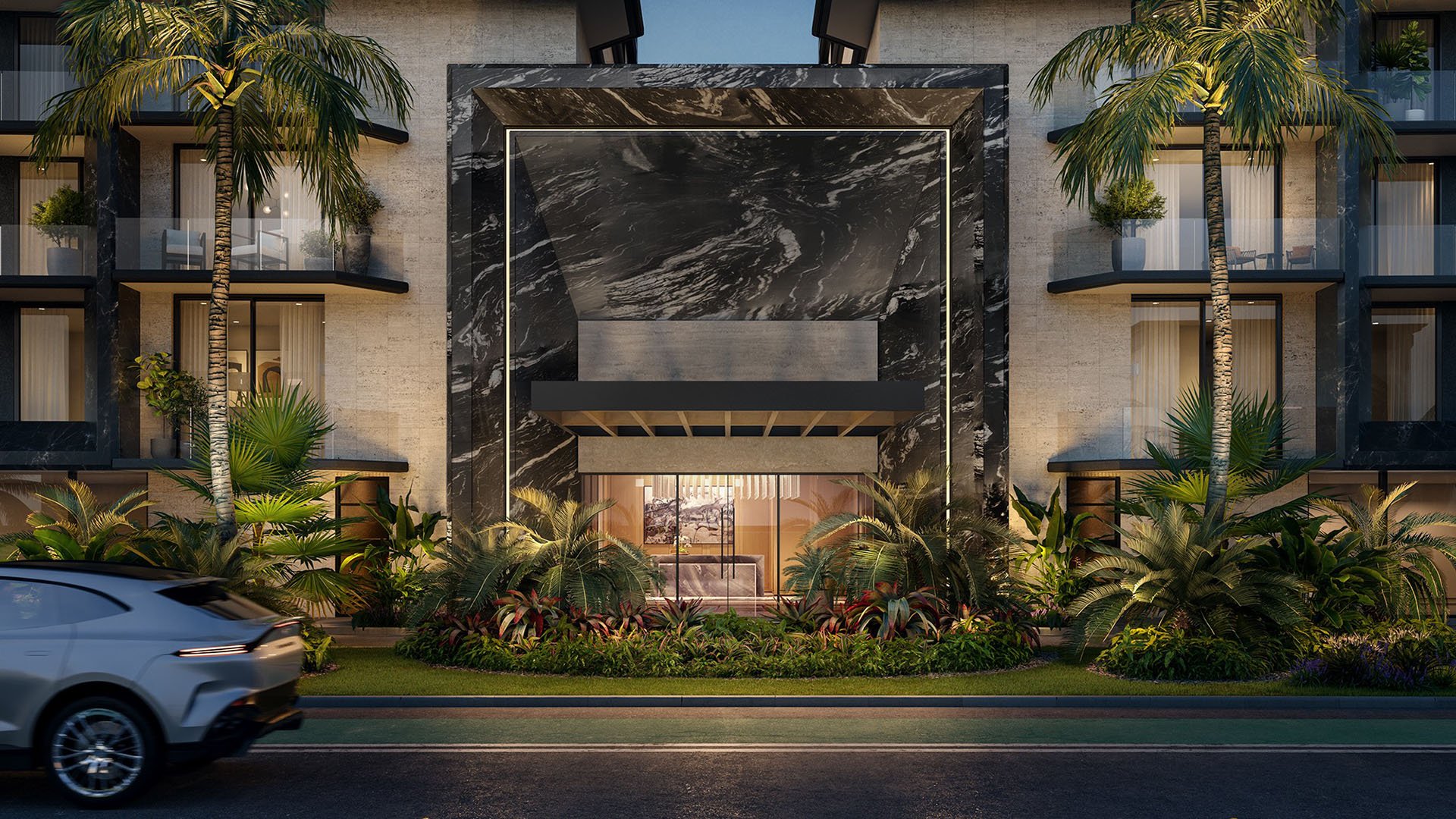
In projects such as The Delmore Surfside, the buyer expectation extends beyond square footage. It is a controlled sequence of arrival, from valet or garage to elevator to private threshold. That sequence becomes part of the residence’s value proposition, and it is also embedded in the building’s permanent cost base.
Private elevator access control changes Pricing & Trends because it supports a different emotional and financial narrative. The buyer is not only purchasing a plan with bedrooms, terraces and views. The buyer is purchasing discretion. The ability to arrive without passing other residents, guests or service traffic can be especially compelling for public figures, family offices, seasonal owners and international buyers who prioritize privacy.
This is one reason luxury developments in Miami Beach and nearby coastal markets often treat private or controlled elevator arrival as part of the architectural identity. At 57 Ocean Miami Beach, the broader appeal of oceanfront living is heightened by the expectation that a residence should feel composed, quiet and personal from the moment one enters the building.
The pricing effect is rarely isolated as a single line item. Instead, it appears within the total value stack: larger residences, fewer neighbors, stronger staffing, more controlled circulation and a deeper sense of exclusivity. A buyer comparing two similarly sized residences should therefore look beyond finishes. The path from street to front door may explain a meaningful part of the difference in price.
The hardware is only the beginning. A private elevator system may involve card readers, destination dispatch programming, key fobs, biometric or mobile credentials, camera integration, fire and life-safety coordination, backup procedures and staff training. Each element can carry installation, monitoring, repair and replacement costs.
In a boutique condominium, those costs often flow into association dues. Service contracts, periodic inspections, software updates and emergency response planning must be funded year after year. If the system is highly customized, replacement parts and specialized vendors may become increasingly important over time.
There is also a staffing dimension. Controlled access works best when the building’s front desk, valet, security and management teams understand how residents, guests, domestic staff, deliveries and contractors move through the property. A beautifully private elevator can become frustrating if visitor clearance is poorly managed or if service access conflicts with resident arrival.
For buyers, the elevator conversation should include the operating budget. Ask how access credentials are issued, how guests are handled, how deliveries reach residences, how service elevators are separated and how the association plans for future upgrades.
Controlled elevator access can strengthen a building’s privacy and security profile. It can limit casual movement through residential floors and reduce the number of people who can reach a private foyer. For owners who travel frequently or keep a residence as a second home, that added control can be an important comfort.
At the same time, privacy systems must be coordinated with emergency access, fire service mode, evacuation procedures and building management protocols. A system that feels exclusive in daily life must remain practical under stress. The most sophisticated buildings make this invisible, giving residents a seamless experience while keeping life-safety systems clear and compliant.
The insurance impact is more nuanced. Controlled access may support a stronger risk-management posture, but complex systems can also create maintenance and liability questions if they are not properly operated. The premium buyer should view elevator access control as part of a broader governance issue, not merely a sales amenity.
In dense urban locations such as Brickell, private elevator access control can help soften the intensity of vertical living. A tower residence may sit within a highly active district, yet the owner’s arrival can feel calm and curated. This is part of the appeal of high-design projects such as St. Regis® Residences Brickell, where service, privacy and arrival experience are central to the luxury proposition.
In Sunny Isles Beach, the same concept operates differently. Oceanfront and near-oceanfront residences often use elevator privacy to reinforce the feeling of an estate in the sky. At Bentley Residences Sunny Isles, the expectation of a controlled, highly personalized arrival aligns with the market’s preference for large-scale residences, views and a strong sense of individual ownership.
The design trade-off is that private access can consume valuable planning flexibility. Elevator cores, foyers and vertical systems must be resolved early. Developers may accept fewer residences or less repetitive floor plates because the resulting homes can command a stronger identity and potentially higher per-unit value.
A private elevator should be evaluated with the same seriousness as the view, floor plan and building financials. Buyers should review the condominium documents, operating budget, reserve planning and maintenance assumptions related to elevator systems. In a boutique building, even modest recurring costs can become material when shared by a small number of owners.
It is also important to understand whether the elevator opens directly into the residence, into a private foyer, or into a semi-private vestibule. Those distinctions affect privacy, security and, at times, the practical use of the home. A direct-entry system may feel more exclusive, but it requires careful guest and service protocols.
Finally, buyers should consider future obsolescence. Access-control technology evolves quickly. A building that feels advanced at delivery will eventually need updates. The best residences plan for that reality through sensible reserves, adaptable systems and management discipline.
Private elevator access control can justify a premium when it is integrated into the entire residential experience. It can make a boutique South Florida building feel more discreet, more secure and more personal. It also changes the cost structure in ways buyers should not overlook.
The true value lies in balance. A well-designed system protects privacy without creating operational friction. A well-managed association funds maintenance without surprise. A well-conceived boutique building turns vertical circulation into part of the architecture of ownership.
Does private elevator access always increase the cost of a residence? It often contributes to higher development and operating costs, especially in boutique buildings where fewer owners share fixed expenses.
Is a direct-entry elevator the same as a private elevator? Not always. A direct-entry elevator may open into a residence or private foyer, while access controls determine who can reach that stop.
Why does this matter more in boutique buildings? Boutique buildings have fewer residences, so elevator maintenance, inspections, staffing and future upgrades are spread across a smaller owner group.
Can private elevator access improve resale value? It can support a stronger resale narrative when buyers in that submarket value privacy, security and a more exclusive arrival sequence.
What should buyers ask before purchasing? Buyers should ask how the system is maintained, how guests are cleared, how service access works and how reserves account for future upgrades.
Does controlled access replace building security staff? No. It is most effective when paired with trained staff, clear procedures and coordinated building management.
Can private elevators create inconvenience? They can if guest access, deliveries or service traffic are poorly planned. Good protocols are as important as the technology itself.
Are private elevators common in South Florida luxury condos? They are a familiar feature in the upper tier of South Florida’s boutique and ultra-luxury condominium market.
Should investors value elevator privacy differently than end users? Yes. End users may prize daily discretion, while investors should focus on dues, reserves and long-term marketability.
What is the simplest way to judge the real cost? Compare the purchase premium, monthly dues, reserve planning and operational quality against the privacy benefit you will actually use.
For a confidential assessment and a building-by-building shortlist, connect with MILLION.
If branded residences are on your mind — as a home or as an allocation — we would be glad to share what we are seeing, privately.
Begin a quiet conversation