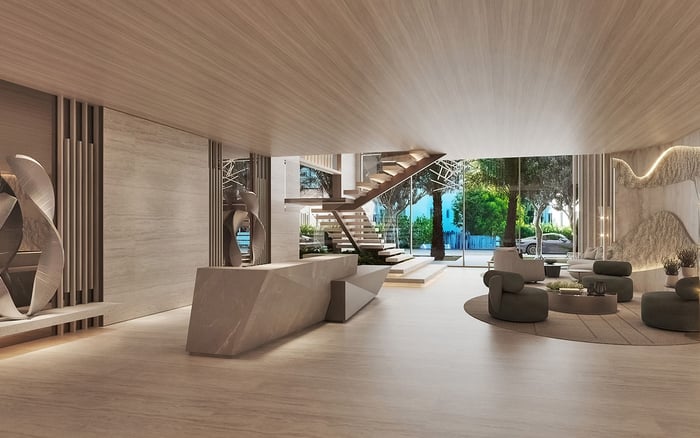
A discreet framework for family offices assessing touchless entry in South Florida residences, with emphasis on privacy, governance, service coordination, and long-term asset stewardship.

For family offices evaluating South Florida residences, touchless entry should not be treated as a decorative convenience. It belongs in the same conversation as estate security, household staffing, insurance posture, privacy expectations, and long-term asset governance. The strongest systems are nearly invisible to the resident, yet exacting in how they authenticate, record, restrict, and revoke access.
In ultra-premium homes and condominiums, the front door is no longer a single threshold. It may include the street gate, motor court, private elevator, garage, lobby, amenity level, service corridor, package room, guest suite, and residence entry. A family office should evaluate the full access journey, not merely the device placed beside a door.
The question is not whether a residence feels technologically advanced. The more important question is whether the access environment supports discretion, continuity, and control across principals, children, guests, household employees, estate managers, visiting advisors, vendors, and emergency personnel.
Before comparing systems, family offices should define how the home will actually be used. A primary residence has different needs from a seasonal home. A pied-à-terre used by multiple generations has different risks from a single-principal retreat. A residence with full-time household staff requires more granular permissions than one managed remotely.
Start with a written access map. Who enters the property, through which path, at what times, and under whose authority? Which users require recurring access, and which require one-time approval? Which areas must remain restricted even when a guest is welcomed elsewhere? This exercise often reveals that the family needs policy clarity before it needs new hardware.
For South Florida portfolios that span Brickell, Miami Beach, Sunny Isles, Fisher Island, Palm Beach, and private enclaves beyond them, consistency matters. A principal should not need a different access ritual at every residence. Yet consistency should not mean identical technology everywhere. It should mean a common governance standard adapted to each property.
In the high-end residential context, convenience is not enough. Touchless entry should enhance privacy rather than create a new trail of exposure. Family offices should ask how credentials are issued, where access logs are stored, who can review them, how long records are retained, and what happens when a phone is lost, a staff member departs, or a vendor relationship ends.
Biometric, mobile, facial, fob-based, keypad, license-plate, and concierge-mediated access each carry different privacy implications. The family office does not need to become the technology vendor, but it should understand the practical tradeoffs. A system that feels seamless on move-in day may become problematic if permissions are difficult to audit or if too many third parties can administer credentials.
Privacy also includes social privacy. The best entry experiences do not announce wealth, disrupt arrival, or create awkward interactions for invited guests. A quiet arrival from garage to private elevator may be preferable to a dramatic technology moment in a public lobby. In this category, restraint is usually more luxurious than spectacle.
Touchless entry is only as strong as the people and procedures surrounding it. Family offices should review the roles of building staff, private security, household managers, estate caretakers, valet teams, and concierge personnel. If a system depends on people making judgment calls, those judgments must be trained, documented, and periodically reviewed.
Consider the difference between access and welcome. The family may want a close relative to arrive without friction, while a service technician should be admitted only within a defined time window and only to approved areas. A children’s tutor, yacht crew member, art handler, private chef, driver, wellness practitioner, or visiting consultant may each require a different access pathway.
The most elegant residences make these distinctions feel effortless. Behind that ease should be a disciplined matrix of permissions, escalation procedures, and emergency overrides. If the family office cannot quickly answer who currently has access, the system is not sufficiently governed.
When evaluating a residence, the family office should look beyond brochure language. Ask whether the access system supports role-based permissions, temporary credentials, remote revocation, dual approval for sensitive areas, visitor pre-clearance, and activity review. Ask how the system functions during power interruptions, network disruptions, device failures, staffing changes, and ownership transfers.
The ownership-transfer question is especially important. A residence can appear beautifully modern while still carrying legacy permissions, unmanaged codes, or unclear administrative rights. A family office should verify that all prior access credentials can be fully removed and that the new owner receives clean administrative control at closing or turnover.
For new-construction residences, the inquiry should begin early. The family office may have an opportunity to coordinate entry preferences with architects, designers, security consultants, and property management before finishes are finalized. Retrofitting later can be expensive, visually intrusive, or operationally disruptive.
Luxury households often focus on the principal’s arrival sequence while underestimating service access. Yet many vulnerabilities and frustrations occur through the least glamorous thresholds: loading areas, staff doors, garages, package zones, storage rooms, back-of-house elevators, and mechanical rooms.
A family office should ensure service access is specific, limited, and revocable. Vendors should not receive broad credentials when narrow permission would suffice. Delivery access should not become household access. Staff access should reflect responsibilities, schedules, and seniority. A departing employee’s access should be removed immediately and documented.
This is not about creating a fortress-like atmosphere. It is about preserving calm. A well-managed service layer allows the home to operate with grace while reducing unnecessary exposure. The residents should experience hospitality; the family office should see control.
Touchless entry should be compatible with the family’s broader residential infrastructure. That may include alarm systems, elevator controls, garage access, guest management, cameras, intercoms, lighting scenes, package handling, household staffing platforms, and estate reporting. The goal is interoperability without over-centralization.
Too much fragmentation creates operational drag. Too much consolidation can create single-point vulnerability. The better approach is a curated ecosystem with clear administrative ownership, written procedures, and periodic review. Family offices should know who controls each layer, who can change settings, and who receives alerts.
For multi-residence families, the family office may establish a baseline access standard: minimum credential controls, revocation procedures, administrative hierarchy, guest protocols, staff onboarding, vendor access rules, and annual audits. Each residence can then be tailored to its architecture, association rules, staffing model, and family usage pattern.
In luxury real estate, entry technology must respect architecture. A poorly placed reader, visible wiring, excessive signage, or clumsy door hardware can undermine an otherwise refined arrival. Family offices should involve design professionals early so that security components are integrated rather than appended.
The tactile experience still matters. Touchless does not mean soulless. The best arrival sequences feel natural: the gate opens without drama, the elevator recognizes authorization, the residence door responds predictably, and the lighting quietly supports entry. If the resident has to think about the system, the design has not fully succeeded.
This is where family offices should balance resilience and beauty. Redundant access options are essential, but they should not clutter the visual field. Emergency functionality should exist, yet remain discreet. Technology should serve the residence, not become its personality.
The strongest evaluation framework has five priorities. First, discretion: the system should protect privacy and avoid unnecessary display. Second, governance: permissions should be clear, auditable, and easy to revoke. Third, resilience: access should remain workable under imperfect conditions. Fourth, integration: the entry experience should align with household operations. Fifth, aesthetics: the system should feel native to the architecture.
Price alone is a poor measure. A more expensive system is not automatically better for the family’s use case. The right solution is the one that fits the property, the people, the operating model, and the family’s tolerance for complexity.
For family offices, the ultimate test is simple: can the residence welcome the right people at the right time, while keeping everyone else out, without making the family think about the machinery behind it? If the answer is yes, touchless entry has moved beyond convenience into the realm of genuine private-client infrastructure.
Should touchless entry be evaluated before or after selecting a residence? It should be considered during due diligence, especially if the family expects private elevators, staff access, or multiple guest profiles.
Is biometric access always the most secure option? Not necessarily. The right choice depends on privacy preferences, administrative controls, backup procedures, and the family’s comfort with biometric data.
What is the most overlooked part of touchless entry? Service access is often overlooked. Vendor, delivery, staff, and back-of-house routes deserve the same rigor as the principal arrival sequence.
How should a family office handle departing staff? Access should be revoked immediately, documented, and reviewed across every residence, garage, elevator, and service area where credentials may exist.
Do condominiums require a different approach than single-family homes? Yes. Condominiums often involve building management, shared areas, elevators, and association protocols, while single-family homes may allow more direct control.
Should guest access be permanent or temporary? Temporary access is usually preferable. It allows the family office to welcome guests without leaving credentials active longer than necessary.
What should be confirmed at closing or turnover? The family office should confirm clean administrative control, removal of prior credentials, backup access procedures, and a current permissions register.
Can touchless entry coexist with traditional keys? Yes, but physical keys should be tightly tracked. Redundancy is useful only when it is governed with the same discipline as digital access.
How often should permissions be reviewed? A periodic review is prudent, especially after staffing changes, vendor changes, seasonal occupancy shifts, or major family travel periods.
What is the best measure of a successful system? The best system feels effortless to residents, precise for authorized users, and transparent to the family office responsible for oversight.
To compare the best-fit options with clarity, connect with MILLION.
If branded residences are on your mind — as a home or as an allocation — we would be glad to share what we are seeing, privately.
Begin a quiet conversation