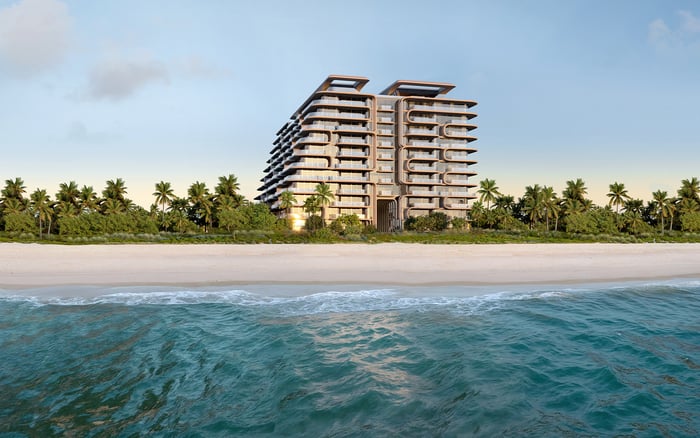
Oceanfront ownership at Arte and Eighty Seven Park should not be confused with included dockage. Buyers need separate legal review of any marina arrangement, a vessel-specific route analysis, and an on-water test before treating a slip as part of the acquisition.

For a yacht owner, an oceanfront address can invite an intuitive but incorrect assumption: water views imply direct boating access. At Arte Surfside and Eighty Seven Park Surfside, buyers should evaluate the residence and the dockage proposition as distinct assets unless binding documents establish otherwise.
Arte is a 16-residence oceanfront condominium at 8955 Collins Avenue in Surfside, designed by Antonio Citterio and Patricia Viel with Kobi Karp Architecture. The property emphasizes residences, beach access, and residential amenities, but does not identify an on-site marina, deeded slips, or bundled yacht-club rights. Eighty Seven Park is an oceanfront condominium at 8701 Collins Avenue, on the northern edge of Miami Beach immediately south of Surfside. It likewise does not identify an on-site marina or boat slips as condominium amenities.
That distinction is central to disciplined due diligence. Oceanfront living offers immediate proximity to the beach, but does not by itself establish a legal right to keep a vessel nearby. Any representation involving a slip, marina access, club privilege, or off-site dockage should be verified independently of the condominium purchase.
A water view is not evidence of a transferable right to keep a vessel nearby.
The first question is not where the slip is located, but what legal interest is being offered. A deeded interest, lease, license, club membership, or informal access arrangement may carry materially different rights and limitations. Buyers should not use these terms interchangeably or describe an arrangement as transferable, guaranteed, or attached to a residence without the controlling instrument.
Request the recorded condominium declaration and amendments, title materials, the seller’s contract or marina agreement, and relevant disclosures. The review should identify the named holder, the precise slip or access privilege, its duration, transfer conditions, approval requirements, recurring costs, termination rights, and any vessel limitations stated in the documents. If the seller says the right follows the residence, the title and governing instruments should clearly support that claim.
The same discipline applies to nearby alternatives. A residence at Rivage Bal Harbour or Onda Bay Harbor may belong in a broader geographic comparison, but no project’s waterfront setting should substitute for document review. Legal counsel and title professionals should reconcile the marketing description with the enforceable right before the buyer assigns value to dockage.
If dockage is separate, the purchase analysis should be separate as well. A buyer can value a residence based on its architecture, privacy, outlook, services, and beach access, then evaluate a proposed slip according to its own legal status and navigational utility. This prevents a loosely described boating benefit from inflating the condominium’s perceived value.
A practical boat-slip review should answer several questions. Can the interest be assigned with a sale, or does a new owner require approval? Is it limited to a particular vessel size or named user? Can the arrangement be revoked or terminated? Do the documents identify operating costs or restrictions? These are diligence questions, not assumptions about either building.
The buyer’s-guide principle is simple: pay for a documented right, not proximity or implication. If the paperwork does not establish transferability, the buyer should underwrite the residence as though the claimed dockage were unavailable until the issue is resolved.
For boats kept around Bal Harbour, Haulover, and nearby bay-side neighborhoods, Bakers Haulover Inlet is the principal nearby connection between northern Biscayne Bay and the Atlantic. The inlet lies north of both condominium properties. Its fixed bridge provides approximately 32 feet of vertical clearance and approximately 125 feet of horizontal clearance.
Vertical clearance must be measured against the vessel’s loaded air draft to its highest fixed point. That calculation includes masts, radar arrays, antennas, arches, and other equipment above the waterline. A vessel exceeding approximately 30 to 32 feet cannot rely on the Haulover route unless the relevant equipment can be lowered enough to pass with an appropriate safety margin.
The stated bridge number is not a promise of clearance under every condition. Buyers should confirm the vertical datum, commonly mean high water, and account for tide, loading, and the vessel’s current configuration. Horizontal clearance also matters for beam, handling, sea state, and the captain’s comfort, even when the opening appears adequate.
The Haulover bridge is only one part of the analysis. Before acquiring separate dockage, map the complete route from the proposed slip to open water and identify every fixed and movable bridge. Some Miami-area bascule bridges have materially lower closed clearances, including approximately 19 to 21 feet at the 79th Street Bridge and 14 to 16 feet at the Shepard Broad Causeway.
A claim of “no fixed bridges” does not mean unrestricted passage. Drawbridges can introduce closed-clearance constraints, opening schedules, operating rules, and delays. Florida Intracoastal Waterway fixed bridges generally provide about 65 feet above mean high water, but lower-clearance exceptions exist, including the Julia Tuttle Causeway. A route that appears viable at a regional level may fail at a single crossing.
Review current nautical charts, bridge details, and the proposed vessel’s specifications together. Then make a physical run with a knowledgeable local captain before closing on the dockage. The test should follow the intended route under realistic tide, traffic, and operating conditions. Guide figures are useful planning references, but they do not replace verification of the specific bridge and conditions encountered.
The strongest acquisition file aligns three elements: a documented right to use the slip, a documented ability to transfer that right, and a tested route suited to the buyer’s vessel. If any element remains uncertain, the boating proposition should remain separate from the residence’s value and the closing decision.
For Arte and Eighty Seven Park, the luxury case rests first on oceanfront residential qualities, not presumed dockage. Buyers seeking both beach living and yacht access can still create a coherent ownership plan, but doing so requires parallel legal, title, marina, and navigational diligence. Precision at this stage protects both enjoyment and resale clarity.
For discreet guidance on South Florida oceanfront and boating-oriented residences, connect with MILLION.
If branded residences are on your mind — as a home or as an allocation — we would be glad to share what we are seeing, privately.
Begin a quiet conversationArte’s public materials do not identify an on-site marina, deeded slips, or bundled yacht-club rights. Any seller claim involving dockage should be verified separately.
Its public project materials do not identify an on-site marina or boat slips as condominium amenities. Buyers should not infer dockage from the oceanfront location.
Transferability depends on the controlling deed, lease, license, membership, or marina agreement. Buyers should require documents that establish the seller’s right and the applicable transfer conditions.
Review title materials, condominium governing documents, the seller’s marina agreement or contract, amendments, and relevant disclosures with qualified legal and title advisers.
The fixed bridge at Bakers Haulover Inlet provides approximately 32 feet of vertical clearance. Actual usable clearance depends on datum, tide, loading, and vessel configuration.
Published descriptions place the bridge’s horizontal clearance at approximately 125 feet. Vessel beam, handling conditions, and an appropriate safety margin still matter.
Measure the loaded vessel to its highest fixed point, including masts, radar arrays, antennas, and arches. Confirm whether any relevant equipment can be safely lowered.
No. Drawbridges can still create closed-clearance limits, opening schedules, operating restrictions, and delays.
A route can be constrained by a single fixed or movable bridge between the slip and open water. Every crossing should be checked against the vessel’s specifications.
Yes. Compare current nautical charts with bridge data, then run the intended route with a knowledgeable local captain before acquiring the dockage.