A buyer-focused guide to evaluating acoustic privacy in Hallandale Beach residences, with practical checks for elevator circulation, mechanical equipment, amenity decks, terraces, and traffic exposure.

In a high-value Hallandale Beach residence, privacy deserves the same attention as the view, the arrival sequence, and the proportions of the primary suite. Evaluate acoustic comfort against how the home will actually be used: early nights, uninterrupted work, visiting family, or long afternoons on a terrace.
The essential distinction is between a feature and a demonstrated result. A private elevator foyer describes an arrival arrangement. A flooring requirement sets an obligation. Neither establishes what a buyer will hear from a bedroom during normal building operations.
Begin with a room-by-room brief. Identify where quiet matters most, then ask what sits beside, above, below, and outside those spaces. Treat elevators, mechanical rooms, amenity decks, and traffic corridors as points to investigate, not presumed defects.
The advertised features of 2600 E Hallandale Beach Boulevard, Unit T3201, include a private elevator entry and foyer, along with split bedrooms and bathrooms. At 1830 S Ocean Drive, Apartment 1705, advertised features include secure elevator access and card entry. These are distinct access arrangements; neither is an acoustic specification.
During an authorized visit, ask for normal elevator trips while someone listens from the foyer, living room, and primary bedroom. Listen separately for arrivals, door operation, conversation, and any perceptible vibration. Record where each event is noticeable rather than labeling the entire residence quiet or noisy.
Service circulation deserves a separate review. At The Hemispheres, contractors and subcontractors must use service elevators rather than resident elevators. Service vehicles are prohibited on the entrance ramp, as is contractor entry at lobby level.
Those rules identify routes to investigate; they do not establish disturbance. Ask management to explain delivery, renovation, and moving access, then compare those routes with the residence under consideration. Review the floors above and below as well as the immediate corridor.
Request plans identifying mechanical rooms and equipment near the residence. Ask management which installations serve the building, when they normally operate, and whether an authorized observation can coincide with those conditions. Do not infer equipment locations from a floor plan showing only saleable rooms.
Inside the home, spend time in bedrooms and workspaces without conversation or background music. Note any persistent hum, intermittent sound, or vibration, along with the operating conditions at that moment. If something warrants investigation, ask a qualified acoustical professional to define the appropriate measurements and assessment criteria.
In Hallandale Beach, emergency-generator noise exceeding 85 dBA at the property line or boundary nearest the equipment is defined as excessive, day or night. That threshold is not an acceptable residential interior sound level or a bedroom comfort target.
Ask about scheduled generator testing and arrange any observation through management. A boundary threshold should never substitute for an assessment inside the residence.
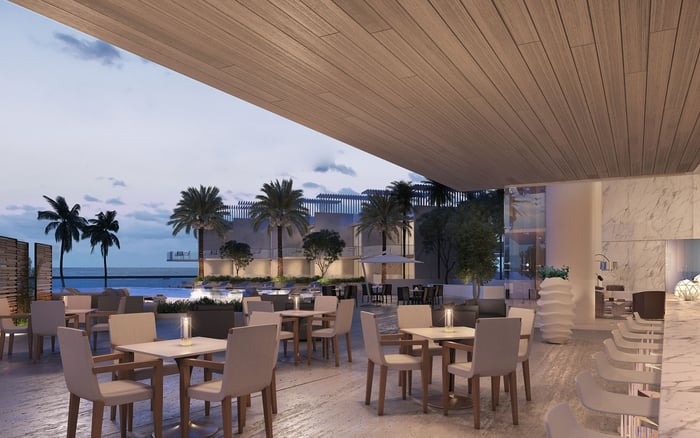
Assess amenities as places with schedules and circulation patterns, not merely as attractive images. Advertised amenities at The Beach Club include five heated infinity-edge pools with expansive sundecks. Unit T3201 at 2600 E Hallandale Beach Boulevard is advertised with access to a rooftop pool deck, an Intracoastal pool, a fitness center, beachfront clubhouse access, and valet services.
These features warrant questions about adjacency and use, not assumptions about noise. Request current amenity hours, event policies, furniture-handling procedures, and access arrangements. Where permission allows, observe the residence while relevant amenities are in ordinary use, then return during a contrasting period.
Mixed-use planning adds another layer. Advertised features at Oasis Hallandale include keyed-access elevator banks, second-level office space, and first-level dining venues. Ask how residential circulation relates to those uses without assuming that keyed access creates acoustic separation.
As of July 8, 2026, Shell Bay by Auberge Hallandale was described as a 20-story project under construction with 108 private residences and a 60-room Auberge resort hotel. Buyers should confirm current plans and review residential and hotel operations separately.
A terrace deserves its own assessment, not an extension of the living-room verdict. 2000 Ocean Hallandale Beach is advertised with both an oceanfront terrace and a garden terrace for its condominiums. That dual orientation makes separate observations particularly useful; it does not establish that either side is quieter.
At each outdoor space, note the time, visible activity, and identifiable sounds. Repeat the observation inside with exterior doors closed and, where appropriate, open. Evaluate the primary bedroom independently of the main living area, especially if their orientations differ.
To assess traffic exposure, request visits during contrasting travel periods rather than drawing a conclusion from one calm showing. Do not assume that a particular floor or view guarantees acoustic privacy.
If the search extends to Sunny Isles Beach and Jade Signature Sunny Isles Beach, carry the same room-by-room brief into the comparison. Compare observed conditions and supporting documentation, not untested expectations attached to a location or project name.
At The Hemispheres, floor soundproofing is required, with minimum IIC and STC ratings of 55 or higher. This is a building-specific requirement, not a measured result for every residence or a standard to assign to other Hallandale Beach buildings.
For a prospective purchase, request the applicable flooring rules, available assembly details, renovation approvals, and relevant acoustic test documentation. Ask whether each document addresses the proposed materials, the installed assembly, or testing performed in the particular residence. Keep those categories distinct.
A practical review file should include:
Plans showing the residence in relation to elevators, service routes, equipment, and amenities.
Current operating rules and schedules relevant to the buyer’s intended use.
Available flooring approvals and acoustic testing documentation.
Visit notes identifying the room, time, door position, and activity observed.
Have an appropriate professional interpret technical material. A requirement on paper is not a guarantee of lived experience.
Before committing, separate observations from assumptions. A quiet visit is useful evidence about that visit, not a promise about every operating condition. Likewise, an advertised amenity or nearby service route is a reason to investigate, not grounds to declare a residence unsuitable.
Where an issue remains material, seek an authorized follow-up visit or professional assessment. Ask counsel how any essential inspection access, documentation, or agreed corrective work should be addressed in the transaction.
The objective is a home whose daily experience supports the buyer’s priorities, with acoustic expectations evaluated as carefully as its finishes and outlook.
For a considered approach to South Florida residence selection, explore MILLION.
If branded residences are on your mind — as a home or as an allocation — we would be glad to share what we are seeing, privately.
Begin a quiet conversationNo. It describes an arrival arrangement, not measured sound isolation; elevator operation should be assessed from the rooms where quiet matters.
No. Secure access and a private foyer describe different features, and neither establishes acoustic performance.
Ask management to explain contractor, delivery, and moving routes, then compare them with the residence’s location. The Hemispheres specifically directs contractors and subcontractors to service elevators.
Request equipment locations and operating information, then arrange authorized observations under relevant conditions. Seek professional assessment if sound or vibration remains a concern.
No. Hallandale Beach’s cited generator provision concerns noise exceeding 85 dBA at the property line or boundary nearest the equipment, not residential interior comfort.
No. They identify uses to investigate through adjacency review, operating rules, and observations during ordinary activity.
Its contractor packet references minimum IIC and STC ratings of 55 or higher as a building-specific requirement. Those requirements are not measured results for every residence.
Separate observations help buyers evaluate each orientation under actual conditions. The oceanfront and garden terraces advertised at 2000 Ocean should not be assumed to have identical acoustic conditions.
Visit during contrasting travel periods and observe bedrooms, living spaces, and terraces separately. One quiet showing does not establish conditions at other times.
Keep relevant plans, operating rules, available flooring and acoustic documentation, and room-specific visit notes. Distinguish documented requirements from observations and unresolved assumptions.