South Florida is building a rare tier of helipad-ready and skyport-prepared towers where owners can fly directly home, bypassing bridges and airport queues. From One Thousand Museum, Aston Martin Residences and Bentley Residences to emerging projects in Edgewater and Miami Worldcenter, these buildings knit cutting edge architecture with private aviation, giving globally mobile buyers unprecedented control over how they move between city, sea and sky.
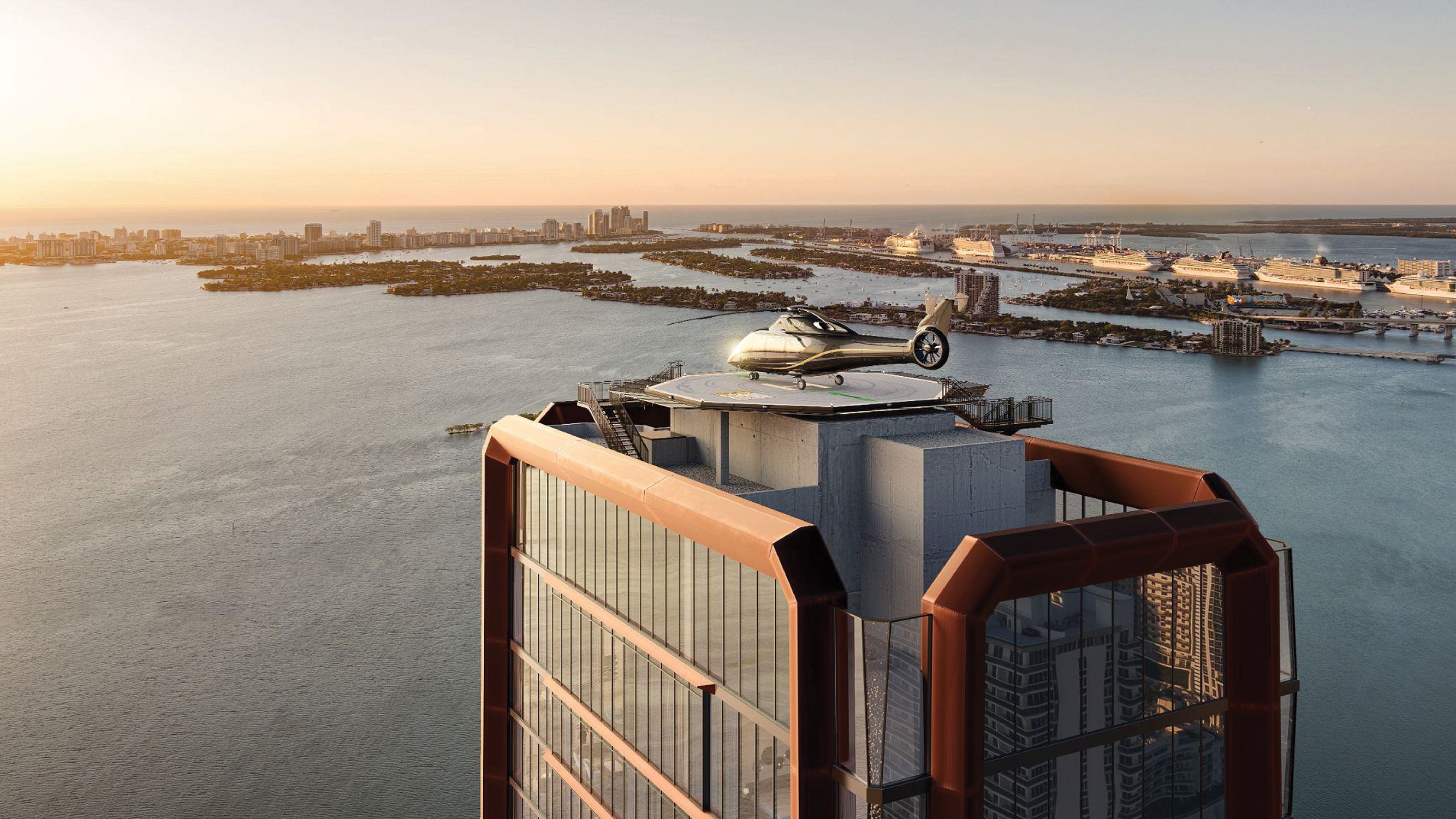
South Florida has always sold an effortless relationship with the water and the sky; now a handful of towers are knitting those elements together in a very literal way. Helipad-ready buildings allow owners to slip past bridges, causeways and airport queues, trading ground level congestion for direct rooftop arrival. For globally mobile buyers who divide their lives between multiple homes, offices and yachts, the ability to fly directly to the building is fast becoming the most coveted amenity of all.
Regulation keeps this club small. Designing a rooftop helipad or future skyport requires specialized structural engineering, fire and safety planning, and approval from both aviation authorities and municipal planners. That scarcity is exactly what makes the few towers that do offer helicopter or eVTOL infrastructure so compelling. They promise time saved, privacy protected and travel compressed into a quiet vertical commute between penthouse and sky.
Downtown Miami is where helipad-ready living first moved from concept to reality. Here, a trio of high profile towers shows three different approaches to arriving by air while still delivering the full suite of waterfront amenities and design credentials buyers expect.
One Thousand Museum is the undisputed pioneer. The Zaha Hadid designed tower, often nicknamed the Scorpion Tower for its sculptural exoskeleton, pairs a 62 story profile with a private rooftop helipad that sits hundreds of feet above Biscayne Boulevard. Residents can reserve the pad through the building concierge, coordinating flights to Miami International Airport, Miami Opa Locka Executive or nearby islands so that airport transfers happen in minutes rather than an hour in traffic. Inside, a sky lounge, indoor aquatic center, wellness level and secure vault reinforce the sense that this is a vertical private club as much as a condominium.
Nearby on the riverfront, Aston Martin Residences brings the aura of a performance car brand into the skyline. The sail inspired tower rises roughly 66 stories at the mouth of the Miami River, with residences oriented to capture sunrise views over Biscayne Bay and sunset vistas back to the city. At the crown, a private helipad is designed to complement the building's deep water marina, giving owners the option to arrive by superyacht or helicopter depending on the day. At Aston Martin Residences, the amenity mix reads like a checklist for a global traveler: private club spaces, a curated art collection, priority berths for large vessels and the kind of discreet arrival sequence that suits both high profile and intensely private clients.
Farther north in Sunny Isles Beach, Bentley Residences translates the heritage of a British grand touring marque into an oceanfront tower. Designed to exceed 60 stories and scheduled for delivery in the later 2020s, the building is best known for its Dezervator car elevator system that carries vehicles directly into glass walled sky garages. The planned rooftop helipad takes that concept one step further, offering what is effectively a private terminal in the sky above one of South Florida's most coveted strips of sand. For residents, a day might begin with a short helicopter hop from a business meeting in Miami, followed by a swim in the Atlantic and dinner in Aventura, all without ever touching a public concourse.
Helipads are not confined to pure residential towers. In Miami's newest mixed use districts, hospitality driven developments are introducing rooftop access that serves both owners and hotel guests.
E11EVEN Hotel & Residences in the Park West neighborhood channels the energy of its namesake nightlife venue into a two tower complex with a full length entertainment program. The first tower, a condo hotel hybrid that has already topped off, is planned with a private rooftop helipad reserved for residents and select guests. Below, day and night life unfold across a members club, signature dining, a resort style pool deck and wellness spa. For buyers, the appeal is the ability to step off a helicopter, descend a few floors and be immersed immediately in the city's round the clock social scene, then retreat to a residence without ever leaving the property.
A few blocks north inside the Miami Worldcenter master plan, Legacy Hotel & Residences takes a more clinical spin on vertical aviation. The tower combines short stay residences, a business focused hotel and a large scale health and wellness center complete with diagnostic facilities and advanced air filtration. Early designs outlined a rooftop helipad that could be used for medical transfers as well as private arrivals, subject to final approvals. Even as details evolve, the intent is clear: for a buyer who sees Miami as both a lifestyle base and a medical hub, Legacy Hotel & Residences aims to make stepping off a helicopter into a consultation room or boardroom as seamless as arriving at a lobby.
The next wave of projects leans into a future where traditional helicopters share airspace with quiet electric vertical takeoff aircraft. For developers, it is as much a branding statement as a technical investment.
Paramount Miami Worldcenter, completed in 2019, was among the first to hard wire this thinking into its roofline. Above the building's celebrated amenity deck, which already includes multiple pools, a soccer field and a recording studio, the developer reserved a five thousand square foot zone engineered to serve as a future skyport. The space is currently used as an elevated observation and event terrace, but structurally it anticipates a moment when eVTOL taxis and private craft are cleared to operate in the Miami skyline. For owners, the message is that the tower is built not just for today's travel patterns but for the next generation of urban aviation.
Across Biscayne Bay in Edgewater, two projects signal how helipad ready living is moving into new neighborhoods. Villa Miami is a boutique scale tower limited to roughly seventy homes within a 56 story copper hued form. Co developed by Terra, One Thousand Group and hospitality partners, it layers a private club concept called The Copper Club through the top floors of the building. The rooftop helipad is expected to tuck into this members only domain, so that arriving by helicopter feels less like using infrastructure and more like stepping directly into a favorite lounge. Just to the north, Tower 36 pairs high end residences with trophy office space in a 635 foot profile designed by Kohn Pedersen Fox. Here too, a rooftop helipad and sky lounge are part of the vision, creating a building where a chief executive could in theory commute by air to their own headquarters and then walk a few floors home.
Not every building can or should carry a helipad. Structural constraints, flight path limitations and community appetite all play a role, particularly in coastal corridors. Some developers have responded by designing indirect but highly polished aviation ecosystems instead. Turnberry Ocean Club Residences in Sunny Isles Beach aligns itself with Fontainebleau Aviation at Miami Opa Locka Executive Airport, giving residents priority services at a private terminal rather than a pad on the roof. On the other side of the bay, Ritz-Carlton Residences Miami Beach offers a yachting driven solution in which owners can reach a floating marine helipad in Biscayne Bay by boat and continue onward by chartered helicopter. In both cases, the experience is curated end to end, even if the aircraft never touches the building.
For buyers, the value of these amenities comes down to three questions: how often will you really fly, how seamlessly does the building manage operations, and how does rooftop access integrate with your broader network of jets, yachts and cars. In practice, helipads in residential settings tend to be used sparingly and scheduled carefully, with strict operating hours and vetted pilots to protect both quiet enjoyment and safety. When matched to the right lifestyle and flight patterns, however, a helipad or skyport can recast South Florida living as a series of short vertical journeys rather than long drives. For a discreet assessment of which towers best align with your travel habits, and which aviation partnerships add meaningful value beyond the rooftop, the advisors at MILLION Luxury can curate a private shortlist tailored to your needs.
Which Miami residential tower already offers a private rooftop helipad?
At the time of writing, One Thousand Museum is widely regarded as the pioneer and remains the only completed Miami condominium tower with an operational private rooftop helipad. Other projects such as Aston Martin Residences, Bentley Residences, E11EVEN Hotel & Residences and Villa Miami have planned helipad or skyport components that are expected to come online as construction progresses and approvals are finalized.
How is helipad use typically managed in these towers?
Use is usually tightly controlled. Residents reserve slots through concierge or building management, flights are limited to approved pilots and charter partners, and operations are constrained to defined hours and routes. The goal is to keep the amenity highly functional for owners while minimizing impact on neighbors and the wider skyline.
What should I consider about noise and privacy with a helipad?
Rooftop operations inevitably add some noise, but serious luxury towers counter this with acoustic design, sound attenuating glazing and careful routing of aircraft. Buyers should review where the helicopters will approach from, how often operations are expected, and what sound mitigation is built into both the residences and the amenity levels to protect privacy and comfort.
Are there good alternatives if my building does not have a helipad?
Yes. Buildings like Turnberry Ocean Club Residences and Ritz-Carlton Residences Miami Beach show how curated partnerships with private airports, marinas and offshore landing platforms can deliver almost the same level of convenience. A well connected residence should plug into a network of car services, fixed base operators and yacht terminals so that the journey from jet or helicopter to home still feels seamless. To map those options against your own travel patterns and shortlist the most efficient addresses, you can speak confidentially with the advisory team at MILLION Luxury.
If branded residences are on your mind — as a home or as an allocation — we would be glad to share what we are seeing, privately.
Begin a quiet conversation