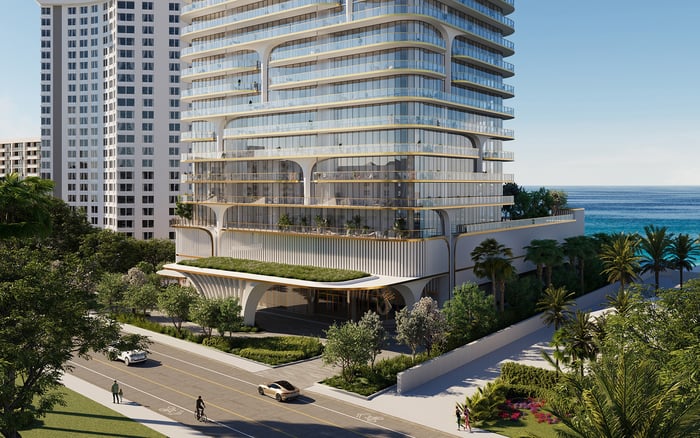
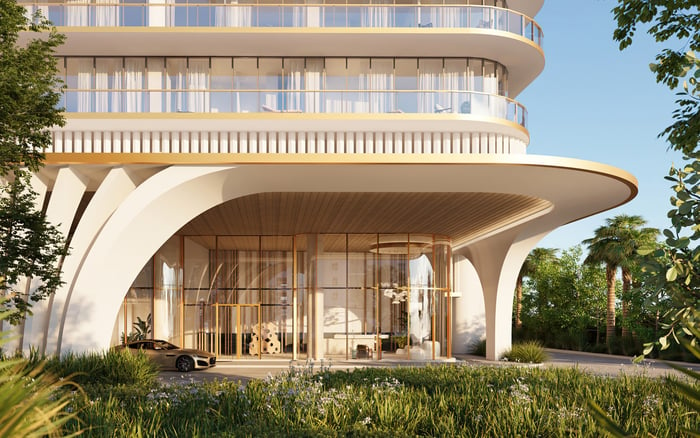
Ocean 580’s full-floor format can reduce same-level interaction, but privacy depends on elevator controls, shared circulation, glazing, sightlines, and disciplined premium analysis.
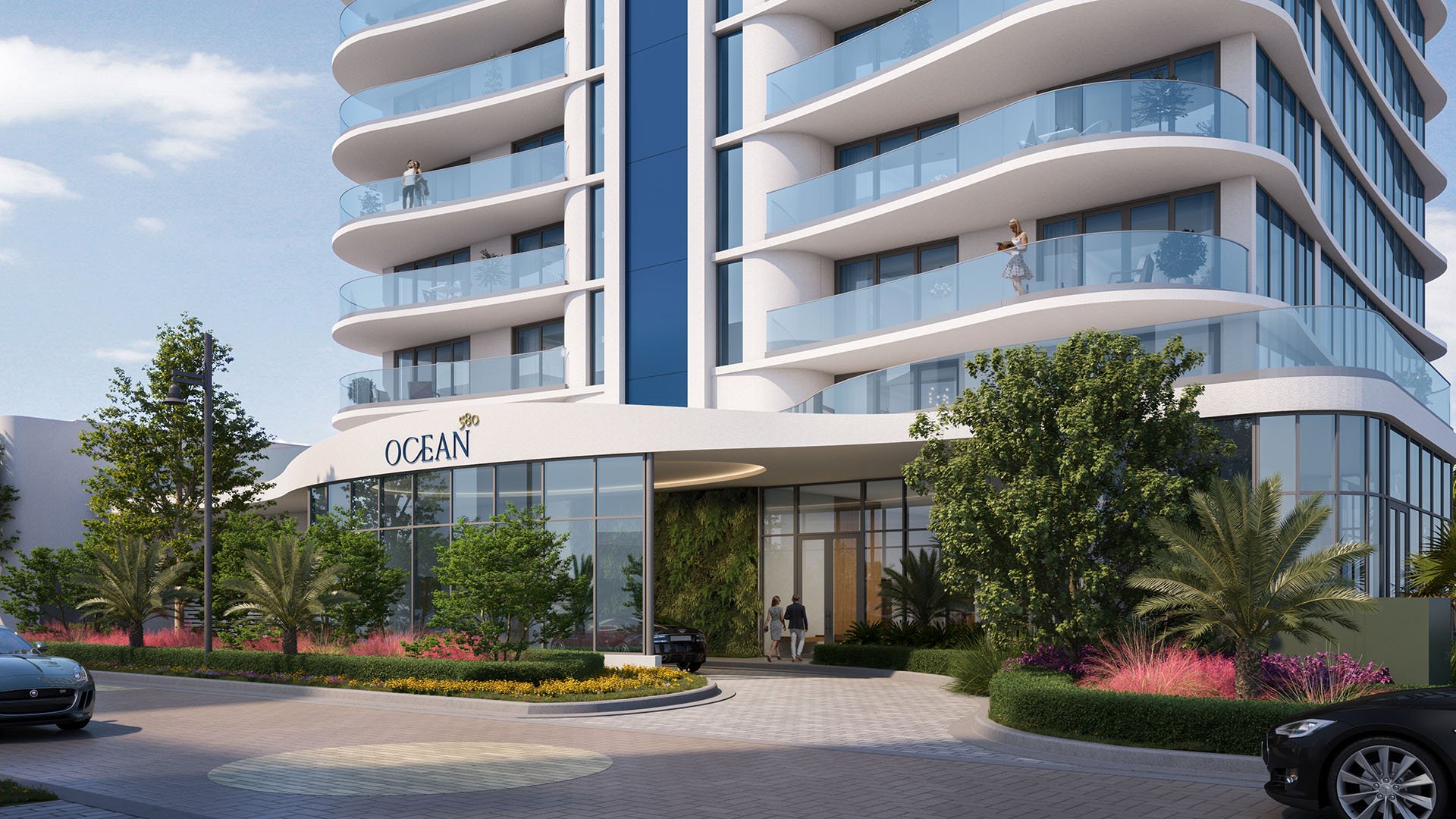
Buyers evaluating the full-floor proposition at Ocean 580 Pompano Beach should distinguish the appeal of a dedicated residential level from the building systems and operating procedures that shape everyday privacy.
The format may limit routine encounters with neighbors and remove other residential entries from the same level. It does not, by itself, establish that every threshold, shaft, vestibule, stair, or service route is exclusive.
For privacy-minded purchasers, any premium should follow verified conditions rather than rely on terminology alone.
A strong arrangement gives the owner control over the residential level while keeping necessary building infrastructure discreetly separated. Buyers should study how each elevator opens, where emergency stairs terminate, and whether service access intersects with private living areas.
Boutique scale and residential separation are related but different considerations. Staffing procedures, deliveries, maintenance access, guest entry, and elevator programming all influence the lived experience. The assessment should extend from the physical plan to the governing documents and operating rules.
Pompano Beach offers a useful local comparison set. Armani Casa Residences Pompano Beach and The Ritz-Carlton Residences® Pompano Beach may help buyers refine their priorities, but every property requires an individual review of access, circulation, residence configuration, and governance.
The phrase “private elevator” can refer to different arrival arrangements. An elevator might provide controlled direct entry into a residence or open into an enclosed lobby outside the legal residence. The distinction can affect security planning, furnishing rights, camera placement, package handling, and access permissions.
Request a review of the complete arrival sequence. Confirm how residents authorize guests, who can override controls, and what procedures apply during maintenance or emergencies. Account for every elevator serving the level and identify connections to stairs, utility areas, or other shared spaces.
The declaration, bylaws, architectural plans, and elevator-control details should be consistent. Any retained access rights for management, staff, contractors, or emergency personnel should be understood before exclusivity is assigned a monetary value.
Large areas of glass can expand views while also increasing visibility into a home. Privacy therefore works in both directions: what a resident can see and where the interior may be observable from outside.
Evaluate sightlines during daylight and after dark. Consider nearby buildings, public approaches, and the possibility that later development could change exposure. Window specifications, shading, interior lighting, room placement, terrace position, and elevation can each affect the result.
An attractive outlook should not be treated as automatic privacy. The practical question is whether the residence can be used comfortably under ordinary lighting conditions without constant dependence on shades.
A full-floor residence may attract a premium for several overlapping reasons, including interior scale, elevation, terraces, outlook, and reduced same-level interaction. A disciplined analysis should avoid attributing all of that value to privacy.
Local alternatives such as W Pompano Beach Hotel & Residences and Waldorf Astoria Residences Pompano Beach can broaden the comparison, although differently configured properties should not be assumed to provide equivalent experiences. The purpose of comparison is to separate the value of space and outlook from the value supported by controlled access.
Privacy is most defensible as a component of value when it is clear in the plans, supported by the documents, and evident in daily operations.
Before committing, request the declaration, bylaws, architectural plans, elevator-control information, window specifications, and any applicable inspection or engineering materials. Review rental restrictions, renovation procedures, staffing practices, camera locations, guest protocols, and package handling.
Ask how cleaners, vendors, contractors, emergency personnel, and management reach the level. Full-floor living is strongest when architecture, technology, legal rights, and operating policy reinforce one another. If those layers conflict, the buyer should reconsider how much of a premium is justified by privacy.
Does full-floor living eliminate all shared circulation? No. Emergency stairs, service routes, elevators, utilities, or staff access may still involve shared building infrastructure.
What should buyers confirm about elevator arrival? Determine whether the elevator enters the residence directly or opens into a separate lobby, and verify who controls that space.
Can building personnel override elevator controls? They may have access for operations, maintenance, or emergencies. The governing documents and control procedures should identify those permissions.
Why do exterior sightlines matter? A residence can feel visually open from within while remaining observable from nearby buildings or public areas.
Should privacy be assessed after dark? Yes. Interior lighting can change exterior visibility, so daytime observations alone may be incomplete.
Which documents should receive priority? Focus on the declaration, bylaws, plans, elevator-control information, window specifications, and applicable inspection or engineering materials.
How should a buyer evaluate a privacy premium? Separate privacy from other value drivers such as interior scale, elevation, terraces, and outlook.
Can rental restrictions influence privacy? Yes. Rental rules can affect turnover, guest activity, access patterns, and the overall residential environment.
Why review delivery and renovation procedures? These procedures show how workers, packages, and other nonresidents move through private or semi-private areas.
What is the central due-diligence test? Confirm that the plans, access technology, legal documents, and daily management practices support the same privacy expectation.
To compare the best-fit options with clarity, connect with MILLION.
If branded residences are on your mind — as a home or as an allocation — we would be glad to share what we are seeing, privately.
Begin a quiet conversation