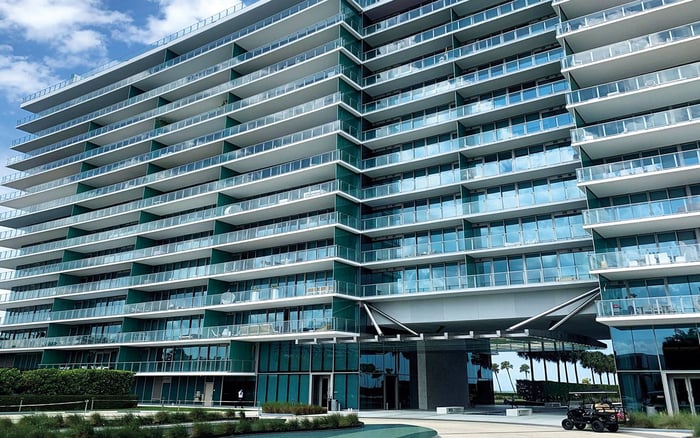
A disciplined first-year plan for a move from San Francisco to Key Biscayne separates association dues from taxes, insurance, optional services and furnishing, then maps each expense to its actual payment date.

Moving from San Francisco to Key Biscayne changes the setting, but the financial transition deserves equal attention. A residence may fit comfortably within an acquisition budget yet require a very different pattern of cash payments in its first year. Association dues are only the beginning. Taxes, insurance, optional services and furnishing each need a distinct place in the plan.
The useful comparison is not one city's average against another's. It is the actual cost structure of the San Francisco residence against the documented obligations of the proposed Key Biscayne property. In San Francisco, luxury-condominium dues vary with unit size, staffing, insurance, amenities and service level. Review the latest association budget, reserve study and potential special assessments before treating current dues as a reliable baseline.
The objective is straightforward: preserve liquidity for both ownership and the way you intend to live.
A September 2026 sample of 99 active Key Biscayne condominium listings showed median monthly-equivalent association dues of $1,708, with the middle half between $1,269 and $2,494. A separate October 10, 2026 sample retained 100 of 107 active listings and showed a median of $1,799.
The October figure annualizes to $21,588 before separately billed services or special assessments. It is a dated listing statistic, not an audited all-in ownership budget. The difference between the samples does not establish a building-specific increase or provide a reliable measure of monthly fee growth.
For a buyer considering Oceana Key Biscayne, the next step is to obtain the particular residence's current dues, billing frequency and schedule of inclusions. The island-wide median does not establish that property's costs.
Lake Tower illustrates why billing detail matters. A sample of 11 listings showed median dues of approximately $1,513 monthly, or $18,156 annually, with most fees billed quarterly. Separately billed club or amenity memberships were excluded. Monthly equivalence supports comparison; the actual invoice schedule determines liquidity needs.
Build the first-year ledger with distinct lines for association dues, property taxes, insurance, optional services, utilities, maintenance, furnishing and an assessment contingency. This is a planning framework, not a market-average budget.
Classify each expense as a contractual obligation, a discretionary choice or an uncertain exposure. Dues belong in the first category. Optional housekeeping and other personally selected services belong in the second. Potential assessments and insurance deductibles need separate contingency treatment.
Ask management to identify what is included, what carries an additional charge and what must be arranged independently. An amenity's presence does not mean every related service is covered by dues.
If the search extends to Park Grove Coconut Grove, use the same worksheet rather than carrying a Key Biscayne allowance into Coconut Grove. Compare written inclusions, not an assumed service experience. For optional services, request vendor quotes specifying frequency, scope, cancellation terms and any initial payment. No substantiated universal allowance can replace those decisions.
An indicative 2026 Key Biscayne tax estimate is approximately 1.56% of assessed value. At that rate, a $5 million assessed value would produce $78,000 annually before exemptions. This is an illustration, not an official parcel-specific quote. A $5 million purchase price does not establish a $5 million assessed value.
Review the property's tax record and its TRIM notice, which shows proposed taxes likely to appear on the November bill. Before relying on the seller's current payment, ask a qualified adviser to evaluate the assumptions applicable to your ownership.
Keep annual liability separate from payment timing. A monthly tax allocation supports disciplined planning, but it does not change when money must leave the account. Record expected payment dates and any closing-related tax amounts identified in the transaction documents. Avoid double counting between the closing ledger and the ongoing budget.
Insurance should not be reduced to a single placeholder. Standard homeowners insurance excludes flood damage, so flood coverage requires separate consideration. Wind exposure and reconstruction cost also deserve explicit review; reconstruction cost can differ substantially from market value or tax assessment.
For a condominium, begin with the association's master policy. Then examine the proposed unit policy and any gaps between the two. Condominium-owner coverage typically addresses personal property, loss of use, liability and interior improvements. Do not import a standalone-home premium estimate into the unit's budget.
Key Biscayne premiums depend on factors including insured dwelling value, construction materials, building age, roof type, wind-mitigation features and proximity to water. Obtain property-specific quotes and record deductibles alongside premiums. A premium is a scheduled expense; a deductible is a potential liquidity requirement. Ask how flood protection is addressed at both the association and unit levels before considering the insurance budget complete.
Furnishing is where a refined vision meets a precise scope. Separate essential move-in purchases from later design decisions, then obtain written quotes for the actual residence rather than assuming a six-figure allowance.
Ask each vendor to distinguish merchandise, design fees, delivery, installation, applicable taxes and storage where relevant. Record deposit requirements and balance-payment milestones so that one commitment is not mistaken for several independent costs.
For a comparison residence at Una Residences Brickell, repeat the exercise using that residence's dimensions and intended use. Compare Brickell and Key Biscayne through specific ownership documents and furnishing scopes, not interchangeable lifestyle budgets.
If occupancy will be seasonal, prioritize what is needed for the first stay. Deferring optional purchases is a cash-management choice, not necessarily a compromise in the finished interior.
Before closing, assemble association documents, tax assumptions, insurance quotes and furnishing commitments. Keep acquisition costs and closing-related payments visibly separate from recurring carrying costs.
For the closing month, enter only amounts and dates established by transaction documents, policies or contracts. These may include insurance payments, association charges and furnishing deposits. In subsequent months, schedule dues at their actual frequency, optional services when contracted and furnishing balances when due.
Place tax payments in the appropriate month rather than smoothing every expense into a misleading monthly average. Maintain a separate contingency for assessments, deductibles and unplanned maintenance. Size it after reviewing the property's exposures, rather than borrowing an unsupported percentage.
The finished plan should show both annual cost and the month with the largest expected cash requirement. That distinction keeps the residence a considered choice rather than a sequence of avoidable liquidity surprises.
Explore your next South Florida residence with MILLION.
If branded residences are on your mind — as a home or as an allocation — we would be glad to share what we are seeing, privately.
Begin a quiet conversationThe October 10, 2026 sample showed median monthly-equivalent dues of $1,799 across 100 retained listings. That is listing context, not a quote for a particular residence.
The $1,799 monthly-equivalent median annualizes to $21,588. It excludes separately billed services and special assessments.
Compare the actual association budgets, reserve information, insurance arrangements and service inclusions of the two residences. Citywide figures cannot establish a particular property's obligations.
No. Lake Tower's sampled fees were mostly billed quarterly, so confirm the specific association's payment schedule.
Do not assume they do. Lake Tower's sampled dues excluded separately billed club or amenity memberships, illustrating the need for a written inclusion schedule.
A purchase price does not itself establish assessed value. The indicative 1.56% estimate should be checked against parcel-specific tax information and ownership assumptions.
It shows proposed property taxes likely to appear on the November bill. Review it alongside the property's tax record when planning payments.
No, standard homeowners insurance excludes flood damage. Review flood protection separately and check how association and unit coverage interact.
Use written quotes for the selected scope rather than an unsupported market allowance. Record deposits, payment milestones and service frequency in the cash calendar.
Quarterly dues, insurance payments, furnishing deposits and taxes can concentrate cash requirements in particular months. A twelve-month calendar shows both total expense and peak payment demand.