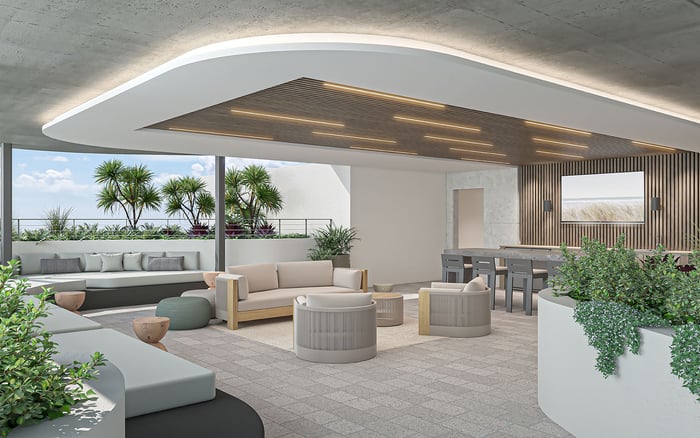
Ziggurat Coconut Grove advertises private residential arrival and hospitality-oriented services. Buyers should distinguish those features from unconfirmed service routes, staff-entry permissions, and household-vendor procedures before signing and closing.

A beautifully composed arrival tells only part of a luxury residence's story. For a household supported by a housekeeper, chef, dog walker, or regular maintenance team, privacy also depends on how those people enter, move through the building, and leave. The question is not simply whether the owner has a private elevator, but whether everyday service can operate discreetly without uncertainty at the threshold.
At Ziggurat Coconut Grove, residences are marketed with private elevators and private foyers with double-door entries. These are meaningful arrival features. They do not, however, establish a staff-exclusion policy, a separate service route, or permission for a vendor to enter while the owner is away. Buyers should treat architectural privacy and operational access as distinct subjects, each requiring confirmation.
Planned at 3101 Grand Avenue, Coconut Grove, Florida 33133, Ziggurat occupies approximately 1.7 acres at the crossroads of Grand Avenue, Matilda Street, and Florida Avenue. Its residential component is a three-story building with 19 residences. Homes range from two to five bedrooms and are marketed with expansive terraces and smart-home features.
The broader program includes a five-story office component and an open-air paseo with retail, cafés, and a gourmet market. That mix gives buyers a specific diligence task: establish where public-facing activity ends and controlled residential circulation begins. Boutique scale alone does not establish how commercial visitors, deliveries, household staff, and residents are separated.
Request drawings that distinguish residential, office, retail, staff, vendor, loading, refuse, and emergency routes. Ask where those routes intersect and what controls each intersection. A clearly identified boundary is more useful than a general assurance of residential privacy.
Before signing, request service-and-circulation drawings for the residence under consideration. Trace a household employee's journey from the street to the front door, then repeat the exercise for a furniture delivery and a contractor carrying equipment. These scenarios can expose questions a residential floor plan alone cannot answer.
The advertised materials do not confirm a dedicated staff-only entrance, service corridor, loading dock, or freight elevator. These features remain unverified-not necessarily absent. Ask whether providers would use a separate entrance, service hallway, service lift, or resident elevator, and request clarification of any shared portions of the route.
For buyers also evaluating Four Seasons Residences Coconut Grove, the useful comparison is a consistent set of questions, not an assumed equivalence between service offerings. Apply the same arrival-to-door exercise to each property, keeping documented features separate from proposed procedures.
Have counsel review how any material access representation relates to the purchase documents. If a particular arrangement is essential to your household, establish its documentary status before relying on it.
A recurring housekeeper and a one-time installer have different access needs. Whether household employees may enter independently or recurring vendors receive standing credentials remains unconfirmed. Pre-registration, identification checks, resident approval, background screening, insurance certificates, and reserved access windows are likewise unspecified.
Request written distinctions among household employees, recurring service providers, occasional visitors, and contractors. Confirm who can authorize each category, whether authorization expires, and how it can be revoked. For owner-absent entry, identify who admits the person to the building and who permits entry into the residence. These are separate permissions and should be addressed separately.
Private elevators should not be interpreted as elevators reserved exclusively for owners. Ask who may use them, how access is granted, and whether an escort is required. If a household employee must arrive before the owner returns, test that scenario against the proposed rules rather than assuming the private foyer resolves it.
Ziggurat advertises a luxury-hospitality-trained concierge, round-the-clock on-site security, and 24-hour valet. These services suggest a hospitality-oriented residential offering, but do not establish a detailed vendor-admission procedure. The concierge's authority to approve or escort providers remains unspecified, as do arrangements for vendor vehicles, moving trucks, and contractor parking.
Ask who handles scheduling, credential checks, elevator reservations, and loading coordination. Confirm whether valet has any responsibility for loading or only for vehicle arrival. A provider should not have to discover the chain of responsibility while waiting at the entrance with equipment.
Mail and package delivery to each residence is also advertised. Clarify the exceptions: oversized furniture, refrigerated groceries, signature-required parcels, and deliveries when no authorized recipient is available. Dog walking, pet care, and dry cleaning are advertised household-support services, but their access procedures still warrant clarification.
The distinction between a service offering and an access rule is equally useful when considering The Well Coconut Grove. Keep the comparison focused on what your household needs to accomplish, without assuming that any property's service language establishes permission to enter a home.
Before closing, obtain the applicable condominium documents and written rules covering domestic staff, recurring vendors, deliveries, movers, and contractors. Ask which provisions govern permitted hours, insurance requirements, reservations, escorts, and owner-absent access. Identify which arrangements are confirmed and which still require a management decision.
Smart-home features are advertised, but integration with building access control, intercoms, camera feeds, or temporary vendor credentials is not confirmed. Ask what the owner can control, what requires building personnel, and how access is withdrawn. Do not assume an in-residence technology feature also controls entry through the building.
Prepare a concise household access brief for review before closing. Include provider categories, expected schedules, owner-absent visits, delivery needs, and any move-in requirements. Compare the brief with the written rules and circulation drawings. The objective is not unrestricted access, but a predictable arrangement that preserves security while allowing the household to function.
The decisive distinction at Ziggurat is straightforward: private residential arrival is documented in the advertised offering, while complete back-of-house separation and household-vendor protocols remain unconfirmed. Neither reassurance nor silence should substitute for a written answer to a material household requirement.
Move from offer to ownership with three things aligned: the physical route, the authority to admit each provider, and the rules governing the visit. That alignment makes service feel discreet rather than improvised, and privacy practical rather than merely visual.
For a considered approach to Coconut Grove ownership, explore MILLION.
If branded residences are on your mind — as a home or as an allocation — we would be glad to share what we are seeing, privately.
Begin a quiet conversationZiggurat is planned at 3101 Grand Avenue, Coconut Grove, Florida 33133, on approximately 1.7 acres at Grand Avenue, Matilda Street, and Florida Avenue.
The residential component is a three-story building with 19 residences. Homes are marketed with two to five bedrooms.
Yes, private elevators and private foyers with double-door entries are advertised. These features do not establish who may use the elevators or enter a residence.
The advertised materials do not confirm a dedicated staff-only entrance. That feature remains unverified rather than proven absent.
A dedicated service corridor, loading dock, and freight elevator are not confirmed. Buyers should request circulation drawings and written clarification of provider routes.
Independent household-employee entry is not established by the published service descriptions. Buyers should confirm both building admission and permission to enter the residence.
A luxury-hospitality-trained concierge is advertised, but vendor-approval and escort authority are unspecified. Request a written explanation of who authorizes and manages provider visits.
The advertised valet service does not establish arrangements for moving trucks, vendor vehicles, or contractor parking. Loading responsibility and vehicle access should be clarified separately.
Advertised smart-home features do not confirm integration with building access control or temporary vendor credentials. Ask which permissions owners can manage and which require building personnel.
Obtain applicable condominium documents, written access rules, and circulation drawings. Reconcile them with household needs for recurring staff, deliveries, contractors, and owner-absent entry.