For Boston buyers considering South Beach, the right residence begins with a realistic weekly itinerary. Evaluate walking routes, school logistics, driver coverage, and private-airport transfers separately before deciding which address best protects your time.

For a Boston household considering South Beach, the most consequential residential question is not simply where to find an exceptional view. It is which address can support an ordinary week without constant coordination. Breakfast on foot, a school departure, an afternoon appointment, and a private-flight connection belong in the same buying conversation. They are not, however, the same transportation problem.
Compare your actual Boston routine with your proposed South Beach routine, rather than relying on either city's broad reputation. List the journeys you make, who makes them, and which departure times cannot move. Then separate discretionary outings from fixed commitments. A residence may support an appealing pedestrian life while still requiring planned vehicle coverage for specific obligations.
The objective is not necessarily to eliminate driving. It is to make the household's dependence on it deliberate rather than surprising.
Begin each walking assessment at the entrance you would actually use. Choose destinations that matter to your household, then walk the routes at the hours you expect to use them. Assess crossings, shade, comfort, and the practicality of returning with groceries or accompanying children. A pleasant leisure walk and a dependable daily errand are different tests.
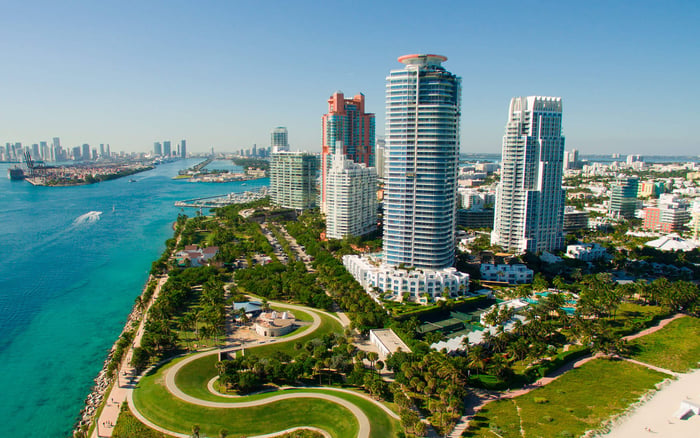
When considering Apogee South Beach, apply that exercise to the specific residence rather than assuming the building's name answers the mobility question. Record which outings genuinely feel easier on foot and which would still prompt a car request. The result should be a personal walking map, not a neighborhood score.
Repeat the exercise for Continuum on South Beach if it enters the shortlist. The purpose is not to declare one building universally more walkable. It is to identify the combination of entrance, routes, and destinations that best matches your habits. Do not substitute a weekend viewing itinerary for the weekday routine you intend to maintain.
A driver can take responsibility for a journey without making its duration disappear. When selecting a residence, distinguish time behind the wheel from time in a vehicle. The first may be delegated; the second still occupies the family calendar.
Build a weekly journey sheet with separate entries for walking, self-driving, and chauffeured travel. Mark overlapping commitments, particularly when one adult is traveling and children have different destinations. Let that exercise determine whether occasional bookings, scheduled coverage, or a more continuous arrangement merits consideration. Do not begin with the assumption that every South Beach household needs the same solution.
For a candidate such as Five Park Miami Beach, include building-level questions: where a vehicle can wait, how pickups are coordinated, and what arrangements apply to guests and household staff. Confirm the answers directly rather than treating parking, valet service, and driver accommodation as interchangeable. These details belong alongside the residence's interior qualities in the final comparison.
School logistics begin with a confirmed campus and a clear understanding of admissions status, not an assumed journey time. Establish the arrival window, dismissal arrangements, after-school schedule, and any transportation options directly with the school. Only then can a residential shortlist be tested against the commitments it must support.
Drive the actual route during the relevant school window, including the approach to drop-off and pickup. Record the return journey as well. For households with multiple children, test the sequence rather than evaluating each campus in isolation. A route that works on its own may not fit between another child's dismissal and an afternoon activity.
Do not borrow airport-transfer estimates to fill in a school schedule. They describe different endpoints and travel conditions. The practical buying question is whether the complete school day works from the proposed address, including a backup arrangement when the usual driver or parent is unavailable. Keep educational fit and transportation convenience distinct, then evaluate their combined effect on the household.
Miami's principal private-flight options include Miami-Opa-locka Executive, or OPF; Miami Executive, or TMB; and Miami International, or MIA. For a South Beach residence search, OPF is a sensible starting point for discussion with the flight team-not a promise of the fastest transfer on every occasion.
OPF has multiple fixed-base operators, 24-hour airport operations, and U.S. Customs and Border Protection on the field. Confirm the selected FBO's arrangements and any international-arrival requirements for the actual flight. Airport operating hours do not establish that every requested service is available without coordination.
Indicative OPF-South Beach driving estimates range from approximately 25-40 minutes, depending on traffic and the causeway used. More optimistic Miami Beach estimates run around 20-25 minutes, while heavy peak conditions, including major events and busy weekends, can extend estimated journeys to 60-90 minutes. These are planning estimates, not measured reliability statistics or guaranteed arrival windows. Miami Beach and South Beach endpoints are not interchangeable; request routing to the exact residential entrance.
Keep road time separate from the total residence-to-aircraft journey. Ask the flight team and ground-transport coordinator to account for vehicle readiness, luggage handling, FBO procedures, and any applicable international formalities. Set an allowance for the particular itinerary rather than imposing a universal inbound or outbound buffer.
If Setai Residences Miami Beach is under consideration, request a complete transfer assessment for its relevant pickup point. Apply the same standard to every finalist so that an optimistic airport estimate does not give one residence an unearned advantage.
TMB, near Kendall in southwestern Miami-Dade, has indicative Miami Beach driving estimates of 35-50 minutes. Its geography also warrants consideration for itineraries centered on Coral Gables, Coconut Grove, the Keys, or southern Miami-Dade. Keep MIA in the comparison when appropriate to the flight, without assuming OPF always wins on ground time.
An advertised helicopter segment of roughly 10 minutes to Miami Beach is not a verified door-to-door solution. Before assigning it value, confirm the landing location, availability, onward transfer, and total elapsed time.
Bring the four assessments together before selecting a home: daily walking, vehicle coverage, school logistics, and airport access. Weight them by frequency and consequence. A recurring school obligation may deserve more influence than an occasional flight; for another household, the balance may differ.
The strongest shortlist tests every address against the same real calendar. Preserve room for enjoyment, but make the logistics explicit. That is how a South Beach residence can be chosen for the life it supports, rather than the itinerary imagined during a viewing.
Explore a residence strategy tailored to your South Florida priorities with MILLION.
If branded residences are on your mind — as a home or as an allocation — we would be glad to share what we are seeing, privately.
Begin a quiet conversationCompare actual weekly journeys, destinations, and fixed departure times rather than citywide reputations. Test each prospective address against that calendar.
Walk from the entrance you would use to your regular destinations at the relevant times. Evaluate crossings, shade, comfort, and the practicality of errands or accompanying children.
Driver coverage should follow the household's actual schedule, not a neighborhood assumption. Map overlapping commitments before choosing occasional, scheduled, or more continuous coverage.
Confirm the campus, admissions position, arrival and dismissal windows, and transportation options. Then test the actual route and pickup sequence during the relevant school periods.
No. School journeys require their own route tests because their destinations, timing, and pickup arrangements differ from airport transfers.
Miami–Opa-locka Executive, or OPF, is a sensible starting point. Compare it with MIA and TMB for the specific flight and residential endpoint rather than assuming it is always fastest.
Indicative guidance is approximately 25–40 minutes, with estimated journeys of 60–90 minutes possible in heavy peak conditions. These figures are driving estimates, not guaranteed door-to-door times.
OPF has U.S. Customs and Border Protection on the field. Confirm the applicable arrangements and requirements with the flight team and selected FBO.
TMB is worth evaluating for itineraries centered on Coral Gables, Coconut Grove, the Keys, or southern Miami-Dade. Indicative driving estimates to Miami Beach are 35–50 minutes, not guaranteed transfer times.
No. An advertised helicopter segment does not establish a residence-specific landing point or total journey; confirm availability, ground connections, and complete elapsed time.