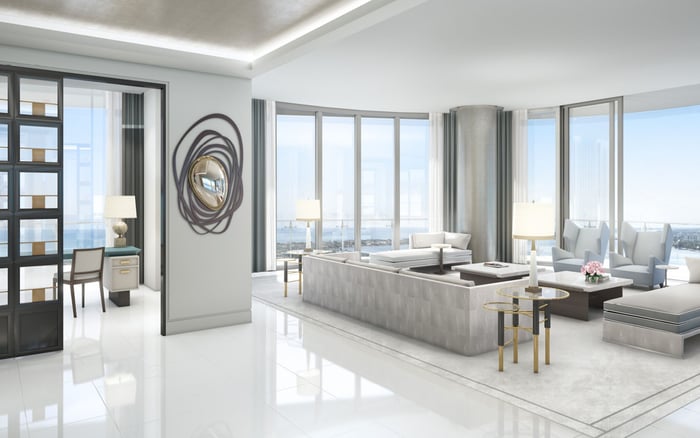
A buyer-focused guide to evaluating closet ventilation, HVAC zoning, humidity control, and customization risks at Forté on Flagler in West Palm Beach.

At Forté on Flagler West Palm Beach, closet ventilation is not a minor technical footnote. It belongs within the larger evaluation of indoor air quality, moisture control, HVAC design, and the long-term protection of luxury finishes. In a waterfront condominium setting, buyers often focus first on views, floor plan, ceiling height, glazing, and amenity programming. Yet some of the most sensitive spaces in a residence are also the most enclosed: walk-in closets, dressing rooms, storage rooms, laundry closets, and utility closets.
Those spaces may hold couture wardrobes, leather goods, shoes, handbags, linens, documents, luggage, electronics, art packaging, or seasonal storage. They may also be the rooms where airflow is easiest to overlook because they are not occupied like a living room or bedroom. A buyer who asks precise questions before contract, customization, or move-in is better positioned to understand how the residence is intended to perform.
Buyers evaluating West Palm Beach luxury residences should bring the same scrutiny to hidden mechanical details that they bring to views and finishes. At this level, comfort is not only what the main rooms feel like during a showing. It is also how the quieter rooms behave when the doors are closed.
The first question is direct: how are the closets intended to breathe? Buyers should ask whether walk-in closets, dressing rooms, storage rooms, and utility closets receive conditioned supply air, return-air pathways, exhaust, transfer grilles, undercut doors, or any other dedicated ventilation strategy. The answer matters because a closet with no direct supply or return may perform differently from the open bedroom or living zone around it.
A sales presentation or floor plan may show a generous dressing room, but it may not show the mechanical logic behind it. Buyers should request mechanical plans or a clear explanation of HVAC supply locations, return-air paths, transfer grilles, door undercuts, and any closet-specific ventilation details. The goal is not to redesign the system at the sales table. It is to understand what has already been designed, what is optional, and what would require approval.
Interior closets deserve particular attention. If a closet is windowless or located deep within the plan, far from the façade or main HVAC supply zones, it may not respond to temperature and airflow in the same way as an open room near glass. That does not mean the design is deficient. It means buyers should understand the difference between perceived comfort in the primary bedroom and air movement inside an enclosed wardrobe area.
The primary suite is often where closet performance matters most. Buyers should ask whether the bedroom, dressing areas, and large closets are served by a dedicated HVAC zone or only by the broader bedroom or living-zone system. A dedicated zone may offer more targeted comfort control, while a broader zone may depend more heavily on air transfer and door position.
The right question is not simply, “Is there air conditioning?” A more useful question is, “How does conditioned air reach and leave the closet when the door is closed?” That wording invites a practical answer about supply, return, transfer, and pressure balance. It also helps the buyer identify whether a proposed custom wardrobe package could interfere with the intended path of air.
High ceilings, deep floor plans, and large glazed areas can also affect airflow balance near interior closets and dressing rooms. Buyers should ask how the system accounts for those spatial characteristics. The point is not to assume a problem. The point is to confirm that the residence’s most enclosed spaces are considered within the same comfort strategy as its most visible rooms.
For many luxury buyers, the closet is closer to a private archive than a storage room. Fine leather, suede, cashmere, gowns, tailoring, accessories, and delicate packaging can be sensitive to prolonged moisture exposure or stagnant air. Buyers should ask whether supplemental dehumidification is available, permissible, or practical for couture wardrobes, leather goods, art storage, and other humidity-sensitive possessions.
This is especially relevant when a buyer plans to live seasonally, travel frequently, or keep doors closed for extended periods. The residence may be conditioned, but the performance of closed rooms can depend on airflow pathways, equipment settings, and the owner’s millwork decisions. A highly customized closet with full-height cabinetry can be beautiful, but it should not unintentionally block grilles, door undercuts, or transfer-air paths.
The best time to raise this question is before customization drawings are finalized. Buyers should ask whether added supply registers, transfer grilles, louvered doors, concealed fans, or dehumidification can be incorporated at the residence level. They should also confirm whether any such upgrades require developer approval, association approval, or coordination with the tower’s core mechanical systems.
A bedroom closet, a laundry closet, a utility closet, and a storage room have different roles. Buyers should ask whether laundry closets, utility closets, and storage rooms have exhaust strategies separate from ordinary wardrobe closets. A laundry area may require a different ventilation approach than a dressing room filled with clothing. A utility closet may need access clearances and equipment considerations that do not apply to millwork-lined storage.
This distinction becomes important during interior planning. A designer may propose concealed doors, integrated panels, thicker millwork, or fully enclosed cabinetry to create a seamless visual effect. Before approving those details, buyers should ask whether the proposed work could block designed airflow paths after move-in. Door undercuts, transfer grilles, and concealed mechanical openings are not decorative afterthoughts. They may be part of how the residence balances air.
Building management questions also belong in the due-diligence file. Buyers should ask how humidity complaints, odors, or moisture issues in enclosed storage areas are handled after occupancy. They should understand whether the response would begin with residence-level inspection, owner maintenance, association review, or coordination with building systems. A clear process can be as valuable as a feature specification.
A polished buyer conversation might include five direct questions. First, which closets receive conditioned supply air, return-air pathways, transfer air, exhaust, or another dedicated approach? Second, are any key closets located deep within the plan, and how is airflow addressed when their doors are closed? Third, is the primary suite controlled by a dedicated HVAC zone or by a broader zone? Fourth, are supplemental dehumidification or closet-specific airflow upgrades permitted? Fifth, will custom millwork, wardrobe systems, or door selections require mechanical review before installation?
These questions are not adversarial. They are appropriate for buyers evaluating a refined residence where invisible performance must support visible luxury. Forté on Flagler sits within a West Palm Beach luxury condominium market where buyers increasingly understand that comfort, preservation, and maintenance are part of value. The highest-quality due diligence looks beyond the grand room and into the spaces that protect what the owner treasures.
Should buyers ask specifically about closet ventilation at Forté on Flagler? Yes. Buyers should ask how walk-in closets, dressing rooms, storage rooms, and utility closets receive or transfer conditioned air.
What is the most important closet ventilation question? Ask how air enters and leaves the closet when the door is closed. That answer clarifies the supply, return, transfer, or exhaust strategy.
Are interior closets different from closets near windows? They can behave differently because windowless or deeper interior spaces may be farther from façade conditions and main supply zones.
Should the primary suite have separate HVAC zoning? Buyers should ask whether the primary suite, dressing areas, and closets are on a dedicated zone or part of a broader bedroom system.
Can supplemental dehumidification be added for luxury wardrobes? Buyers should ask whether it is available, permissible, and compatible with the residence and building systems.
Do laundry closets need a different strategy than wardrobe closets? They may. Laundry, utility, and storage areas should be reviewed separately from ordinary bedroom closets.
Should buyers request mechanical plans? Yes. Plans can show supply locations, return paths, transfer grilles, undercut doors, and closet-specific ventilation details.
Can custom millwork create ventilation issues? It can if it blocks designed airflow paths. Buyers should review wardrobe systems and door details before installation.
Who approves closet ventilation upgrades after purchase? Buyers should confirm whether developer, association, or building-system coordination is required before making changes.
Is closet ventilation part of luxury value? Yes. It supports indoor air quality, moisture control, and the long-term protection of finishes and personal collections.
For a discreet conversation and a curated building-by-building shortlist, connect with MILLION.
If branded residences are on your mind — as a home or as an allocation — we would be glad to share what we are seeing, privately.
Begin a quiet conversation