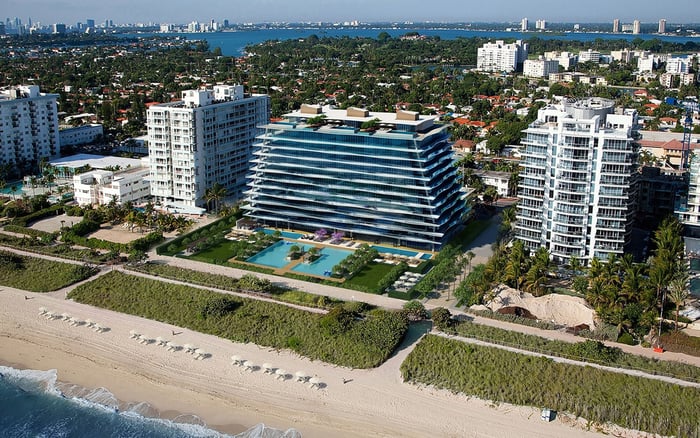
A discreet family-office framework for evaluating Fendi Château Residences beyond design, with emphasis on transaction documents, association governance, financial obligations, and insurable risk.

Fendi Château Residences Surfside presents a distinctive proposition: an ultra-luxury condominium on the Atlantic Ocean that translates Fendi’s fashion and design identity into a cohesive residential setting. Its mid-rise form, limited residence count, substantial ocean frontage, expansive interiors and terraces, multi-bedroom layouts, and resort-style amenities define the lifestyle thesis.
For a family office, however, the aesthetic proposition is only the opening chapter. The acquisition case should be tested across four connected workstreams: title and transaction documents, deposit mechanics, association governance, and insurance. Privacy and scarcity may support desirability, but neither independently addresses contractual rights, future assessments, decision-making authority, deductibles, exclusions, or claims exposure.
This distinction matters across branded residences, where a compelling design identity remains separate from the legal and financial architecture of ownership. The appropriate posture is neither skeptical nor deferential. It is document-led.
The review should begin with a version-controlled document index. At minimum, counsel and the family office’s advisers should examine the declaration, articles, bylaws, rules, amendments, current budget, financial statements, reserve materials, recent meeting minutes, assessment history, insurance policies, claims information, inspection materials, title commitment, relevant survey materials, and the proposed purchase agreement with all riders and disclosures.
Each document should be assigned an owner, review status, date, and open issue. Material terms should then be reconciled across the complete set. A use restriction in the declaration, for example, should be checked against the rules, amendments, and contract rather than read in isolation.
The same discipline is useful when comparing nearby residential formats. Arte Surfside offers another Surfside reference point, while The Surf Club Four Seasons Surfside presents a different branded-hospitality context. These are not substitutes for property-specific diligence. They help the investment committee determine which ownership features matter most to the family.
Deposit exposure should be mapped from signed obligation through ultimate disposition. The review should identify the payee, escrow holder, due dates, release conditions, default provisions, financing contingencies, inspection rights, closing conditions, cure periods, and remedies, where applicable. No assumption about protection should arise from the residence’s positioning or the sophistication of the parties.
For a resale, deposit analysis will ordinarily center on the negotiated contract and escrow instructions. For any other transaction structure, counsel should determine which documents govern and whether funds may be released before closing. The family office should also confirm signing authority, entity names, beneficial-ownership requirements, wire procedures, and independent callback controls.
A one-page funds-flow schedule is valuable. It should show every contemplated payment, recipient, authority, deadline, refund condition, and approval gate. This converts contractual language into an operational control, reducing the risk that a time-sensitive transfer is treated as an administrative detail.
In a boutique condominium, governance can be especially consequential because major costs may be allocated across a limited ownership base. That observation is a diligence principle, not a conclusion about this property. The investment committee should examine board composition, election and appointment rights, voting thresholds, amendment powers, owner controls, management arrangements, related-party relationships, enforcement practices, and procedures for capital decisions.
Budgets, reserves, minutes, and assessments should be read as one system. The objective is to understand how the association identifies obligations, funds them, communicates them, and responds when actual costs diverge from plan. Repeated deferrals, unresolved disputes, large contracts, or significant projects warrant explanation and supporting records.
The review should also distinguish service expectations from enforceable obligations. Resort-style amenities are integral to the residential concept, but operating standards, cost allocation, access rights, and the ability to modify services must be verified in the governing materials. Ocean House Surfside provides another local frame for discussing scale and ownership priorities without implying equivalent documents or economics.
Oceanfront ownership demands a layered insurance review. The family office’s insurance adviser should analyze the association’s master policies, property limits, windstorm and flood treatment, deductibles, exclusions, valuation basis, ordinance or law provisions, business-income treatment where relevant, liability protection, directors and officers coverage, fidelity or crime protection, and current claims information.
The next step is a gap analysis between association coverage and the owner’s unit-level program. Interior improvements, contents, collectibles, additional living expenses, personal liability, domestic-staff exposure, umbrella limits, water damage, cyber risk, and ownership through an entity may require tailored treatment. Policy language and governing documents should be compared to establish who insures each component.
Deductibles warrant particular attention. Depending on the documents and circumstances, a master policy may transfer a substantial first layer of loss to the association or owners. The committee should model plausible out-of-pocket obligations rather than focus solely on premiums. No conclusion about current coverage, limits, deductibles, exclusions, claims, or premiums should precede receipt and specialist review of the operative materials.
The final memorandum should distinguish confirmed facts, contractual rights, adviser interpretations, unresolved questions, and closing conditions. It should also identify post-closing controls, including insurance renewals, association notices, budget reviews, entity compliance, and document retention.
Fendi’s design language, generous indoor-outdoor living, and low-density beachfront concept may suit a family seeking privacy and a substantial primary or second-home residence. Yet suitability ultimately depends on whether the legal, financial, governance, and insurance findings align with the family’s risk limits.
The central principle is simple: luxury should be evaluated as both an experience and an ownership system. The first can inspire an acquisition. The second determines whether it remains well governed after closing.
What is Fendi Château Residences Surfside? It is an ultra-luxury condominium development in Surfside with an Atlantic Ocean beachfront setting and a residential concept shaped by Fendi’s design identity.
Why is the property considered low density? Its mid-rise format and limited residence count position it as a more private alternative to larger Miami-area condominium towers.
Which documents should a family office prioritize? Priority materials include the governing documents, amendments, budget, financial statements, reserve materials, minutes, assessment history, insurance policies, claims information, and purchase contract.
Can branding indicate governance quality? No. Branding and design may shape the lifestyle proposition, but governance quality must be evaluated through operative documents, financial records, minutes, and actual controls.
How should deposits be reviewed? Counsel should identify who holds each deposit, when it is due, when it may be released, the applicable refund conditions, defaults, remedies, and closing contingencies.
Why should reserves and minutes be read together? Reserves show planned funding, while minutes may reveal contemplated work, shifting priorities, disputes, or decisions that affect future obligations.
What insurance materials matter most? Review master policies, endorsements, deductibles, exclusions, valuation terms, relevant association provisions, and available claims information alongside proposed unit-level coverage.
Does a master policy eliminate the need for owner coverage? No. An owner’s adviser should identify gaps involving interiors, contents, liability, living expenses, collectibles, staff, umbrella protection, and the chosen ownership structure.
How should assessment exposure be evaluated? Examine budgets, reserve materials, minutes, completed and proposed projects, prior assessments, governing allocation provisions, and any unresolved financial obligations.
What should determine the final acquisition decision? The decision should balance residential fit with verified contractual rights, governance findings, financial obligations, insurance gaps, and clearly defined closing conditions.
For a discreet conversation and a curated building-by-building shortlist, connect with MILLION.
If branded residences are on your mind — as a home or as an allocation — we would be glad to share what we are seeing, privately.
Begin a quiet conversation