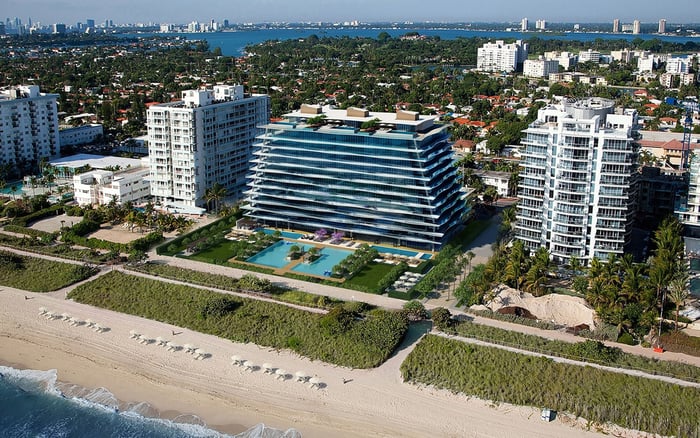
At Fendi Château Residences, the first-year association cash requirement may extend beyond 12 monthly fees. This buyer-focused analysis separates recurring dues from any confirmed capital contribution, reserves, assessments, taxes, insurance, and closing cash.

At Fendi Château Residences Surfside, the acquisition price is only one component of the liquidity required to close on a residence and carry it through the first year. The 58-unit oceanfront condominium was originally marketed with residences priced from $6 million to $25 million. Even at this level of the market, however, association obligations warrant line-by-line scrutiny.
The central distinction is timing. Monthly association fees are recurring obligations. A capital contribution or working-capital payment, when required by the governing documents, is an upfront association obligation that may be due at closing. Combining the two into a single annualized percentage can obscure how much cash must be available on day one.
The first-year number should separate recurring dues from every upfront association obligation.
This distinction is especially relevant in the resale market, where listing figures may lag behind a current budget, an adopted fee schedule, or an owner ledger. A polished offering presentation can provide useful orientation, but it is no substitute for the documents governing the residence and association.
Listed fees illustrate why a unit-specific calculation matters. Unit 303 carried a monthly association fee of $9,283, equal to $111,396 over 12 months. Unit 901 showed $8,899 per month, or $106,788 annually. Unit 1004 showed monthly maintenance and common charges of $9,757, equal to $117,084 per year.
A building-level figure of approximately $2.88 per square foot per month can serve as an initial screening tool. Applied to a hypothetical 3,000-square-foot residence, it yields an estimated monthly fee of $8,640 and an annual total of $103,680. It should not, however, replace the current charge for the residence under consideration. The listed unit examples differ materially, and the actual allocation may reflect the condominium’s governing structure.
That discipline applies across Surfside’s rarefied condominium landscape. Buyers comparing Arte Surfside, The Surf Club Four Seasons Surfside, and Fendi Château should evaluate each association independently. Shared geography and luxury positioning do not make their fee structures interchangeable.
A universal capital-contribution requirement for Fendi Château has not been established through a building-wide schedule. Any assumption expressed as a number of monthly fees is therefore a planning scenario, not a confirmed obligation. The declaration, association records, current fee schedule, and unit-specific estoppel must determine whether a payment applies and, if so, in what amount.
Unit 303 provides a useful illustration. If a contribution equaled two months of its listed $9,283 fee, the upfront amount would be $18,566. At three months, it would be $27,849. Adding those hypothetical amounts to 12 months of listed dues would increase first-year association cash from $111,396 to approximately $129,962 or $139,245.
Those totals exclude acquisition and closing costs, property taxes, owner insurance, special assessments, and residence-level expenses. Nor do they confirm that either contribution applies. The point is to show how a seemingly compact clause in the fine print can alter closing liquidity without changing the recurring monthly fee.
For an affluent buyer, this is less a question of affordability than of capital coordination. Funds may need to be positioned before closing, particularly when the purchase coincides with portfolio transactions, renovations, furnishings, or another residential acquisition.
Under Florida’s Chapter 718, condominium associations must adopt annual budgets covering estimated revenues, operating expenses, and applicable reserve funding. Buyers should distinguish ordinary operating costs from reserve contributions intended for major capital expenditures and deferred-maintenance components.
Association funds must be maintained in the association’s name. Operating and reserve funds may be combined for investment only when separately accounted for, and the combined account cannot fall below the amount identified as reserve funds. These rules make the budget structure, reserve treatment, and association records central to due diligence-not administrative background.
A capital contribution should not be interpreted as protection against future increases or assessments. It is one input into the association’s finances. Reserve balances must be considered alongside planned work, adopted budgets, board disclosures, and any existing or contemplated special assessment.
The same analytical rigor belongs in broader buyer’s guides to branded residences. Brand prestige may shape design, service, and identity, but it does not explain how an association allocates operating costs, funds reserves, or charges an incoming owner.
A practical worksheet begins with purchase and closing cash, then adds 12 months of the residence’s current association fee, any confirmed capital contribution, disclosed special assessments, property taxes, insurance, and unit expenses. Each item should remain on a separate line so its timing and purpose remain clear.
Property taxes should not be folded into association dues. They are distinct owner expenses, just as insurance and private residence costs are separate from common charges. Keeping them separate also allows a buyer to distinguish cash due at closing from costs payable later in the first year.
For perspective, the listed annual association totals across Units 901, 303, and 1004 range from $106,788 to $117,084 before additional ownership costs. The difference between the lowest and highest examples is $10,296 annually. That spread alone supports using the selected residence’s current figure rather than a generalized building estimate.
A nearby option such as Ocean House Surfside may invite comparison, but the analysis should remain document-specific. The relevant question is not which building presents the more appealing headline fee. It is what the fee covers, how the budget separates operations and reserves, and what additional cash the incoming owner must contribute.
Before closing, counsel and financial advisers should reconcile the declaration, current association budget, current fee schedule, association records, owner ledger, and unit-specific estoppel. The review should identify the exact recurring charge, any capital or working-capital requirement, unpaid balances, and disclosed special assessments.
The estoppel is especially important because it focuses the inquiry on the selected residence rather than the building in the abstract. The current budget then provides context for operations and reserve funding. Board materials and disclosures can clarify planned projects or financial decisions that may affect future cash requirements.
This document-led approach preserves the pleasure of acquiring a design-forward home while imposing the precision expected of any significant asset purchase. At Fendi Château, the most useful first-year figure is not a broad carrying-cost estimate. It is a dated, unit-specific schedule distinguishing what recurs, what is due upfront, and what remains contingent.
For discreet guidance on South Florida luxury property decisions, connect with MILLION.
If branded residences are on your mind — as a home or as an allocation — we would be glad to share what we are seeing, privately.
Begin a quiet conversationBegin with the selected residence's current monthly association fee and multiply it by 12. Do not substitute a building average for unit-specific documentation.
No. If required, it should be modeled as a separate upfront association obligation rather than part of the 12 recurring payments.
No publicly available building-wide schedule was identified. The governing documents, association records, fee schedule, and estoppel should confirm the actual requirement.
Its listed monthly fee of $9,283 equals $111,396 over 12 months, before any contribution, assessment, taxes, insurance, or other costs.
Two months of its listed fee would add $18,566, bringing illustrative first-year association cash to approximately $129,962.
Three months of its listed fee would add $27,849, bringing illustrative first-year association cash to approximately $139,245.
It is useful for preliminary screening only. The current fee assigned to the specific residence should control the calculation.
No. Property taxes are a separate owner expense and should remain on their own line in the first-year cash schedule.
No. A capital contribution does not eliminate the possibility of fee increases or special assessments.
Review the declaration, current budget, fee schedule, association records, owner ledger, board disclosures, and unit-specific estoppel with appropriate advisers.