A buyer-focused guide to assessing Miami neighborhoods through the lens of school access, daily routing, and after-school logistics, with practical context on Coral Gables, Coconut Grove, Brickell, and Pinecrest-oriented decision-making.

For family buyers in Miami, school quality is only the first screen. The more revealing question is whether a neighborhood can support the full daily sequence: morning departure, arrival window, midday flexibility, pickup timing, and the handoff into sports, tutoring, or supervised care. In a market where one household may be balancing two careers, multiple children, and different campuses, the school run becomes a meaningful part of real estate strategy.
That is why MILLION Luxury advises buyers to evaluate neighborhoods as operating systems, not simply as addresses. A highly regarded school loses practical value if the route depends on congested arteries, cumbersome tower valet patterns, or a transfer that adds friction twice a day. By contrast, a neighborhood with dependable local access, established streets, and realistic after-school options may offer a smoother family life, even when the home search is more competitive.
In Miami-Dade, this calculation is especially important because the best-fit school is not always the closest one. Families often explore public assignment, private options, and transfer opportunities at the same time, which means the home search should be built around the actual school plan rather than assumptions tied to ZIP code alone.
A disciplined evaluation starts with four questions.
First, what school is the home assigned to, and is that the school the family actually intends to use? Transfer flexibility can broaden options, but it can also lengthen both drop-off and pickup. A home that appears convenient on paper may prove less so once the real campus decision is made.
Second, how complicated is the route? Families should examine whether the trip relies on major choke points, dense commercial corridors, or buildings with slow curbside circulation. In vertical districts, even leaving the garage can affect punctuality. Buyers considering urban inventory such as 2200 Brickell or Una Residences Brickell should think beyond the residence itself and ask how the district performs during morning departure and afternoon pickup windows.
Third, what happens after the final bell? For many families, supervised after-school programming can change the viability of a neighborhood because it reduces the pressure of an early pickup and creates a buffer for work schedules, traffic, and extracurricular transitions.
Fourth, how weather-sensitive is the route? Miami’s rain patterns and storm season can quickly disrupt travel time. A school trip that works comfortably on a clear morning may feel very different when streets are slick, curb access tightens, and afternoon thunderstorm conditions compound congestion.
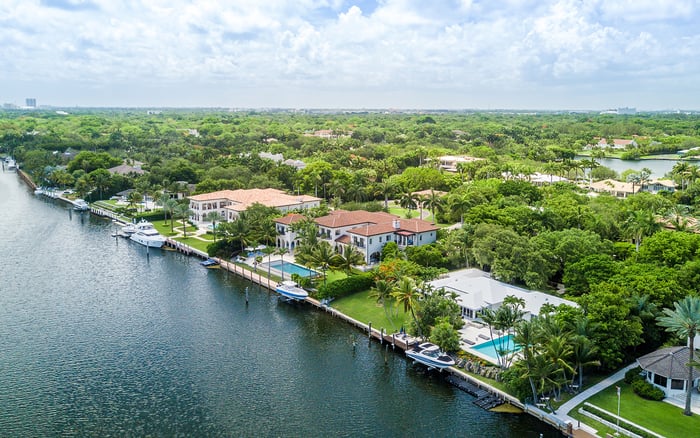
Coral Gables remains one of the clearest examples of a neighborhood where physical form supports family routine. It is widely regarded as family-oriented, with established school access and stronger walkability than many newer urban districts. Its sidewalk network and local street infrastructure also matter in practical terms: a route that can include a short walk, stroller movement, or bike-assisted portion often feels materially easier than one that requires a full car sequence every time. Buyers drawn to the area often explore residences such as Ponce Park Coral Gables and The Village at Coral Gables because the broader setting aligns with a more traditional family cadence.
Coconut Grove offers a different but equally compelling pattern. It is one of Miami’s more established family neighborhoods, strengthened by access to schools, parks, and after-school activity options. For households that want a residential atmosphere without feeling removed from the urban core, the Grove can offer a useful middle ground. Buildings such as Arbor Coconut Grove and The Well Coconut Grove sit within a neighborhood context that many families find easier to integrate into school and activity scheduling.
Brickell is different. It remains one of Miami’s premier luxury districts, but family buyers should approach it realistically. The neighborhood’s dense urban setting generally offers fewer immediate K-12 options than more traditional family areas, so many households rely on schools outside the district and plan for longer car commutes. That does not disqualify Brickell for families, but it does change the screening criteria. In Brickell, the question is less about whether the home is exceptional and more about whether the daily route is sustainable.
Pinecrest and the Palmetto area continue to attract strong interest from buyers who place public-school reputation near the top of the brief. In practical terms, those areas are often pursued because easier local access can support more consistent routines. That can make them especially appealing for family-oriented home searches where the school decision is central to the purchase.
Many buyers underestimate the difference between an early dismissal and a managed late-afternoon finish. On-site after-school care, tutoring, and recreation can transform a neighborhood from merely acceptable to highly functional. It creates margin for meetings, sibling scheduling, and the unpredictability of Miami traffic.
This is particularly relevant for buyers comparing a more walkable neighborhood against a glamorous but logistically demanding one. If one school offers dependable on-campus after-school coverage while another requires an exact pickup window, the choice affects not just the child’s schedule but the household’s entire rhythm.
For condominium buyers, this analysis should be attached to the residence from the beginning. A beautifully finished home in a district with daily pickup friction may suit a different stage of life better than a family in active school years. That is true whether one is comparing urban inventory in Brickell or more family-centric choices in Coral Gables, Coconut Grove, or Pinecrest.
The most effective approach is to score each neighborhood on six lived factors: assigned-school confidence, alternative-school feasibility, route simplicity, after-school coverage, weather resilience, and long-term adaptability. This last point matters. School capacity, roadway work, and local development can all change how a route performs over time, so buyers should assess not only today’s convenience but the likelihood that daily patterns remain manageable.
Families should also benchmark school options carefully before making a final purchase decision. Ratings can be useful for comparison, but they work best as an opening screen rather than a substitute for assignment verification and route testing. In practice, the best buying decisions come from pairing school research with repeated neighborhood visits during real drop-off and pickup hours.
That is where luxury buying becomes more nuanced. The premium is not only for architecture, finish, or prestige. For many households, value is found in reduced daily friction: a simpler morning, a less stressful pickup, a neighborhood that absorbs routine gracefully.
How important is school assignment versus school rating? Both matter, but assignment determines what is actually accessible from the home and how the daily route will function.
Can a strong school still be inconvenient for family life? Yes. A well-regarded campus may still create stressful routines if the commute is long or pickup windows are tight.
Why do families often favor Coral Gables? Coral Gables is often valued for established streets, walkability, and a neighborhood form that supports smoother school routines.
Is Coconut Grove a practical choice for school-age children? Often, yes. Coconut Grove combines a residential feel with access to schools, parks, and after-school activities.
What should Brickell buyers watch most carefully? Brickell buyers should test the actual school route and building circulation, since many families rely on schools outside the immediate area.
Why is after-school planning so important? It can extend the day to a more manageable schedule and reduce the pressure of an early, exact pickup.
Does weather really affect school commutes that much? Yes. Rain and storm season can materially change timing, curb access, and traffic patterns across Miami.
Why do Pinecrest-area homes appeal to family buyers? They are often associated with school-focused searches and routines that may feel easier to manage day to day.
Should buyers rely on online school comparisons alone? No. They are useful for screening, but route testing and assignment confirmation are essential before committing.
What is the best way to shortlist comparable options for touring? Start with location fit, delivery status, and daily lifestyle priorities, then compare stacks and elevations to validate views and privacy.
When you're ready to tour or underwrite the options, connect with MILLION Luxury.
If branded residences are on your mind — as a home or as an allocation — we would be glad to share what we are seeing, privately.
Begin a quiet conversation