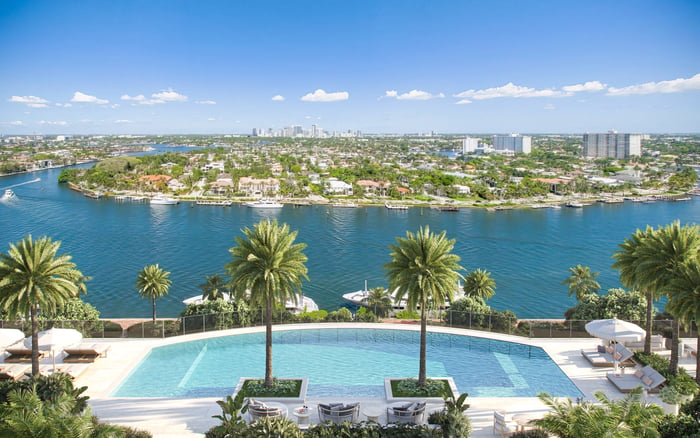
Viceroy Brickell’s advertised riverfront access invites a closer look at the documents behind the lifestyle. Buyers should distinguish views, physical connections, recorded rights, and off-site privileges before committing.

The appeal of Viceroy Brickell extends beyond the apartment door. At 77 SE 5th Street, Miami, FL 33131, the project sits within One Brickell, at the gateway of Brickell Avenue and the Miami River. Its advertised combination of water and skyline views, direct riverfront-promenade access, and an off-site beach-club membership offers a compelling lifestyle proposition.
For a discerning purchaser, however, the question is not simply whether a connection exists. It is what authorizes that connection, who may share it, and which conditions govern its use. A view, a physical route, and an enforceable access right warrant separate consideration.
Buying a condominium rather than a freestanding estate does not diminish those distinctions. Ask advisers to connect the experience being offered with the boundaries, instruments, and operating arrangements that support it. This is not an allegation of a defect or access dispute. It is a way to define precisely what the buyer is valuing.
Direct access to the Miami Riverfront Promenade is an advertised feature at Viceroy. It is meaningful, but “direct” is not a substitute for “exclusive,” “privately owned,” or “unconditional.” Examine each question separately rather than treating a seamless walk to the river as the complete answer.
Ask counsel to identify the promenade’s ownership, the instrument authorizing residents’ access, and the parties entitled to use the relevant route. Does access attach to unit ownership? Are tenants, guests, and invitees included? Is the route subject to hours, closures, relocation, or other restrictions? These are questions for document review, not established Viceroy conditions.
The same distinction belongs in a comparison with Baccarat Residences Brickell. Rather than inferring equivalent rights from an appealing setting, request a separate explanation for each property under consideration. The objective is not to rank marketing language, but to compare the rights supporting the buyer’s intended use.
Begin with identity. Use 77 SE 5th Street as the building address, then ask the closing team to reconcile the contract’s legal description with the condominium documents and relevant survey materials. An address is the starting point for that exercise, not its conclusion.
Frame the survey discussion around practical questions. Where does the condominium property end relative to the promenade? Where are the intended pedestrian and vehicular routes shown? Do those routes cross a separately controlled parcel? Which recorded instruments should be read alongside the depicted boundaries?
Ask the surveyor, title professional, and counsel which materials are appropriate for the transaction. Do not assume every condominium purchase calls for the same survey scope. Request an explanation of any route essential to the purchase decision in both spatial and documentary terms.
An annotated plan paired with the instruments counsel considers relevant is a useful review deliverable. It gives the buyer a concrete question to ask: does the path shown during the visit correspond to the access right described in the documents? Do not infer an encroachment, boundary conflict, or missing easement merely because the question warrants attention.
Ask counsel to identify the beneficiaries of any applicable pedestrian easement. Does its language include unit owners, occupants, guests, or invitees? Does it also authorize use by a shared-facilities owner, employees, or contractors? These are review questions, not descriptions of Viceroy’s arrangements.
Beneficiary language deserves careful reading. Ask who can use an access area, for what purposes, and under whose authority. If an applicable instrument uses “non-exclusive,” have counsel explain precisely what that means for the contemplated purchase. Do not translate it automatically into either unrestricted public use or residents-only privacy.
Maintenance and decision-making deserve equal attention. Who would maintain the route? Who would allocate costs, approve changes, or address an interruption? Could the arrangement be amended or terminated, and whose consent would be needed? At Viceroy, those answers require review of the applicable documents, not an analogy to another building.
Waterfront descriptions and controlled-entry features address different aspects of a residence. Neither a waterfront label nor a key-card system, by itself, establishes recorded access rights or residents-only control of the promenade.
During a visit, follow the journeys that matter to your household: arrival from the street, movement between parking and the residence, a guest’s entrance, and the walk toward the river. Ask which doors or gates are controlled, who operates them, and where the building’s security boundary differs from a shared or external route.
If Cipriani Residences Brickell is also on the shortlist, use the same arrival questions there without presuming the properties share an access structure. A consistent inspection brief provides a more useful basis for comparison than an impression of privacy formed during a single appointment.
Complimentary membership to Grand Bay Beach Club in Key Biscayne is an advertised Viceroy benefit. For a buyer who values time away from the city, it merits a separate review rather than being folded into the riverfront-access discussion.
Ask for the membership terms and the document identifying the beneficiary. How long does membership last? Does it transfer on resale? May tenants or guests use it? Are there charges beyond membership, reservation conditions, or circumstances permitting suspension or termination? The advertised benefit alone does not establish these details.
Keep the categories distinct: views, on-site routes, recorded access rights, and off-site privileges. For each, identify the supporting document, eligibility, restrictions, costs, and amendment provisions. This prevents an attractive amenity package from being treated as a single permanent entitlement.
Before committing, ask your advisers for a concise written explanation of any access feature material to your decision. Prioritize the relationship between survey boundaries and recorded instruments, the permitted users of essential routes, any applicable shared-cost obligations, and the terms of the beach-club benefit.
If an answer remains unresolved, discuss its significance with counsel within the transaction’s contractual timetable. The aim is not to demand exclusivity where none has been promised. It is to avoid paying for an assumption about privacy, convenience, continuity, or control.
Viceroy’s advertised riverfront connection can remain central to its appeal while receiving disciplined scrutiny. The strongest purchase decision aligns the lifestyle expectation with the documented rights.
For a discreet conversation about evaluating South Florida residences, connect with MILLION.
If branded residences are on your mind — as a home or as an allocation — we would be glad to share what we are seeing, privately.
Begin a quiet conversationViceroy Residences Brickell is at 77 SE 5th Street, Miami, FL 33131. Ask the closing team to reconcile the contract’s legal description with the applicable condominium documents.
Yes, direct access to the Miami Riverfront Promenade is an advertised amenity. That statement alone does not establish ownership, exclusivity, or all conditions of use.
Residents-only access is not established here. Ask counsel to identify the relevant ownership and access instruments and explain who may use the route.
Ask whether relevant survey materials clarify property boundaries and the location of important access routes. Your advisers should determine the appropriate scope for the transaction.
No, a key-card system alone does not establish residents-only rights to the promenade. Ask which access points it controls and review the applicable access instruments.
No, waterfront descriptions should not be treated as recorded access instruments. Have counsel identify the documents supporting any access feature material to your purchase.
Do not assume that it does. Ask counsel to explain the permitted users, purposes, and restrictions in the instrument applicable to the purchase.
Ask who maintains essential routes, how any applicable costs are allocated, and who can approve changes. These are questions for document review, not verified Viceroy obligations.
Viceroy advertises complimentary membership to Grand Bay Beach Club in Key Biscayne. Buyers should separately review duration, transferability, eligibility, and any additional charges.
No defect or access dispute is established. The article identifies diligence questions intended to align the buyer’s expectations with the applicable documents.