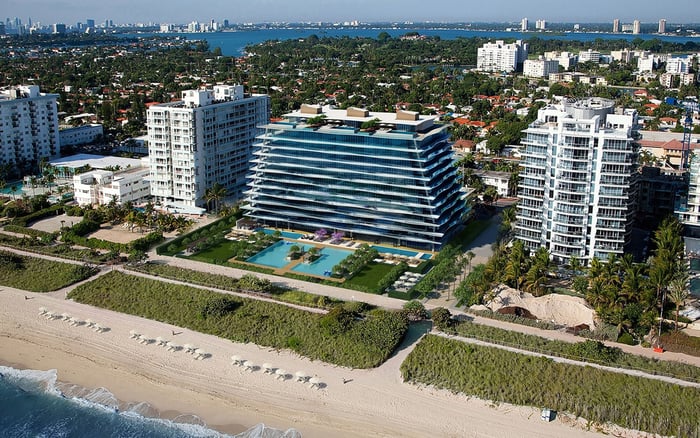
In Surfside, the sliding glass door is not a decorative afterthought. It is a primary building-envelope decision that determines comfort, durability, insurance posture, and day-to-day livability. This editorial examines what “efficiency” really means for hurricane-impact sliding glass doors in a luxury coastal residence and how a buyer can evaluate performance without relying on marketing shorthand. Rather than assume a single metric, we break efficiency into four buyer-relevant categories: storm resilience, air and water management, acoustic calm, and operational longevity. We also outline practical questions to ask during a purchase process and what to look for in drawings, specifications, and mockups when available.

In a coastal market like Surfside, the view is only half the story. The other half is the performance of the opening that frames it. For ultra-premium buyers evaluating The Delmore Surfside, hurricane-impact sliding glass doors sit at the intersection of architecture and risk management: they’re among the largest glazed openings in the residence, they face constant salt exposure, and they’re expected to deliver opposing outcomes at once. They should feel nearly weightless day to day, yet perform as a hardened barrier when conditions deteriorate.
In South Florida, buyers often treat “impact” as a binary pass-fail box. In reality, two impact-rated systems can produce very different results in comfort, energy behavior, air tightness, water management, and long-term serviceability. When an opening functions as a wall of glass, those differences stop being theoretical-they become your daily baseline.
For sliding doors, “efficiency” is best evaluated as a composite across four disciplines. Each influences resale value and the lived quality of a home, especially in Oceanfront product.
Impact resistance is essential, but the buyer’s lens should widen: how does the full assembly behave under wind pressure, wind-driven rain, and repeated cycling? Efficiency here includes structural stiffness (minimizing deflection), dependable lock engagement, and the ability of frames and interlocks to stay aligned as the building moves. Large panels can be engineered to meet demanding criteria, but engineering is only part of the outcome. Installation tolerances, anchoring details, and water pathways are inseparable from performance.
In South Florida, air leakage isn’t an abstract lab concept. It’s the draft you feel at the track and the humidity load your HVAC must remove. A tighter sliding system reduces that burden and supports steadier interior conditions-especially relevant for art, millwork, and high-end finishes.
Water management is just as practical. A door can perform well in wind-driven rain testing and still create nuisance issues if the track does not drain efficiently, if weep paths clog, or if the threshold detail isn’t coordinated with balcony drainage. For a buyer, efficiency is the quiet absence of towels on the floor during summer squalls.
Surfside sits between the ocean’s constant broadband sound and the intermittent spikes of street activity. Acoustic efficiency is what allows a residence to feel resort-like at midnight-not merely photogenic at noon. Sliding doors are often the soft point in the acoustic envelope because large moving panels require joints, brushes, and seals.
If you’re comparing coastal benchmarks, pay attention to how different buildings deliver the “quiet view.” In Surfside, properties such as Ocean House Surfside and Arte Surfside tend to attract buyers who value privacy and calm; doors that glide beautifully but transmit too much exterior noise can erode that expectation.
A sliding glass door is a moving machine. Rollers, tracks, interlocks, multi-point locking, and handle sets must hold up under frequent use in a corrosive environment. Efficiency includes how little effort operation requires over time-and how consistent the door feels year after year.
This is where luxury buyers benefit from being unromantic. “It feels smooth today” is not the same as “it will feel smooth after years of salt air.” Ask how rollers are protected, how the track sheds debris, and how hardware can be accessed for service without dismantling finishes. The most elegant solution is the one designed to be maintained.
Even when a development’s final procurement isn’t fully disclosed during evaluation, you can still gauge the seriousness of the door strategy by requesting a few categories of information. The goal isn’t to micromanage a manufacturer choice; it’s to confirm the building-envelope approach is coherent.
Request standardized test results for air infiltration, water penetration resistance, and structural performance under design pressures, along with the exact configuration tested. “Impact-rated” alone is not enough, because efficiency is as much about leakage control and deflection behavior as it is about debris resistance.
Where materials emphasize floor-to-ceiling glass, remember that size and configuration drive outcomes. A large multi-panel opening can behave very differently than a smaller slider, even if both are impact products.
If a physical mockup is available, spend time with it. Check panel alignment, gasketing quality at meeting rails, and seal continuity around the perimeter. Listen as well: close the door slowly and note the final latch engagement. A precise, confident closure often signals a well-resolved system.
On the drawing side, ask for typical head, jamb, and sill details. The sill is the “truth serum” condition. When water has a clear drainage path and the threshold is coordinated with balcony slope and waterproofing, the system typically performs better in the real world.
In high-end homes, the door is handled dozens of times per week. Efficiency is partly ergonomics: a handle that feels right, a lock that engages cleanly, and a glide that remains consistent.
Ask whether doors are configured with multi-point locking and how the lock sequence interacts with panel movement. Confirm whether the design anticipates seasonal building movement and whether adjustment points remain accessible for alignment over time.
It’s tempting to assume “better glass” automatically translates to dramatic shifts in electric bills. In practice, energy performance depends on glass coatings, spacer technology, frame design, and air tightness-and also on orientation, shading, and the HVAC strategy. In Surfside, solar gain and humidity control can be as consequential as insulation value.
You can still evaluate energy-minded design without leaning on buzzwords:
Ask whether glazing selections are coordinated with solar exposure and balcony shading.
Ask whether the overall envelope strategy supports stable humidity control.
Watch condensation risk: in a humid climate, thermal bridging at frames and tracks matters.
If your lifestyle includes leaving doors open frequently, even the best door system cannot outperform that habit. The most efficient system is the one that supports the way the home is meant to operate: sealed when conditioning, open and breezy when weather allows.
Surfside’s luxury corridor carries a specific expectation set: privacy, thoughtful security, and the sense that a building is designed for long-term ownership-not quick turnover. Door performance is part of that identity.
For buyers cross-shopping, it can help to compare design intent across nearby Oceanfront peers. Fendi Château Residences Surfside has helped define a brand-forward, detail-conscious standard in the area; regardless of aesthetic preference, the expectation it reinforces is that everyday touchpoints should feel composed.
Similarly, in adjacent Bal-harbour, buildings such as Rivage Bal Harbour draw buyers who care as much about quiet, climate stability, and finish preservation as they do about views. That buyer profile tends to interrogate glazing, seals, and maintenance pathways early, because replacement cost-and the disruption of a problematic door system-can be significant.
Without drama, this shortlist separates a door system that performs from one that merely photographs well.
What is the maintenance plan for tracks, rollers, and drainage paths? If the answer is vague, efficiency will degrade.
How will the building manage salt exposure on exterior hardware and finishes? Coatings and material selection matter.
Is there a clear pathway for service calls that does not damage interior finishes? Access is a design choice.
How are balcony thresholds coordinated with waterproofing and drainage? This is where small errors become recurring nuisances.
What is the intended user experience for large openings? If doors are enormous, ask how they’re made to feel effortless.
In a luxury residence, the ultimate test isn’t a single hurricane season. It’s whether the door system stays quiet, tight, and graceful through daily cycles and years of coastal exposure.
If you want a buyer-oriented hierarchy, prioritize in this order:
First, confirm storm and water management are engineered as a system, not a label. Second, insist on air tightness and acoustic composure, because these define livability. Third, evaluate operational longevity-including service access and hardware quality-because this defines the ownership experience.
When those priorities align, hurricane-impact sliding doors stop being a compromise. They become what they should be in Surfside: a refined interface between the interior and the Atlantic that performs quietly, day after day.
What makes a hurricane-impact sliding door “efficient”? Efficiency blends storm resistance with low air leakage, good drainage, and smooth long-term operation.
Is “impact-rated” the same as “waterproof”? No. Impact addresses debris resistance; water control depends on thresholds, seals, and drainage design.
How can I evaluate performance without technical jargon? Ask for tested ratings for air and water infiltration and review sill and jamb details for drainage paths.
Why do tracks matter so much in coastal condos? Tracks collect salt and debris; if they clog or corrode, glide quality and sealing performance degrade.
Do larger glass panels reduce performance? Not necessarily, but larger panels demand more robust frames, interlocks, and precise installation.
Will better sliding doors noticeably reduce noise? They can, especially with tighter seals and better glazing, but acoustics are a whole-envelope outcome.
Can efficient doors help with humidity control? Yes. Lower air leakage reduces humid air infiltration, helping HVAC maintain stable interior conditions.
Should I prioritize multi-point locks on sliders? Often, yes. They can improve security and seal engagement when properly engineered and maintained.
What’s the biggest red flag during a walkthrough or mockup visit? A door that requires force to latch or feels misaligned, which can signal long-term adjustment issues.
How should I think about door efficiency when buying in Surfside? Treat it like a core building system: it protects finishes, comfort, and peace of mind in Oceanfront living.
For a tailored shortlist and next-step guidance, connect with MILLION Luxury.
If branded residences are on your mind — as a home or as an allocation — we would be glad to share what we are seeing, privately.
Begin a quiet conversation