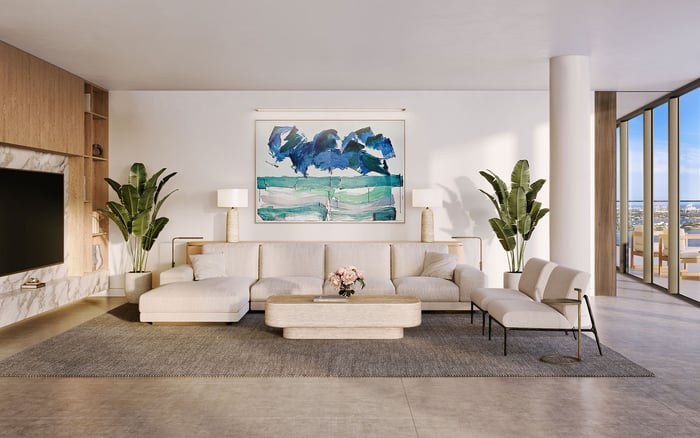
For an Edgewater residence intended to function seamlessly between visits, wellness branding is only the opening proposition. Buyers should test amenity capacity, operating rules, air and water systems, remote-care protocols, and real-world medical routes before committing.

A lock-and-leave residence in Edgewater should do more than look composed when its owner returns. It must remain protected, conditioned, serviced, and ready for use throughout extended absences. For second-home buyers, management protocols can therefore matter as much as views, finishes, and shared amenities.
Begin by separating marketing language from written obligations. Establish who monitors leaks, HVAC performance, and indoor humidity; who may enter during an emergency; how packages are stored; and how approved vendors gain access. Hurricane preparation, post-storm inspections, emergency contacts, and reporting procedures should also be documented. A staffed desk is not a substitute for a defined remote-ownership program.
This distinction is particularly important when evaluating a new development. Determine which systems are proposed, which are included in governing or operating documents, which have been commissioned, and which have been independently tested.
Wellness space has value only when residents can use it at the desired time. Assess each sauna, steam room, treatment room, cold plunge, studio, and pool as an operating service. Request hours, resident-to-facility ratios, daily capacity, cleaning intervals, supervision standards, planned closures, and equipment-downtime procedures.
When comparing options such as EDITION Edgewater, Cove Miami, and Lilli Miami Edgewater, apply the same capacity test to each property. Buyers should obtain written answers about booking, guest eligibility, staffing, fees, cancellations, maintenance interruptions, and any holiday restrictions rather than relying on an amenity list alone.
For pools and fitness areas, practical access matters more than headline features. Confirm operating hours, reservation requirements, guest policies, cleaning schedules, lane or equipment availability, and procedures during maintenance closures.
Shared amenities can become scarce when reservation rules are restrictive. Obtain the current or proposed operating plan for spa treatments, guest suites, private offices, shared work areas, and fitness sessions. Confirm advance-booking windows, duration limits, fees, cancellation penalties, recurring-reservation policies, and the number of simultaneous bookings permitted per residence.
Guest privileges deserve equal scrutiny. Can an owner authorize a visitor while away? Must the owner be present? Are overnight guests registered differently from treatment or office guests? Written rules should also clarify access control, staffing, unit-management options, and the division of responsibility among the owner, management, and association.
“Purified air” is not sufficiently specific for due diligence. Request filter-efficiency ratings, outdoor-air delivery information, equipment locations, replacement intervals, monitoring methods, warranties, service contracts, and the party responsible for ongoing costs. Most importantly, identify the boundaries of coverage. Treatment in corridors or common areas does not necessarily establish conditions inside a residence.
Ask how the system’s performance will be verified after commissioning and how residents will be notified of outages or maintenance. In-unit HVAC equipment, humidity management, filter access, replacement responsibilities, and service availability should be reviewed separately from common-area systems.
Central water treatment may be valuable, but its scope must be explicit. Request system specifications, commissioning records, testing procedures, maintenance schedules, service contracts, redundancy plans, and anticipated association costs.
Confirm whether treatment reaches pools, spas, hot tubs, ice machines, kitchens, and every residential fixture. Ask what happens during servicing or failure, how residents are notified, who reviews test results, and whether point-of-use filtration remains advisable. In an unfinished building, distinguish design intent from delivered, commissioned, and independently tested infrastructure.
Medical access requires a practical review. Identify at least two emergency-care options and test the routes from the building during the times the owner is most likely to need them. Confirm how building personnel handle emergency responders, elevator access, guest registration, and entry to an unoccupied residence.
Remote-care planning should address emergency contacts, authorized entry, privacy, key or credential management, and communication with an owner’s designated representative. Owners who rely on particular physicians or specialists should test those routes personally rather than depend on generalized neighborhood descriptions.
Before signing, assemble a written schedule covering amenity capacity, booking rights, guest eligibility, air and water specifications, maintenance responsibilities, remote monitoring, storm response, and medical-access procedures. Review condominium documents, budgets, management agreements, and proposed operating plans together. The strongest lock-and-leave proposition is not necessarily the building with the longest amenity list; it is the one whose systems, staffing, rules, and costs remain coherent while the owner is elsewhere.
What is the first lock-and-leave document to request? Request written remote-ownership protocols covering alarms, access, packages, storms, inspections, and emergency contacts.
How should buyers compare wellness capacity? Compare household ratios, daily throughput, hours, reservation requirements, cleaning intervals, and expected downtime.
Are advertised spa facilities guaranteed to be available? Availability should not be assumed. Confirm operating hours, staffing, booking windows, fees, cancellation rules, guest rights, and holiday restrictions in writing.
What should an air-quality review include? Verify filtration efficiency, outdoor-air delivery, coverage areas, monitoring, replacement frequency, service costs, and in-unit conditions.
What documentation supports a central water-treatment claim? Request specifications, commissioning records, recurring test procedures, maintenance schedules, redundancy plans, warranties, and a clear coverage map.
Should pools and ice machines be included in the water review? Yes. Ask whether treatment extends to pools, spas, hot tubs, ice machines, kitchens, and residential fixtures.
Why do guest rules matter for an absentee owner? They determine whether authorized visitors can use shared spaces or gain access while the owner is away.
What booking terms deserve close attention? Review advance windows, duration limits, fees, cancellation penalties, recurring reservations, and per-residence booking limits.
How should buyers assess emergency entry procedures? Confirm who may authorize access, how credentials are controlled, how the owner is notified, and how emergency responders reach the residence.
How should buyers verify medical access? Test routes to at least two emergency-care options and confirm responder access, elevator procedures, and emergency-entry protocols.
To compare the best-fit options with clarity, connect with MILLION.
If branded residences are on your mind — as a home or as an allocation — we would be glad to share what we are seeing, privately.
Begin a quiet conversation