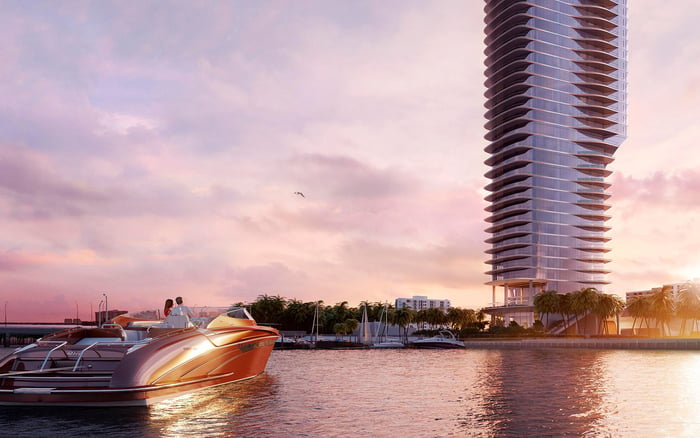
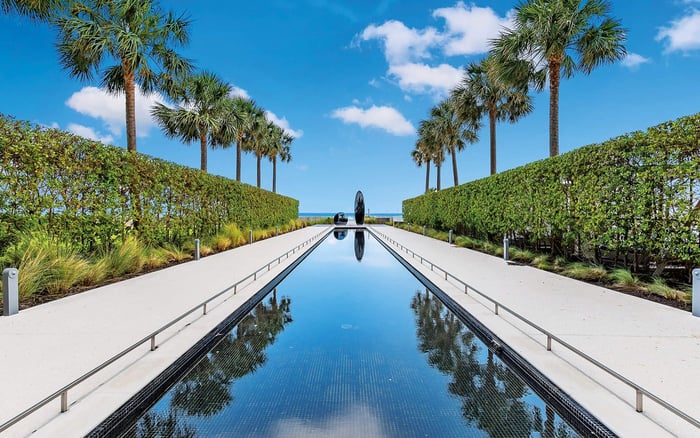
For Boston buyers establishing a Key Biscayne base, the decisive travel detail is not simply the flight. Airport selection, causeway timing and a verified after-hours arrival plan should inform both the itinerary and the property search.

For a Boston buyer establishing a South Florida base, Key Biscayne should be evaluated against the rhythm of actual use: a Thursday evening arrival, a working Friday, a family weekend and a return north. The right residence must fit that calendar as comfortably as it fits a design brief.
The meaningful measure is not airborne time alone. It is the complete journey from departure in Massachusetts to entry into the home, including airport handling, ground transportation and the final crossing along the Rickenbacker Causeway. Airport choice and property choice belong in the same conversation.
When evaluating Oceana Key Biscayne, ask for the building's actual after-hours arrival procedures rather than assuming what the residential experience includes. A clear entry protocol is a practical complement to the qualities that first attract a buyer.
Miami International Airport, MIA, is the principal commercial-travel option in this comparison. It operates around the clock and handles international arrivals, but congestion can affect ramps and ground access during busy periods. It has no hard nighttime curfew, although noise-abatement procedures and preferential runway use apply.
Private-flight options from the Boston area include Hanscom Field, BED, and Norwood Memorial, OWD, with Miami-Opa Locka Executive, OPF, and Miami Executive Airport, TMB, among the South Florida arrival choices. Ask the operator to assess the departure airport, aircraft and arrival arrangements together rather than selecting each independently.
OPF has an 8,000-foot runway and three fixed-base operators, or FBOs. These are useful operational details, not proof of the quickest journey to Key Biscayne. A roughly 30-minute access estimate for Brickell or Miami Beach should not become a promise for an island transfer.
For each viable airport, request a residence-specific ground-transfer estimate for the intended day and arrival window. Compare handling arrangements, pickup location and likely road conditions alongside the flight schedule. These facts do not establish any airport as universally fastest.
An airport's ability to receive aircraft does not mean every supporting service will be available when needed. For an evening arrival, have the operator and FBO confirm flight-specific arrangements, including handling and the passenger-to-driver handoff.
For an itinerary involving international arrival at TMB, historical screening hours warrant particular care. A service extension announced July 3, 2019, set hours until midnight Thursday through Monday, while Tuesday and Wednesday service ended at 7 p.m. Those historical hours are not a current operating commitment; do not base a booking on them without confirmation.
A direct Boston arrival and an arrival following an international leg require different planning. Confirm the requirements for the actual routing. Recheck relevant service hours and pickup arrangements on travel day, especially if the expected arrival time changes.
The Rickenbacker Causeway provides road access to Key Biscayne, making its conditions central to the airport-to-residence calculation. The principal congestion concerns involve peak seasons, weekends, special events and departing beach crowds, rather than ordinary weekdays alone.
Major traffic jams in March 2025 prompted residents to seek stronger action. Outside peak periods, however, travel toward Key Biscayne has generally been problem-free. Both points matter: the crossing deserves planning, but a difficult peak-period experience should not define expectations for every arrival.
Ask for a transfer range rather than one reassuring number. Have the driver reassess conditions before pickup, and avoid scheduling a critical meeting immediately after landing. Identify a mainland fallback, such as a meeting location or overnight option, before a substantial delay forces a decision.
For buyers also considering Una Residences Brickell, compare transfers from the same airport, within the same arrival window, to the exact address. The purpose is to understand how a Brickell base would fit the working week, not to presume that every mainland journey is shorter.
Boston-to-Miami private-flight planning deserves additional lead time in the cooler months. November through January is the strongest southbound demand period, while elevated repositioning activity extends from December through April. These are planning signals, not guarantees of aircraft availability or pricing.
Early-December Art Basel is a particular pressure point. OPF aircraft parking may sell out, making coordination several weeks ahead prudent. Confirm the aircraft plan, parking arrangements and ground transport together rather than treating a flight reservation as the final step.
The Miami Grand Prix period is another potential demand spike that can complicate aircraft positioning and airport access. For important travel dates, ask the operator what happens if the preferred arrival arrangement becomes unavailable.
Empty-leg opportunities can suit a flexible visit, but they depend on aircraft repositioning schedules. That date sensitivity makes them a poor foundation for a fixed executive itinerary. Keep discretionary travel opportunities separate from trips with immovable obligations.
A secure arrival requires a coordinated procedure, not simply a vehicle category. Before departure, connect the operator, FBO, driver and residence team around one agreed plan. For commercial travel, establish the equivalent handoff from terminal pickup to building entry.
Verify the driver's identity, vehicle details and meeting point. Provide passenger information to building security through the residence's approved process, and confirm how entry works after staffed hours. Ask who can resolve an access problem if the flight is delayed beyond the original arrival window.
Reconfirm these details on travel day and communicate material timing changes. These are planning recommendations, not island-wide requirements. An executive vehicle does not itself guarantee security, and there is no basis here for treating rideshare as inherently unsafe. The objective is a verified handoff that everyone understands, with a workable backup.
Before committing, rehearse a representative arrival where practical. Ask management to explain late-night owner access, guest authorization and driver coordination. Distinguish documented procedures from informal assurances, and evaluate the property at the times you expect to use it-not only during a convenient daytime showing.
If the search also includes Coconut Grove, apply the same questions to Park Grove Coconut Grove. A consistent arrival brief makes comparisons meaningful without assuming equivalent staffing, access policies or transfer times across residences.
The strongest purchase decision is one in which the home and the travel plan reinforce each other. For a Boston-based owner, confidence comes from knowing what happens after touchdown, including on evenings when the schedule slips.
For a residence search shaped around your Boston-to-South Florida travel rhythm, connect with MILLION.
If branded residences are on your mind — as a home or as an allocation — we would be glad to share what we are seeing, privately.
Begin a quiet conversationEvaluate MIA for commercial travel and OPF or TMB for private travel. The best choice depends on the flight arrangements and a residence-specific ground-transfer estimate for the intended arrival window.
Options include Hanscom Field, BED, and Norwood Memorial, OWD. Have the operator assess the departure airport together with the aircraft and South Florida arrival arrangements.
MIA operates around the clock and has no hard nighttime curfew. Noise-abatement procedures and preferential runway use still apply.
No. The approximate 30-minute estimate discussed concerns Brickell and Miami Beach, not Key Biscayne; obtain an estimate for the actual residence and travel window.
The July 2019 schedule is historical and requires current confirmation. Do not book an international arrival around those hours without checking the applicable service arrangements.
Peak seasons, weekends, special events and departing beach crowds merit particular attention. Outside peak periods, travel toward Key Biscayne has generally been described as problem-free.
November through January is identified as the strongest southbound demand period, with elevated repositioning activity during December through April. Treat these windows as planning signals rather than availability or pricing guarantees.
Both periods can increase private-aviation demand and complicate logistics. For early-December Art Basel, arrange logistics several weeks ahead because OPF aircraft parking may sell out.
They are date-sensitive opportunities tied to aircraft repositioning. They can suit flexible visits but should not replace a dependable plan for immovable commitments.
Verify the driver, vehicle and pickup point, provide passenger details through the building's approved process, and confirm after-hours entry. Coordinate the operator, FBO, driver and residence team, then reconfirm arrangements on travel day.