At Oceana Bal Harbour, the elevator is more than circulation. Direct residential arrival reshapes privacy, presentation, and the transition from public building to private home, while making unit-specific access details essential to buyer due diligence.

At Oceana Bal Harbour, vertical access shapes the residential experience before the front door enters the conversation. The oceanfront condominium at 10201-10203 Collins Avenue offers private elevator galleries that open directly into residences. Some descriptions use the terms lobby, foyer, or entry, but the underlying proposition remains consistent: arrival is integrated into the home rather than concluding in a conventional shared corridor.
The distinction may appear subtle on a floor plan. In daily life, it can be transformative. Residents move from the building’s shared realm into a controlled threshold with fewer visual encounters, less corridor activity, and a more composed sense of entry. For owners who value discretion, the luxury is not simply speed. It is the removal of an intermediate public space.
Prospective buyers can explore Oceana Bal Harbour as the central expression of this direct-arrival concept, while recognizing that the precise configuration must be evaluated residence by residence.
A private elevator entry is not automatically synonymous with full-floor ownership. Available information confirms private or direct arrival, but it does not establish that every residence occupies an entire floor. Nor does it mean that every elevator, landing, or service route is exclusive to one owner.
The terminology deserves scrutiny. A gallery may function as a designed extension of the residence. A lobby or foyer may be a contained vestibule between the elevator and the interior. An entry may describe a more immediate opening into the living environment. Each can feel private, yet the physical dimensions, door sequence, access permissions, and relationship to neighboring residences may differ.
Most homes have private elevator foyers, service quarters, and private entrances, suggesting that layouts are not necessarily identical throughout the building. Buyers should therefore resist treating a building-wide amenity description as a substitute for the specific floor plan, elevator schedule, and condominium documents governing the home under consideration.
When an elevator opens into a private gallery, the arrival sequence becomes an architectural event. Oceana Bal Harbour residences feature interiors by Piero Lissoni, and ceilings of at least 10 feet support a sense of volume as owners move from the elevator threshold into the home. Standard residences offer up to four bedrooms, while penthouses may have five.
The design opportunity is considerable. Art, lighting, flooring, and sightlines can establish the character of the residence immediately. There is no shared hallway forcing the home’s identity to begin at a conventional door. This is where Design & Architecture becomes operational rather than decorative: circulation, privacy, and presentation work as a single composition.
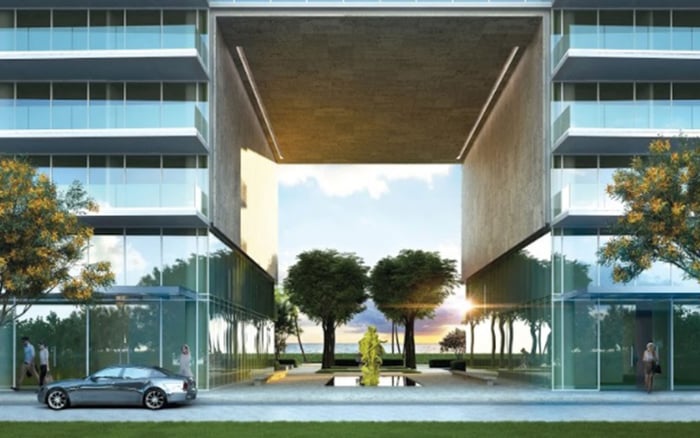
Buyers comparing contemporary coastal ownership may also consider Rivage Bal Harbour, The Delmore Surfside, and Arte Surfside. The relevant comparison is not merely whether a brochure uses the word private, but how each project choreographs the passage from vehicle arrival to residence.
Interior arrival privacy should be distinguished from building security. Oceana’s security features include elevator security, card entry, and secured garage or parking. Those controls are meaningful, but buyers should still establish who can call the elevator, which floors credentials permit, how guests are admitted, and what happens during service, deliveries, or emergencies.
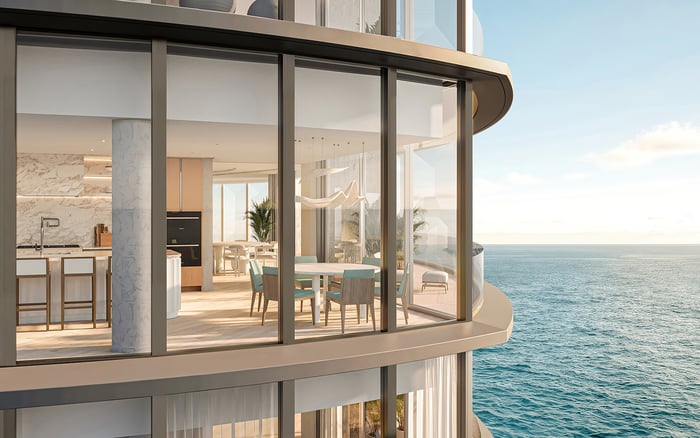
It is equally important to distinguish elevator privacy from exterior seclusion. Large oceanfront terraces, oversized balconies facing multiple directions, and glass walls designed to optimize views create a different privacy equation. Orientation, neighboring sightlines, elevation, and the geometry of adjacent terraces all influence whether outdoor rooms feel exposed or sheltered.
In other words, Oceanfront living can offer a secluded arrival without guaranteeing complete visual privacy at the glass line. Balcony and terrace conditions should be reviewed in daylight from both the interior and exterior edges of the home.
Within a Buyer's Guides approach, the most valuable questions are practical. Request the exact residence floor plan and identify the boundary between common elements and the unit. Confirm whether the elevator opens directly into conditioned residential space, a private vestibule, or a shared landing with controlled access.
Then examine access control. Determine how owner credentials, household staff, guests, vendors, and building personnel reach the floor. Ask whether service circulation is separate, where deliveries pause, and whether service quarters or private entrances are included in the particular layout. Review emergency procedures and clarify whether elevator access changes during fire alarms, storms, maintenance, or power interruptions.
Finally, test the sequence personally. Travel from secured parking or the main entrance to the residence. Note every door, credential point, waiting area, camera, and potential encounter. The best vertical-access plan should feel intuitive in ordinary life, not merely impressive during a showing.
An average list-price reference of $2,889 per square foot provides context for evaluating premium features at Oceana Bal Harbour. It should not be read as a valuation for any individual home. Floor height, orientation, condition, terrace character, layout, and the exact elevator arrangement can all shape a buyer’s perception of value.
Direct arrival is difficult to reduce to a line-item adjustment because its benefit is experiential. It can make a condominium feel more residential, reduce incidental exposure, and give the threshold a level of ceremony typically associated with a private home. For buyers in Bal Harbour, that emotional distinction may be as important as the elevator technology itself.
Do elevators open directly into residences at Oceana Bal Harbour? Residences have private elevator galleries, lobbies, foyers, or entries that support direct residential arrival.
Does a private elevator entry mean the residence occupies a full floor? No. Direct elevator arrival should not be interpreted as proof of full-floor exclusivity.
Are elevator configurations identical in every residence? Buyers should not assume so. Most residences have certain private-entry features, rather than a universally uniform configuration.
What should a buyer verify on the floor plan? Confirm the landing configuration, unit boundary, door sequence, neighboring access, and connection to service circulation.
Is elevator privacy the same as building security? No. Private arrival concerns the residential threshold, while security includes credentials, monitoring, parking access, and operating procedures.
What access features have been identified for the building? Security features include elevator security, card entry, and secured garage or parking.
How should buyers assess guest and staff access? Ask how credentials are issued, which floors they permit, and whether household staff or vendors use separate service routes.
Does direct arrival ensure privacy on terraces? No. Terrace and window privacy depend on orientation, elevation, adjacent sightlines, balcony geometry, and glass exposure.
Why do ceiling heights matter to the arrival experience? Ceilings of no less than 10 feet can make the transition from elevator gallery to interior feel more expansive.
Can elevator privacy affect perceived value? Yes. A controlled, direct arrival can enhance discretion and residential character, although it should be considered alongside layout, views, condition, and terrace exposure.
If you'd like a private walkthrough and a curated shortlist, connect with MILLION.
If branded residences are on your mind — as a home or as an allocation — we would be glad to share what we are seeing, privately.
Begin a quiet conversation