A buyer-focused framework for assessing medical-equipment power, recurring caregiver access, and emergency response at 619 Residences, with an emphasis on unit-specific documentation and enforceable commitments.

For a household that relies on medical equipment or regular caregivers, luxury is measured partly by continuity: equipment that remains usable, caregivers who can arrive without friction, and responders who can reach the residence. At 619 Residences by Foster + Partners + Nobu Hospitality in Brickell, these operational questions deserve the same attention as views, finishes, and service.
For medically necessary features, the evidence must be specific: the selected unit, its electrical infrastructure, its access route, and the rules governing daily use. Obtain current approved plans rather than relying on general project descriptions.
An unconfirmed feature is not necessarily unavailable. It means a buyer should not consider that feature established until the appropriate documents and written commitments confirm it.
A wellness offering does not, by itself, establish an on-site medical clinic or continuous nursing services. Assess any proposed air purification, water treatment, climate controls, or longevity programming separately from the household's clinical requirements.
Medical-gas infrastructure, oxygen storage, dialysis support, a nursing station, and other clinical facilities are not confirmed here. A household requiring these capabilities should assess each need separately rather than infer support from a wellness program.
Begin with a written household brief prepared with the relevant clinicians and equipment providers. Identify devices, operating requirements, storage needs, delivery frequency, and caregiver schedules. This turns a broad question about suitability into specific requirements the project team can address individually. Ask who would provide any proposed clinical service, what access residents would have, and whether the arrangement would be documented separately from residential amenities.
Dedicated circuits and supported loads for ventilators, oxygen concentrators, infusion pumps, hospital beds, medication refrigeration, and dialysis equipment are not confirmed here. Whole-residence generator backup, resident-accessible emergency outlets, battery storage, and automatic-transfer arrangements serving individual units likewise require verification.
The diligence package should include the unit load calculation and panel schedule, emergency-power riser, generator load schedule, automatic-transfer-switch schedule, and life-safety electrical plan. Have an appropriately qualified electrical professional evaluate those documents against the actual equipment requirements. The question is not simply whether a generator exists, but whether the intended device can receive suitable power at its intended location.
Request written identification of any in-unit outlets that remain powered during an outage, their supported loads, and whether medical devices may use them. Ask the technical team to explain transfer behavior and operating limitations. Separately, clarify permissions for dedicated-circuit installation, batteries, oxygen cylinders, medical gases, and equipment delivery through common areas.
Apply the same unit-specific test to a Brickell shortlist that includes The Residences at 1428 Brickell. This is a comparison standard, not an assertion that another property provides medical backup.
Ask the electrical professional to identify applicable permitting and code requirements, including generator exhaust, fuel protection, emergency shut-off, and emergency-personnel signage. General generator documentation does not establish medical-equipment capacity inside a residence. Confirm the applicable permitting authority before treating general requirements as a project-specific compliance determination.
Arrival amenities do not establish dedicated caregiver spaces, overnight caregiver permits, or a separate caregiver entrance. Verify the availability and terms of valet parking, self-parking, or private garages for the selected residence rather than assuming they support the household's care arrangements.
The number, dimensions, location, and accessibility specifications of spaces intended for caregivers are not confirmed here. Ask for a marked parking plan and written operating rules addressing accessible-space locations, distance to the lobby, valet hours and retrieval times, overnight parking, loading-zone dwell time, guest registration, and recurring caregiver credentials.
Test those rules against a realistic schedule: an overnight caregiver, a shift change, an equipment delivery, and a vehicle requiring additional clearance. Clarify whether credentials attach to an individual or an agency, how substitutes register, and whether any private garage entitlement can accommodate the intended arrangement.
A buyer also considering St. Regis® Residences Brickell should apply the same operating questions without assuming equivalent policies. Valet service is an amenity; dependable caregiver access requires a defined arrangement. General parking and accessibility provisions do not settle either project's final layout or caregiver rules.
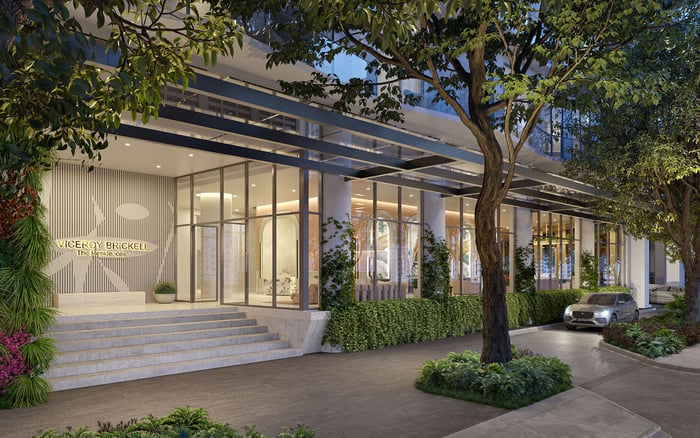
A porte-cochère establishes an arrival amenity, not proof that an ambulance can stage there or that emergency vehicles have unrestricted access. Ambulance staging, fire-command-center location, stretcher-elevator dimensions, elevator emergency-power coverage, and responder access procedures at 619 require verification.
Request the fire-department access plan and trace the intended route from vehicle staging to the residence. Obtain stretcher-elevator dimensions and capacity, elevator redundancy information, firefighter radio coverage, and access-control override procedures. Ask who would meet responders and how they would proceed if normal entry systems were unavailable.
Review the route as a continuous sequence: staging location, entrance, security threshold, elevator, corridor, and residence door. Check dimensions and procedures together. A spacious arrival area alone cannot establish an adequate transfer route or operating protocol.
Review the qualifications and change provisions attached to specifications, pricing, and amenities. Distinguish among an advertised feature, a planned technical capability, an operating policy, and an enforceable purchase commitment.
Ask counsel to incorporate essential power, parking, accessibility, and responder-access commitments into the purchase agreement or a rider where appropriate. Review whether condominium rules could later restrict equipment, installations, storage, deliveries, or recurring caregivers. Define the evidence needed to confirm each commitment, and ask counsel what protections are available if an essential requirement remains unresolved.
The purchase decision should rest on a short, explicit set of requirements reviewed by the household's clinical, technical, and legal advisers. Architecture and hospitality can shape an exceptional home; suitability for medical needs depends on documented infrastructure and usable access, not inference.
For a discreet assessment of your South Florida residential priorities, connect with MILLION.
If branded residences are on your mind — as a home or as an allocation — we would be glad to share what we are seeing, privately.
Begin a quiet conversationFocus on the selected residence, its electrical infrastructure, its access route, and the rules governing daily use. General project descriptions are not a substitute for unit-specific documentation.
Current approved plans help establish the design being evaluated. Buyers should match those plans to their selected residence and essential requirements.
No. Wellness amenities alone do not establish an on-site medical clinic or continuous nursing services.
This article does not confirm whole-residence generator backup or resident-accessible emergency outlets. Obtain unit-specific confirmation of powered outlets, supported loads, and permitted medical-device use.
Request the unit load calculation, panel schedule, emergency-power riser, generator load schedule, automatic-transfer-switch schedule, and life-safety electrical plan.
Dedicated caregiver spaces, overnight caregiver permits, and a separate caregiver entrance are not confirmed here. Valet service alone is not a written caregiver-parking guarantee.
Obtain written rules for overnight parking, valet hours, loading-zone dwell time, guest registration, and recurring caregiver credentials. Confirm accessible-space locations and the route to the lobby.
No. A porte-cochère does not establish ambulance staging or unrestricted emergency-vehicle access.
Request stretcher-elevator dimensions and capacity, emergency-power coverage, and elevator redundancy information. Verify these details for the intended responder route.
Ask counsel to address essential power, parking, accessibility, and responder-access commitments in the purchase agreement or a rider. Review whether future condominium rules could restrict the intended arrangements.