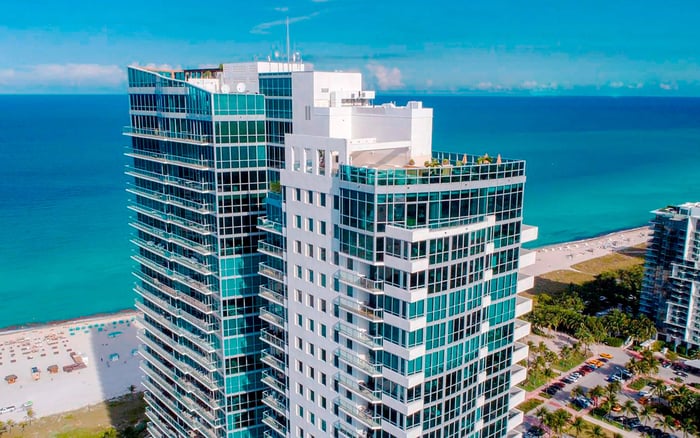
A buyer-focused guide to evaluating cabanas and private storage at Continuum on South Beach through the lenses of privacy, service convenience, scarcity, and resale differentiation.

At Continuum on South Beach, a cabana or private storage space is not simply an accessory. It is an ancillary real estate asset tied to one of Miami Beach’s most distinctive ownership environments: a resort-scale oceanfront condominium setting in South of Fifth, at the southern tip of Miami Beach.
That distinction matters. Continuum on South Beach is not a conventional urban-format tower where outdoor amenities are compressed into a podium or rooftop. Its lifestyle value is shaped by two primary residential towers within a large oceanfront complex, extensive landscaped grounds, multiple resort-style pools, a private beach-club component, tennis, fitness facilities, and direct proximity to the sand.
In that context, cabanas and storage spaces require a more sophisticated analysis than price per square foot. They should be evaluated through privacy, location, service access, scarcity, legal status, carrying cost, and future marketability. For Miami Beach buyers comparing trophy residences, these details can influence both daily comfort and resale positioning.
The mistake many buyers make is treating a cabana like a small enclosed space. At Continuum, its value is more experiential. A dedicated cabana can function as a private or semi-private base within the property’s pool, beach, and landscaped amenity areas. It gives the owner a place to pause, host discreetly, store essentials temporarily during the day, and move through the resort environment with less friction.
Pool location is central. A cabana near the activity pattern an owner actually uses can feel materially more valuable than one that is larger but less convenient. Pool proximity, sightlines, privacy from passersby, relation to landscaped buffers, ease of access from the residence, and connection to beach-club service all influence usefulness.
Pool value is also emotional. Buyers who use the property as a second home often want immediate ease when they arrive. A cabana can reduce the sense of repeatedly preparing for the same beach or pool ritual. For families, it can create a recognizable base. For owners who entertain, it can provide a quieter boundary between social activity and personal space.
Cabana value at Continuum is closely tied to scarcity. Few condominium properties combine direct ocean frontage, expansive grounds, resort-style pools, beach-club positioning, tennis, fitness, and a landscaped outdoor setting in one South of Fifth address. Oceanfront scale is difficult to replicate, especially in a mature luxury market where land and amenity depth are finite.
This is why a cabana should not be reduced to its interior measurements. The setting around it is part of what the owner is buying. A modest cabana in the right amenity zone can be more desirable than a larger space with compromised privacy or awkward service access.
Scarcity should be considered in two ways. First, how many comparable cabana experiences exist within the property itself? Second, how many comparable outdoor ownership experiences exist across South of Fifth and the broader Miami Beach luxury market? The stronger the answer to both questions, the more meaningful the cabana may become as a differentiator.
Private storage may be less glamorous than a cabana, but it can be just as practical. In a high-end condominium setting, storage supports beach equipment, pool items, seasonal goods, household overflow, luggage, sports gear, and owner supplies that do not belong in a primary living area.
At a property where the lifestyle is built around outdoor amenities, storage can make the residence live larger. Owners may not want paddle gear, beach bags, children’s items, or entertaining pieces cycling through elevator corridors and closets. The point is not merely space, but order.
Beach-access convenience is also cumulative. A well-positioned storage space can reduce daily friction and preserve the calm of the residence. For a second-home owner, it may allow the apartment to remain turnkey between visits. For a full-time owner, it can keep the home refined while supporting an active coastal routine.
Buyers should evaluate cabanas and storage as separate investment decisions. The most important question is not only whether the asset exists, but how it is held. Is it deeded, assigned, licensed, or otherwise governed by association documents? Can it transfer with the residence? Can it be sold separately? Is association approval required? Is it subject to separate taxes, assessments, fees, or use restrictions?
These questions should be answered before value is assigned. A cabana with strong lifestyle appeal but limited transferability may have a different resale profile than one that moves cleanly with the residence. Similarly, a storage space with high utility may be less financially meaningful if its legal status limits future marketability.
The goal is clarity. Sophisticated buyers should ask for documentation, confirm what is included in the purchase, and understand whether cabana or storage rights are permanent, conditional, revocable, or subject to association rules.
Cabanas and storage spaces can differentiate otherwise similar residences within the same luxury building. When two units offer comparable views, finishes, floor levels, and interior condition, ancillary assets can become tie-breakers. They help answer a buyer’s practical question: which residence will live better?
Resale impact is strongest when the cabana or storage asset is easy to understand, desirable in daily use, and clearly transferable. A cabana with privacy, proximity, and service convenience may improve the way a residence presents to future buyers. A storage space may support the ownership narrative by making the unit feel more complete and easier to maintain.
Still, these assets should not be valued automatically. A buyer should consider carrying costs, actual use, marketability, and whether the asset aligns with the likely future buyer profile. South of Fifth buyers tend to be highly sensitive to lifestyle efficiency, privacy, and service quality, which makes these factors especially relevant at Continuum.
Start with use. How often will the owner use the pool, beach, landscaped grounds, tennis, fitness facilities, and private beach-club environment? If the answer is often, a cabana may hold significant personal value. If use will be occasional, focus more carefully on resale and carrying costs.
Next, study location. Is the cabana exposed or discreet? Does it feel connected to the main amenity experience without being too public? Does it allow smooth movement between the residence, pool, beach, and service areas? Is it shaded, buffered, or positioned in a way that improves privacy?
Then separate utility from prestige. A cabana can carry status, but its best value usually comes from repeated ease. Storage is similar. Its worth is revealed over time, in the daily absence of clutter, errands, and improvisation.
Finally, confirm the paper. The South of Fifth market rewards precision. Before assigning premium value, understand legal status, transferability, fees, and the approval process. At Continuum, cabana-storage analysis is less about ornament and more about how an already resort-like property can be made more private, more convenient, and more complete.
Why are cabanas at Continuum on South Beach considered valuable? They are tied to a rare oceanfront resort setting with pools, landscaped grounds, beach-club amenities, and daily privacy benefits.
Should I value a cabana by square footage? No. Location, privacy, service access, proximity to pools or beach areas, and transferability may matter more than size.
Is private storage important in a luxury condominium? Yes. Storage can support beach, pool, seasonal, and household needs while helping the residence remain orderly.
Can a cabana improve resale positioning? It can, especially when it is desirable, practical, clearly documented, and transferable with the residence.
What should I ask before buying a cabana? Ask whether it is deeded, assigned, licensed, transferable, separately assessed, and subject to association approval.
Are cabanas and storage always included with a residence? Not necessarily. Buyers should confirm exactly what rights or spaces are included in the purchase documents.
Does cabana privacy matter as much as location? Yes. A well-located cabana with poor privacy may be less desirable than one with a calmer, more discreet setting.
How does Continuum’s setting affect cabana value? Its oceanfront acreage, multiple pools, landscaped grounds, and resort-style amenities make the outdoor experience central to ownership.
Should investors treat storage and cabanas separately? Yes. Each has its own utility, scarcity, legal status, costs, and future marketability.
What is the best way to shortlist comparable options for touring? Start with location fit, delivery status, and daily lifestyle priorities, then compare stacks and elevations to validate views and privacy.
For a discreet conversation and a curated building-by-building shortlist, connect with MILLION.
If branded residences are on your mind — as a home or as an allocation — we would be glad to share what we are seeing, privately.
Begin a quiet conversation