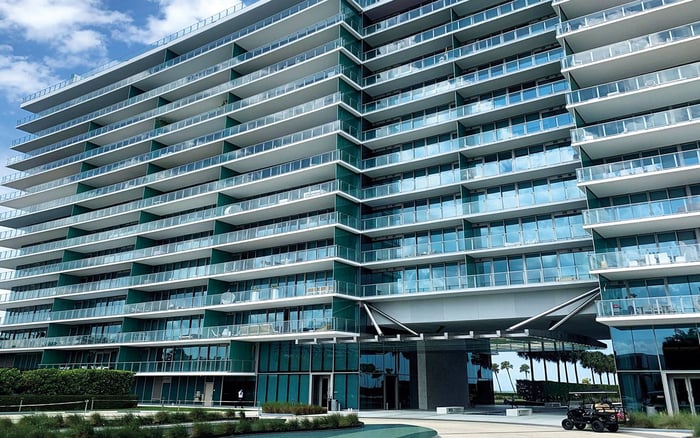
A considered furnishing installation begins before closing. For Key Biscayne buyers, customs classification, interim storage, building access, and verified coverage should be coordinated as separate approvals rather than assumed to follow the purchase timeline.

A beautifully furnished Key Biscayne residence begins with decisions that rarely appear on a floor plan. An imported dining table needs a customs pathway. A crated cabinet needs a workable loading route. An installation team needs authorized access, and the owner needs clarity about protection as possessions move between carriers, storage, and the residence.
For a buyer preparing a home at Oceana Key Biscayne, the essential distinction is between closing readiness and installation readiness. Treat the transaction, shipment release, and building approval as separate milestones. A scheduled closing does not confirm that a truck can arrive that afternoon.
Begin with a single coordination document shared among the buyer’s representative, designer, customs broker, mover, storage provider, and building contact. Record who authorizes each handoff, which documents remain outstanding, and what happens if delivery must be rescheduled. The objective is a controlled arrival, not simply an ambitious date.
The customs treatment of a personal collection is not necessarily the same as that of newly purchased furnishings. Used household effects may qualify for duty-free entry when they have been used abroad for at least one year, are intended for the importer’s personal use, and are not intended for sale or another person.
That category can include furniture, carpets, paintings, tableware, books, artwork, and similar household furnishings. Eligibility may require evidence of prior use. Qualifying effects should ordinarily be imported within 10 years of the importer’s last arrival from the country where they were used. Review these conditions before packing, not after arrival.
Furniture purchased abroad and shipped to the United States requires customs entry procedures and may attract applicable duties and taxes. Personal use alone does not create an exemption. Keep the bill of sale and bill of lading accessible; Form 3461, Entry/Immediate Delivery, is identified in the release process for personally imported furniture. Confirm the applicable filing requirements with the customs professional handling the shipment.
Request an item-level review rather than treating everything as “furnishings.” Furniture commonly falls within Harmonized Tariff Schedule Chapter 94, but classification depends on the product. Wood and composite-wood pieces merit early attention because their materials may trigger additional federal requirements or documentation.
A four-to-six-week preparation window is a planning recommendation, not a statutory deadline or a verified building requirement. Use it to assemble records, request access instructions, evaluate storage, and identify pieces needing special handling. Begin earlier whenever the shipment or transaction warrants it.
Build the calendar around decision points: documentation ready, release confirmed, storage authorized, closing completed, access approved, and installation accepted. Do not base the final delivery commitment solely on an estimated arrival date.
Uncleared goods can be transferred to a General Order Warehouse after 15 days, creating additional storage charges. Customs readiness is therefore a financial concern as well as a scheduling concern. Distinguish this customs-related storage exposure from a warehouse deliberately selected to hold furnishings awaiting installation.
For buyers also considering Coconut Grove residences such as Park Grove Coconut Grove, the same planning discipline applies to each property review. Obtain the actual destination’s requirements rather than carrying assumptions from one address to another.
If closing or access shifts, a prepared storage option gives the team an alternative to an improvised delivery. Before authorizing storage, request written terms covering receiving, inventory, handling, storage charges, release procedures, and onward delivery. Establish who can instruct the warehouse and who must approve additional costs.
For high-value pieces, ask the provider to describe environmental controls, security arrangements, and any restrictions affecting delicate materials. Request confirmation that those arrangements suit the actual inventory. A description such as premium storage does not establish a particular climate standard or level of protection.
As a recommended safeguard, create a photographic condition record before packing and update it at receipt, unpacking, and final placement. Identify each crate and its contents consistently across documents. Agree in advance how discrepancies will be recorded and who can accept delivery when the owner is absent.
Many Key Biscayne apartment buildings and high-rises require a mover’s certificate of insurance before allowing service-elevator or loading-dock access. Request that document early, then obtain the association’s actual move-in package. General moving practices are no substitute for address-specific approval.
Confirm elevator reservations, approved moving hours, loading instructions, gate access, service entrances, and parking arrangements before dispatch. Ask the mover to verify the complete route for oversized pieces, including doorways, turns, elevator openings, and the final room. Do not rely on assumed loading-space dimensions or clearance figures.
If the residence is not yet available, seek written clarification of whether pre-closing access is permitted and who must authorize it. Do not schedule installation on the assumption that early access will be granted.
A buyer weighing Key Biscayne against Brickell, perhaps including Una Residences Brickell, should apply the same questions separately at each address. This is a due-diligence approach, not a statement about any named building’s policies.
A mover’s certificate of insurance does not, by itself, establish protection for the furnishings. Treat building-access documentation and the owner’s property protection as separate reviews.
Ask the relevant provider or insurance adviser to confirm in writing what applies during international transit, customs-related holding, warehouse storage, local transport, unpacking, and installation. Request the applicable limits, valuation basis, deductibles, exclusions, and claim-notification requirements. None should be inferred from a COI or a service description.
Pay particular attention to handoffs. Identify when one party’s responsibility ends and another’s begins, including periods when crates remain unopened. Resolve unclear protection before authorizing movement rather than relying on a verbal assurance after damage is discovered.
Design & Architecture decisions should include the practical sequence of arrival: which pieces enter first, where crates are opened, and who approves final placement. Confirm customs release, receiving authority, building access, and the agreed coverage arrangements before dispatching the truck.
A successful installation is more than furniture inside the residence. It is an orderly handover with documented condition, resolved exceptions, and a clear record of acceptance.
For a considered approach to your next South Florida residence, connect with MILLION.
If branded residences are on your mind — as a home or as an allocation — we would be glad to share what we are seeing, privately.
Begin a quiet conversationThey may qualify if used abroad for at least one year, intended for the importer’s personal use, and not intended for sale or another person. Evidence of prior use may be required.
No. Furniture purchased abroad requires customs entry procedures and may incur applicable duties and taxes.
Keep the bill of sale and bill of lading accessible. Confirm filing requirements with the customs professional handling the shipment, including the applicability of Form 3461.
Uncleared goods can be transferred to a General Order Warehouse after 15 days, creating additional storage charges.
Wood and composite-wood materials may trigger additional federal requirements or documentation. Review the specific products before shipping.
A four-to-six-week preparation window is a planning recommendation, not a legal deadline or universal building requirement. Begin earlier when the shipment or transaction warrants it.
Obtain the actual move-in package and confirm insurance documentation, elevator reservations, moving hours, loading instructions, and entry arrangements. Requirements must be checked for the specific address.
A certificate of insurance does not by itself establish protection for the furnishings. Confirm the applicable transit, storage, and installation coverage separately in writing.
Request written terms for receiving, inventory, handling, charges, release, and onward delivery. Also ask about environmental controls, security, and suitability for the particular pieces.
Do not assume pre-closing access is available. Obtain written clarification of whether it is permitted and who must authorize it before scheduling installation.