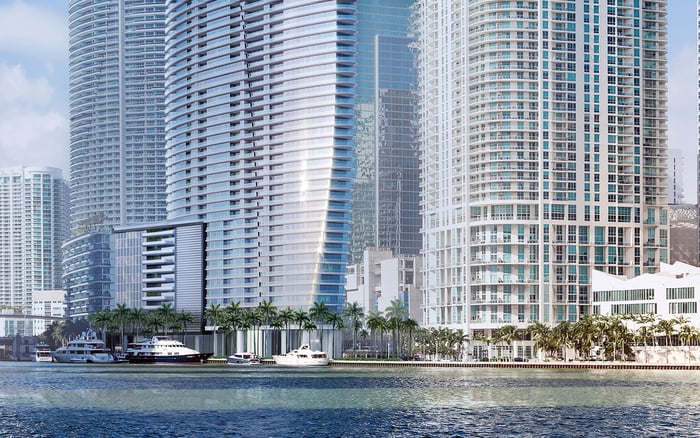
A disciplined closing review should connect county records, municipal files, permit history, condominium documents, survey findings, and association records before a Downtown Miami penthouse purchase becomes final.

A penthouse acquisition is rarely defined by interior square footage alone. Its value may also rest on a private elevator foyer, expansive terrace space, rooftop improvements, parking, storage, a cabana, or other privileges that feel inseparable from the residence. At closing, each feature should be tested against the legal record.
That discipline matters throughout Downtown Miami, whether the buyer is considering Aston Martin Residences Downtown Miami or another condominium tower. The central question is not simply whether title to the unit is insurable, but whether the searches, permits, recorded documents, association files, and physical conditions tell one coherent story.
Confirm that the closing team searched Miami-Dade County records for deeds, mortgages, judgments, liens, releases, and other recorded instruments affecting the residence. Request the search's effective date and ask whether updates will be completed immediately before closing.
The review should use the penthouse's legal description and unit folio-not merely its street address. It should also consider recorded condominium documents and any instruments affecting the broader property. For buyers comparing penthouses at One Thousand Museum Downtown Miami, the same principle applies: the residence and the condominium regime must be examined together.
A county records search is not a substitute for municipal research. Confirm the municipality with jurisdiction over the address and folio, then ask the closing team to determine the appropriate lien and violation search.
Ask whether the scope extends to code enforcement, building and zoning, utilities, solid waste, public works, and right-of-way matters-not merely recorded liens. The search should address both the unit folio and any common-area or master folio associated with the condominium.
A buyer examining Waldorf Astoria Residences Downtown Miami should have counsel determine which folios and property identifiers require review. Also ask what type of report will be delivered and whether it includes payoff or partial-payoff information.
Permit history should be searched twice: once for the specific penthouse and once for the entire condominium building. Records may be indexed differently, and a polished renovation does not establish that every permit reached final inspection.
The review should identify open or expired permits, incomplete or failed inspections, unsafe-structure records, and related code-compliance cases. Major alterations warrant particular attention, including balcony enclosures, pools, outdoor kitchens, railings, structural work, and extensive interior renovations. Ask for evidence that required inspections passed and permits were formally closed.
Building-level issues can be equally consequential. Request association records concerning structural repairs, life-safety work, recertification, unsafe-structure proceedings, and planned or pending assessments. The objective is to determine whether unresolved work could prompt corrective construction, delay closing, or result in an assessment after acquisition.
A survey can identify boundaries, improvements, easements, and encroachments, but it should not be read in isolation. Counsel should compare it with the recorded condominium plat and declaration to establish the unit's boundaries and the legal status of terraces, rooftop areas, parking, storage, and cabanas.
This comparison is especially important when evaluating residences at Casa Bella by B&B Italia Downtown Miami or any tower where lifestyle features may involve several categories of ownership and use. Ask whether a pool, pergola, railing, outdoor kitchen, or similar improvement extends beyond the unit boundary or occupies an easement area.
Recorded utility, mechanical, telecommunications, maintenance, or access easements may cross rooftop or terrace areas presented as private. Determine who may enter, for what purpose, by which route, and subject to what notice or restoration obligations.
Every ancillary feature should be classified. A private elevator foyer, rooftop deck, cabana, parking space, storage area, or boat slip may be part of the unit, a limited common element, an exclusive-use area, or a license. Those categories are not interchangeable. Ask whether the association, utilities, contractors, or neighboring owners hold access or maintenance rights over spaces central to the penthouse experience.
Before funds are released, request written payoff figures and identify who must cure each lien, violation, or permit defect. If an item cannot be resolved before closing, the contract and closing documents should specify whether funds will be escrowed, how much will be retained, who controls the cure, and what happens if the issue persists.
The strongest closing file aligns county records, municipal results, permit databases, association disclosures, condominium documents, and survey findings before contractual review deadlines expire. Any inconsistency should be investigated rather than explained away.
Is a Miami-Dade County records search enough for a Downtown Miami penthouse? No. The closing team should also determine which municipal searches and condominium records are relevant to the property.
Which municipality should perform the lien and violation search? Use the municipality with jurisdiction over the property's address and folio, as confirmed by the closing team.
Should the search use more than the unit folio? Ask whether the unit folio and any condominium common-area or master folio require review.
What should a municipal search cover? Ask about code enforcement, building and zoning, utilities, solid waste, public works, and right-of-way matters.
Why search permit history at both unit and building levels? Unit alterations and broader building work may appear in different records and can present distinct closing concerns.
Which penthouse improvements require closer permit review? Focus on balcony enclosures, pools, outdoor kitchens, railings, structural work, and extensive interior renovations.
What should the association provide before closing? Request available records on structural repairs, life-safety work, recertification, unsafe-structure matters, and planned or pending assessments.
What does the survey add to the review? It can help identify boundaries, improvements, easements, and encroachments for comparison with recorded condominium documents.
Is an exclusive-use area the same as owned unit space? Not necessarily. Counsel should determine whether a feature is unit property, a limited common element, an exclusive-use area, or a license.
How should an unresolved lien or permit issue be handled? Obtain written cure responsibility and payoff information, then document any agreed escrow arrangement if the issue cannot be resolved before closing.
For a tailored shortlist and next-step guidance, connect with MILLION.
If branded residences are on your mind — as a home or as an allocation — we would be glad to share what we are seeing, privately.
Begin a quiet conversation