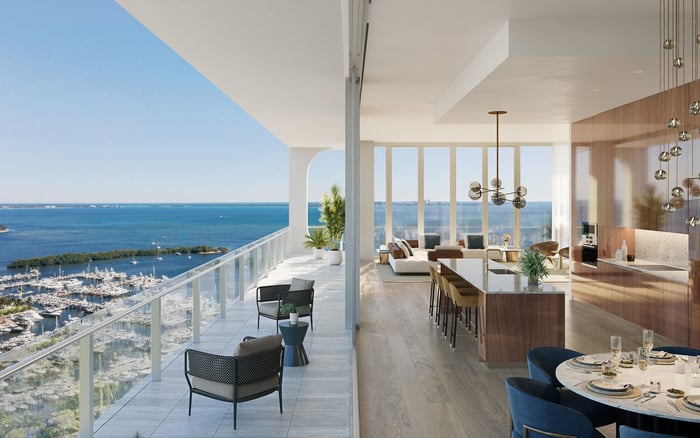
A junior sailing commitment can reshape a family’s home search in Coconut Grove. From introductory lessons to year-round racing, the right location decision begins with the school-club-home routine, not simply the waterfront address.

For a family buying in Coconut Grove, sailing can be a welcome weekend interest or an organizing principle of daily life. The distinction matters before the first property tour. Occasional lessons leave considerable flexibility in a home search; a competitive schedule requires the household to repeat the school-club-home journey several times each week.
Coconut Grove Sailing Club sits at 2990 South Bayshore Drive, Miami, FL 33133, on Biscayne Bay beside Peacock Park. That address is a useful search anchor, but it cannot substitute for understanding the family’s daily movements. The most compelling home is not necessarily the one that appears closest on a map. It is the one that supports the routine without compromising the rest of family life.
For luxury buyers, convenience becomes a personal measure: how comfortably a residence accommodates school, training, work, siblings, and the return home.
The competitive junior program practices three to four days per week year-round and serves sailors approximately ages 10-18. Racing sessions become longer during school breaks. For a committed sailor, proximity deserves consideration beyond the standard school calendar.
The pathway progresses through Discover, Develop, Race, and Beyond, with preparation for college, national, or Olympic-track sailing. This is a development framework, not a promise of any individual outcome. The competitive pathway uses tryouts, and open-practice opportunities may be available during some seasons. Confirm eligibility and availability before making racing central to a purchase decision.
Younger children can enter learn-to-sail and Optimist programs from age six. ILCA and C420 youth offerings generally begin around age 12, depending on the program. Seasonal camps, discovery weeks, and private coaching offer other ways to participate without assuming a race-team commitment.
A family exploring Arbor Coconut Grove should begin with the same question as a family considering an individual house: are we accommodating today’s lessons, a confirmed racing schedule, or a possible future interest? Each calls for a different emphasis on location.
Treat route testing as a buyer exercise, not evidence that any particular neighborhood has a proven advantage. Start at the actual school, continue to the club, and finish at the candidate residence. Repeat the journey at the times the household would use it, rather than relying on mileage or an off-peak estimate.
Include the less visible transitions. How does the child get from dismissal to the vehicle? Who handles the sailing bag? Where does a parent or caregiver go between drop-off and collection? If siblings attend different activities, test those movements too. These questions reveal whether a location supports the whole household, rather than a single convenient destination.
When evaluating Park Grove Coconut Grove, apply that full-route test to the specific residence under consideration. Do not infer a particular travel time, walking route, or parking arrangement from the project name or a map. Verify access and arrival procedures separately.
The useful comparison is consistency: which candidate best supports a repeatable afternoon while preserving enough time for dinner, homework, and rest?
A school-week test is only half the exercise. Camp programming spans summer, winter, and spring breaks, while competitive racing sessions become longer during school holidays. A home that fits a short afternoon lesson should also be assessed against the family’s intended break schedule.
The 2026 fall youth season runs August 29-December 13. Its offerings include a once-weekly Friday option from 4:00-6:00 p.m. and a twice-weekly Tuesday/Thursday option. These are specific 2026 offerings, not a permanent annual timetable, and should not be confused with the competitive team’s training frequency.
Before committing to a property, confirm current practice days, session lengths, fees, membership requirements, tryouts, and availability directly with the program. Then place the confirmed schedule alongside school commitments and household travel. The aim is not to predict every future season, but to avoid buying around a timetable that does not match the child’s actual participation.
Once the route works, examine how the home handles the return from sailing. Consider where equipment would be stored, how wet clothing would move to laundry, and whether the layout supports an orderly transition into the evening. These are inspection questions, not assumed features of any residence.
For buyers considering Four Seasons Residences Coconut Grove, the same discipline applies: establish the practical details of the particular home and building rather than letting the name answer them. Ask about vehicle access, storage permissions, and any rules relevant to the household’s intended routine.
For an individual house, assess the corresponding practicalities during inspection and due diligence. Neither format should be presumed superior. A condominium may suit one family’s preferences while a house better serves another’s. The decision should follow verified arrangements, desired responsibilities, and the way the household lives.
Waterfront appeal and access to junior training are distinct purchase considerations. A bay outlook does not establish an easier school-to-practice journey, and a home without waterfront frontage should not be dismissed before its actual route has been tested.
Likewise, participation in a sailing program does not by itself establish a need for a private dock. If a property includes waterfront infrastructure, obtain property-specific advice on flood exposure, insurance, seawall condition, and dock-permit status. None of those questions can be settled by the sailing calendar.
A search that includes The Well Coconut Grove should distinguish emotional appeal from verified daily suitability. Keep the family’s non-negotiables in view: the school journey, the confirmed training commitment, the residence’s practical fit, and the ownership obligations the buyers are prepared to accept.
The strongest location decision leaves room for sailing to deepen without requiring the entire household to revolve around an unconfirmed ambition. Buy for the commitment that exists, test the next plausible stage, and preserve flexibility for changing interests.
In Coconut Grove, the luxury of a well-chosen family home lies partly in the freedom it creates between appointments. A considered address supports the sailing day while remaining a satisfying place to live when no practice is scheduled.
Explore a family-focused Coconut Grove property search with MILLION.
If branded residences are on your mind — as a home or as an allocation — we would be glad to share what we are seeing, privately.
Begin a quiet conversationThe club is at 2990 South Bayshore Drive, Miami, FL 33133, on Biscayne Bay beside Peacock Park. Use that address as the anchor for testing potential home locations.
The competitive junior program practices three to four days per week year-round. Racing sessions become longer during school breaks.
The competitive program serves sailors approximately ages 10–18. Confirm the specific eligibility requirements and tryout arrangements before planning around participation.
Learn-to-sail and Optimist programs begin at age six. ILCA and C420 youth programs generally begin around age 12, with eligibility dependent on the program.
The season runs August 29–December 13, 2026. These dates should not be treated as a permanent annual calendar.
Youth offerings include seasonal camps, discovery weeks, and private coaching. The 2026 fall schedule also includes a Friday 4:00–6:00 p.m. once-weekly option and a twice-weekly Tuesday/Thursday option.
Travel the complete school–club–home route at actual dismissal and practice times. Include caregiver handoffs and sibling commitments rather than evaluating distance alone.
Waterfront frontage does not establish a commute advantage. Test each property's actual route and assess waterfront ownership questions separately.
Evaluate equipment storage, laundry arrangements, vehicle access, and the transition into the evening routine. Verify these details for the specific residence rather than assuming they are available.
Confirm current practice days, fees, eligibility, tryouts, membership requirements, and availability directly with the program. Match the confirmed commitment to both school-week and holiday transportation plans.