A practical luxury buyer’s guide to evaluating South Florida homes through the lens of resale liquidity, especially when the building is highly specialized.
A move from Brooklyn to Bal Harbour is rarely just a change of address. It is a recalibration of privacy, seasonality, service, architecture, and daily rhythm. For buyers accustomed to New York’s dense, highly comparable apartment market, South Florida can feel more nuanced. Two residences with similar views may have very different long-term demand profiles because the building itself carries a distinct identity.
That is where resale liquidity becomes central. The question is not only, “Do I love this home?” It is also, “How many future buyers are likely to understand and value this exact proposition when I eventually sell?” In a specialized building, the answer depends on more than finishes. It depends on the depth of the audience, the clarity of the lifestyle, the quality of the floor plan, and the building’s ability to remain desirable as tastes evolve.
This is the quiet discipline behind a confident acquisition. The most elegant purchase is not the loudest one. It is the one that feels personal today and remains broadly legible tomorrow.
A specialized building can be boutique, branded, wellness-focused, architecturally ambitious, club-like, marina-oriented, ultra-private, or tightly tied to a particular neighborhood lifestyle. Specialization is not a weakness. In many cases, it is the very reason a buyer is drawn to the property. The risk appears when the specialization narrows the future buyer pool too much.
A Brooklyn buyer may be used to evaluating co-ops and condominiums by block, building condition, light, and monthly carry. In South Florida, the building’s lifestyle promise can be just as important. Does it feel like a resort residence, a discreet full-time home, a lock-and-leave pied-à-terre, or a wellness retreat? Each answer attracts a different future buyer.
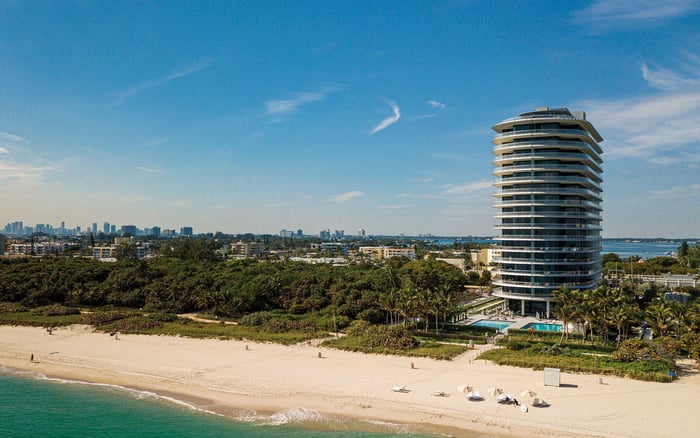
The stronger the concept, the more important it is to ask whether that concept has staying power. A residence at Rivage Bal Harbour, for example, belongs in a conversation about buyers who want Bal Harbour prestige, waterfront presence, and a more curated residential atmosphere. The liquidity question is whether those qualities remain clear and desirable to the next owner, not merely to the first one.
Resale is not only about price. It is about the number of qualified buyers who can quickly recognize value. A highly customized home in a highly specialized building may be beautiful, but if only a narrow slice of the market wants that combination, the exit can require more patience.
Start by identifying the likely future buyer. Is the next owner a New Yorker seeking a seasonal base, a Miami professional upgrading into services, an international family prioritizing security, or a downsizer trading a single-family home for convenience? A liquid property usually speaks to more than one of these profiles without losing its identity.
Floor plan matters enormously. Flexible bedroom counts, gracious entertaining space, privacy between primary and guest areas, strong outdoor usability, and intuitive circulation tend to travel well across buyer categories. Highly personal build-outs can be seductive, but the more specific they become, the more they may require the future buyer to share the same taste.
The same logic applies to carrying costs and rules. A building’s service level should feel proportionate to the lifestyle being purchased. When fees, restrictions, or operating complexity exceed what the likely buyer pool expects, liquidity can narrow even if the residence itself is exceptional.
Bal Harbour has a distinct buyer psychology. It is associated with privacy, luxury retail proximity, beachfront living, and a quieter sense of arrival. The buyer who chooses Bal Harbour often values discretion over spectacle. That can support strong liquidity when the residence, building, and price all align with that expectation.
Surfside sits adjacent in geography but can feel different in tone. It may appeal to buyers who want oceanfront living with a softer residential scale and immediate access to the broader Miami Beach corridor. A project such as The Delmore Surfside naturally belongs in the discussion for buyers comparing privacy, architecture, and neighborhood texture along this stretch of coast.
Brickell is another resale universe. It offers a more urban rhythm, with financial district energy, dining, walkability, and a deeper pool of buyers who may use the residence differently. For buyers considering a city-facing South Florida base, St. Regis® Residences Brickell illustrates how a recognized hospitality identity can clarify the building’s promise for both current use and eventual resale.
The key is not to declare one market more liquid than another. It is to match the building’s specialization to the audience most likely to compete for it later.
Investment discipline does not have to flatten the emotional pleasure of buying. It gives the romance a framework. Before committing, evaluate the residence in three layers: the home, the building, and the micro-market.
At the home level, favor layouts that are easy to understand within moments of entry. Buyers may admire drama, but they pay for usability. Natural light, view orientation, terrace function, bedroom privacy, and storage all influence how quickly a future buyer can say yes.
At the building level, consider whether the amenity program feels timeless or trend-dependent. Wellness, dining, beach service, concierge, parking, and security can all add conviction when they are executed with restraint. A specialized amenity is strongest when it expands daily life rather than becoming a novelty.
At the micro-market level, think about substitution. If a future buyer does not choose your building, where else will they look? Bay Harbor, for instance, may attract a buyer seeking a calmer residential setting near the beach corridor, and Onda Bay Harbor can enter the conversation when water, boutique scale, and neighborhood convenience are part of the brief.
This comparative set is essential. Liquidity improves when the property can win against its natural alternatives on more than one dimension.
Ask what the building is known for and whether that identity is easy to explain in one sentence. Ask whether the residence depends on a single feature, such as a dramatic view, or whether it offers a complete living proposition. Ask whether the rules support the way you will actually use the home.
Also ask how the property would photograph, show, and feel unfurnished. Strong resale homes usually retain their logic even when personal style is removed. If the architecture, proportions, views, and flow carry the experience, the next buyer has less work to do.
For buyers crossing from Brooklyn into South Florida, the best approach is neither defensive nor impulsive. Buy the life you came for, but choose a home with an exit audience larger than your own reflection. In a specialized building, that balance is the difference between owning something rare and owning something difficult to resell.
What does resale liquidity mean in luxury real estate? It refers to how readily a property can attract qualified buyers and convert interest into a sale when it returns to the market.
Is a specialized building harder to resell? Not always. It can be very liquid if its concept is clear, enduring, and appealing to a deep enough buyer pool.
Why does Bal Harbour require a different resale lens? Bal Harbour buyers often prioritize privacy, setting, service, and prestige, so the home must align with those expectations.
Should I avoid highly customized interiors? Not necessarily, but customization should not compromise layout, light, storage, or broad future appeal.
Are branded residences better for liquidity? A strong brand can clarify value, but liquidity still depends on pricing, execution, rules, and the future buyer pool.
How should a Brooklyn buyer compare South Florida neighborhoods? Compare daily lifestyle first, then evaluate how many future buyers are likely to want that same lifestyle.
Does Brickell offer a different resale audience than the beach? Yes. Brickell often draws buyers seeking a more urban, service-rich, and walkable residential experience.
What matters most inside the residence? Clear flow, usable outdoor space, privacy, light, and flexible rooms tend to support broader resale appeal.
Can a boutique building be liquid? Yes, if its scale, design, service model, and location are compelling to more than a narrow niche.
What is the best first step before buying? Define your lifestyle priorities, then pressure-test the property against the likely expectations of a future buyer.
For a discreet conversation and a curated building-by-building shortlist, connect with MILLION.
If branded residences are on your mind — as a home or as an allocation — we would be glad to share what we are seeing, privately.
Begin a quiet conversation