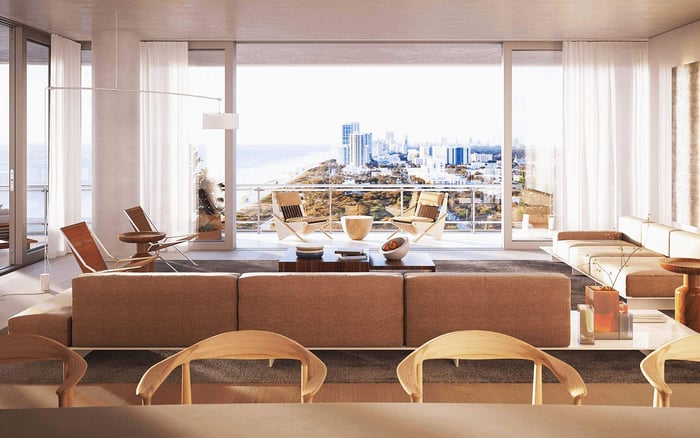
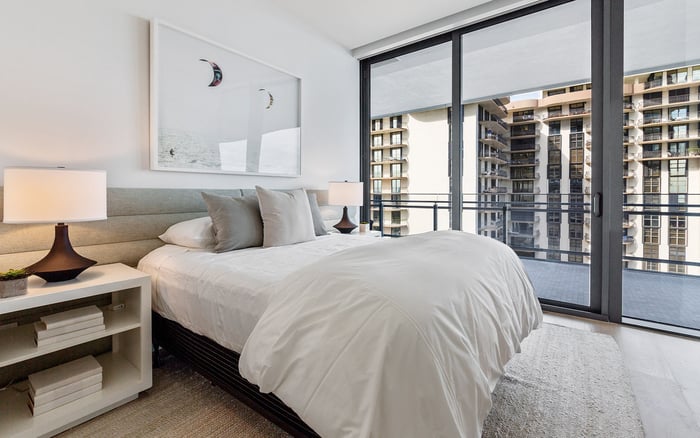
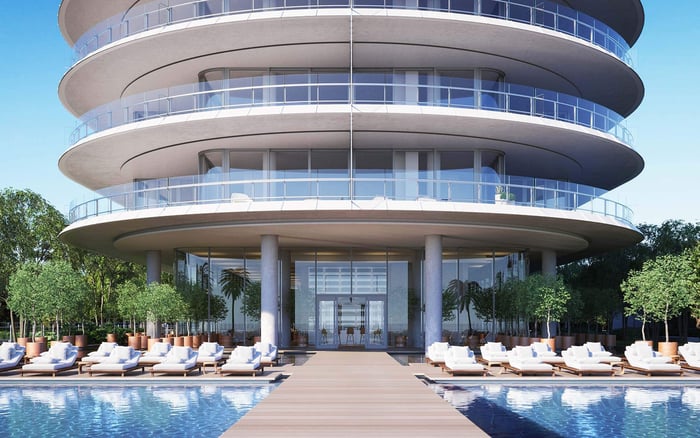
Eighty Seven Park’s oceanfront architecture is only part of the purchase decision. A discerning buyer should also examine neighboring commercial uses, service-vehicle routing, valet operations, and privacy from the street to the residence.
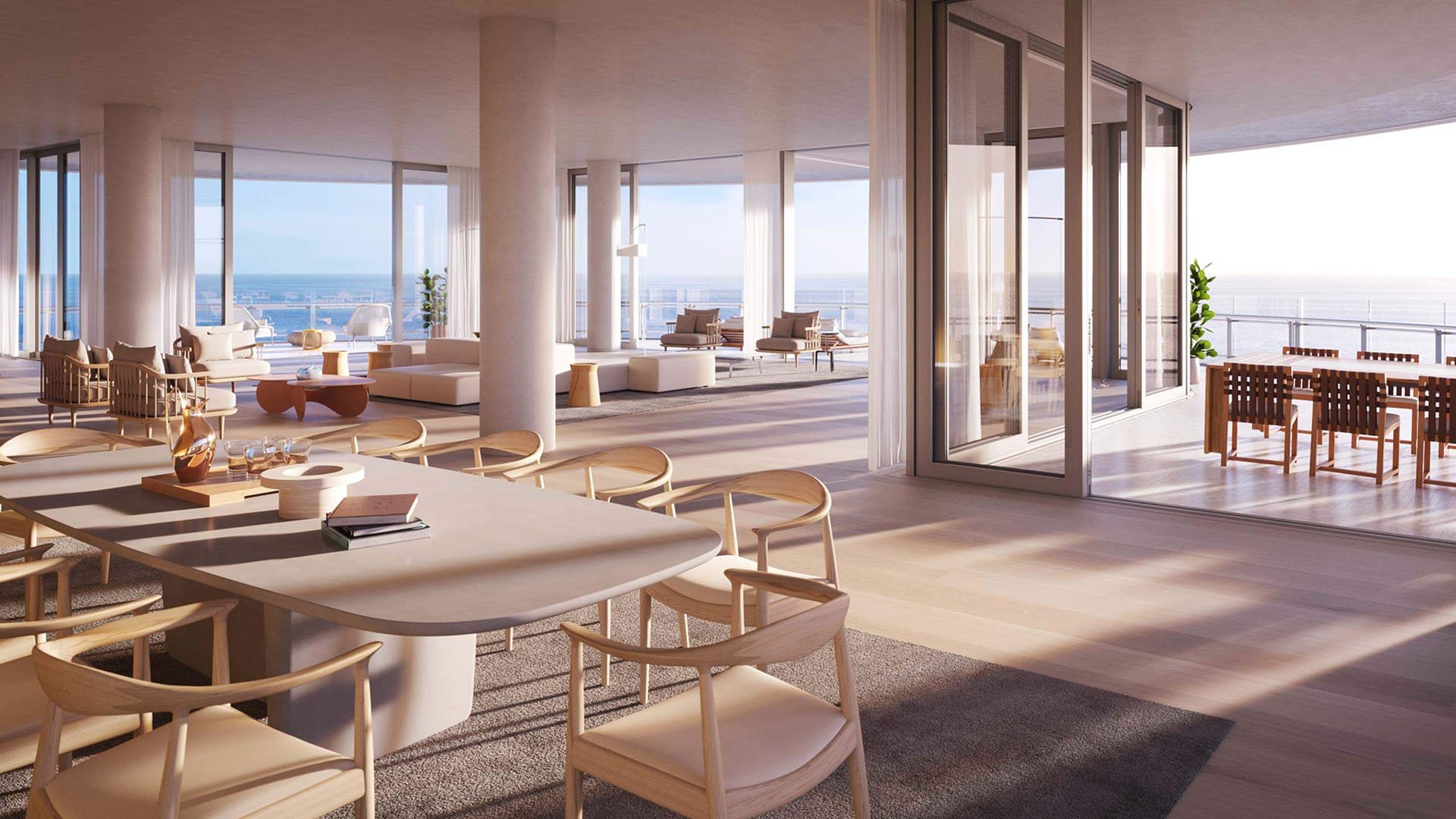
At Eighty Seven Park Surfside, the purchase decision extends beyond the apartment’s proportions and ocean outlook. For a buyer who values discretion, the route from Collins Avenue to the residence deserves the same attention as the floor plan. Retail adjacency, delivery movements, and valet operations belong in that assessment-not as presumed problems, but as conditions to verify.
The geographical distinction matters from the outset: the building stands at 8701 Collins Avenue in Miami Beach’s North Beach area, near the Surfside boundary rather than within Surfside proper. Municipal boundaries determine which rules need checking. Neither a neighborhood label nor the appearance of a nearby commercial parcel establishes the applicable zoning.
The objective is straightforward: determine whether the building’s daily operations support the privacy you intend to purchase.
Designed by Renzo Piano Building Workshop, the oval tower is wrapped in terraces and contains 68 residences across 18 stories. The Atlantic lies to the east, a public park to the south, and a private residents’ garden to the north. Each edge has different implications for outlook and access.
White columns, or piloti, elevate the building above its landscaped base. The composition is architecturally significant, but it does not establish that arrivals are invisible from Collins Avenue. Planting, setbacks, and structural openness must be evaluated from actual viewing positions.
Walk the permitted public approach, then follow the authorized resident route with management. Examine where vehicles pause, where passengers step out, and how much of the transition indoors remains visible. Repeat the exercise after dark, when lighting may change the relationship between the entrance and its surroundings.
A private garden is an amenity, not a guarantee of continuous screening. The useful question is what it shields along the route you will actually use.
The absence of an identified on-site retail component does not confirm that all permitted commercial uses are exclusively residential in character. Request current documentation of permitted and operating uses, including whether any amenity admits nonresidents.
The pool, spa, salon, enoteca, library, and concierge illustrate a service-rich residential program. They do not, by themselves, establish the presence or absence of public storefront activity. Access policies and operating arrangements are the relevant evidence.
Across Collins Avenue, Terra owned a small lot and planned a retail project in November 2015. That historical proposal does not establish a current project, tenant, opening date, or loading arrangement. Before assigning convenience value or nuisance risk, identify the opposite parcel and verify its present use and approvals.
For a buyer also considering Arte Surfside, ask the same questions rather than assuming equivalent commercial surroundings. Investigate entrances, loading locations, operating hours, and potential vehicle queues independently at each property. A comparable purchase price or coastal setting would not make those operating conditions interchangeable.
A residential building can require substantial logistical coordination without public shops. The important distinction is not simply retail versus residential, but whether service movements intersect with resident arrivals.
Verify the Collins Avenue valet arrival arrangements at Eighty Seven Park, along with the complete current routing of residents, contractors, couriers, and moving trucks. Structured parking alone does not establish a separate, concealed garage-level resident drop-off.
Ask management for the current access and loading plan, then walk through these operational details:
Identify the service entrance and where delivery vehicles may stop.
Establish whether couriers enter the lobby, use a service route, or transfer parcels to staff.
Confirm move-in hours, reservation requirements, and contractor access rules.
Ask how simultaneous resident arrivals and large deliveries are handled.
Verify whether a discreet-arrival protocol exists and when it is available.
Request a demonstration of any alternative arrival route offered as a purchase advantage. Confirm who may use it, how guests are handled, and whether staffing or scheduling affects access. A route on a drawing is not the same as a routinely available service.
No measured delivery frequency, valet waiting time, or noise level is established here. A quiet appointment should not become a conclusion about everyday conditions.
Where feasible, arrange observations during weekday delivery periods, evening arrivals, and peak-season valet activity. Record vehicle type, stopping position, queue length, and how long any shared route remains occupied. Distinguish vehicles serving the condominium from those stopping elsewhere on Collins.
The aim is not to label every delivery disruptive. It is to understand whether routine service activity delays entry, exposes passengers to public view, or becomes noticeable inside the particular residence.
When comparing Fendi Château Residences Surfside, apply the same observation standard. Do not infer that either property performs better without checking its actual arrangements. Consistent observation makes the comparison useful; impressions gathered at different times and under different conditions do not.
A compass direction does not adequately describe privacy. Inspect the actual apartment and terrace for sightlines toward Collins Avenue, the arrival court, service areas, and opposite parcels. Check both standing and seated positions, particularly where outdoor dining or lounging would occur.
Repeat the interior inspection with terrace doors open and closed. Note what can be heard rather than assuming that landscaping or an ocean-facing outlook provides acoustic protection. If sound is material to the purchase, consider an appropriately qualified assessment instead of relying on a brief visit.
Evaluate the public park and private residents’ garden separately. Neither their presence nor their location proves exclusive access, complete visual screening, or silence.
Ask counsel to confirm municipal boundaries and parcel-specific rules before relying on nearby zoning language. Surfside’s consideration of off-site queuing and arrival surges in September 2021 does not establish an applicable requirement for this Miami Beach property. Likewise, Surfside’s SD-B40 height provisions should not be assigned to the opposite parcel without confirming its designation.
Before committing, reconcile three things: the current written operating rules, management’s explanation, and your observations. If a concealed arrival or tightly separated service route is essential, make that requirement explicit rather than treating it as implied by the architecture.
The strongest purchase decision preserves both kinds of luxury: the spatial pleasure visible in the residence and the operational discretion experienced each time you return.
For a considered approach to South Florida’s most distinctive residences, explore MILLION.
If branded residences are on your mind — as a home or as an allocation — we would be glad to share what we are seeing, privately.
Begin a quiet conversationEighty Seven Park is at 8701 Collins Avenue in Miami Beach’s North Beach area, near the Surfside boundary. Buyers should verify applicable rules using the property’s jurisdiction, not its neighborhood label.
The oceanfront condominium contains 68 residences across 18 stories.
Renzo Piano Building Workshop designed the oval tower, which is wrapped in terraces and elevated on white columns.
No on-site retail component is identified in the available property description. Buyers should confirm current permitted and operating uses rather than treating that omission as a verified commercial-use schedule.
Terra’s plan for a small lot across Collins dates to November 2015. That historical proposal does not confirm current tenants, development status, or loading arrangements.
No. Structured parking does not establish a separate, concealed garage-level drop-off or a routinely available discreet-arrival protocol.
Request the current access and loading plan, service-entry location, courier procedures, move-in hours, and contractor rules. Ask how service vehicles are handled during simultaneous resident arrivals.
Observe weekday delivery periods, evening arrivals, and peak-season valet activity where feasible. A single quiet showing does not establish typical waiting times or traffic conditions.
No. The private residents’ garden and neighboring public park are distinct spaces, and neither establishes complete visual or acoustic screening.
The cited Surfside workshop language does not establish an applicable rule for Eighty Seven Park in Miami Beach. Any height or queuing provision requires confirmation of jurisdiction and parcel-specific applicability.