A buyer-focused ranking of three landmark Downtown Miami residences, weighing scarcity, market depth, carrying costs and the quality of post-delivery resale evidence.
In Downtown Miami, a celebrated name can establish an opening price, but it cannot guarantee a durable resale premium. Once the launch period passes, buyers focus on what is genuinely difficult to replicate: architectural authorship, low unit count, exceptional scale, protected outlooks, operating discipline and a convincing record of completed transactions.
This distinction is particularly important in a district where branded residences increasingly compete for the same sophisticated buyer. A logo may command attention, but the secondary market is more exacting. It distinguishes between a building-wide identity and the merits of an individual residence, then discounts for carrying costs, competing inventory and the time required to sell.
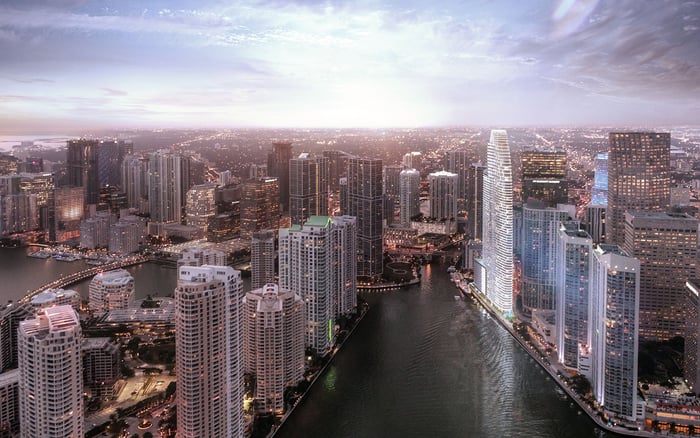
The comparison begins with One Thousand Museum Downtown Miami, a completed architectural landmark whose 84 residences create the strongest scarcity case in this group. Its position differs materially from that of larger branded developments, where deeper inventory can support liquidity while giving prospective purchasers more alternatives.
The strongest long-term premium is attached to an asset buyers cannot easily substitute.
This ranking weighs current evidence rather than brand recognition alone. Completed status, scarcity, asking inventory, recorded transactions, residence diversity and carrying costs all influence the order. Visible asking prices are useful signals, but they are no substitute for achieved prices.
1. One Thousand Museum - scarcity with an established market
Completed in 2019, the 62-story tower at 1000 Biscayne Boulevard contains only 84 residences. Zaha Hadid's recognizable exoskeleton gives the property an architecture-led identity independent of a hospitality or automotive license. That combination of authorship and low density offers the clearest structural defense against commoditization.
An August 9, 2026 snapshot showed eight listings, an average asking price of $1,756.79 per square foot, a median asking price of $7.495 million and an average of 157 days on market. Another snapshot showed 14 active listings near $1,660 per square foot, underscoring why market figures must be dated and reconciled. Available homes were also marketed from about $6.2 million to $23.8 million, including a six-bedroom residence spanning 8,400 square feet. The profile favors patient, ultra-high-net-worth end users rather than rapid turnover.
2. Aston Martin Residences - greater liquidity with more internal competition
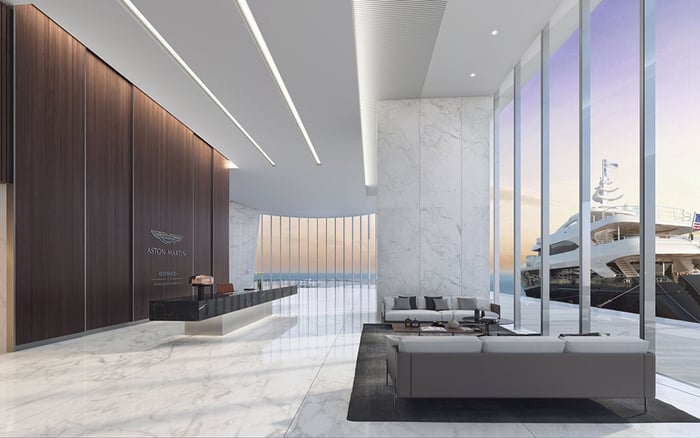
At 300 Biscayne Boulevard Way, Aston Martin Residences occupies the convergence of the Miami River and Biscayne Bay. Its approximately 391 residences across 66 floors create a broader market than One Thousand Museum. That scale may support transaction activity, but it also requires sellers to differentiate by floor, view, exposure and residence line.
An August 2026 snapshot showed about 50 residences for sale, ranging from $850,000 to $75 million. That extraordinary spread makes a building-wide average less revealing. Recorded transactions included an approximately 1,699-square-foot home that sold for about $2.05 million after a $2.35 million ask, and an approximately 3,643-square-foot home that closed at $4.65 million after a $5.75 million ask. Those gaps reinforce the importance of negotiation and achieved pricing.
3. Waldorf Astoria Residences Miami - compelling stature, untested stabilization
Planned as a waterfront, 100-story condo-hotel tower at 330 Biscayne Boulevard, Waldorf Astoria includes approximately 360 condominium residences. Its height, hospitality identity and projected sellout above $1 billion give it considerable profile, but its resale durability cannot yet be separated from preconstruction expectations.
Sales launched in May 2021, with one-bedroom residences starting around $1.1 million. Early pricing began near $1,100 per square foot, while a March 2026 snapshot included 15 listings and a 1,078-square-foot one-bedroom asking $3.15 million, or roughly $2,922 per square foot. Until delivery and subsequent closings establish a mature secondary market, visible prices remain expectations rather than proof of stabilized resale value.
Scarcity is not simply a low residence count. It becomes valuable when paired with a recognizable idea and homes suited to the intended buyer. One Thousand Museum combines 84 residences, large-format inventory and an exterior identifiable without signage. This reduces dependence on a renewable brand agreement as the sole source of distinction.
Its weakness is the inverse of the same proposition: a narrow, expensive market can require time. The 157-day average from one August snapshot is a reminder that uniqueness does not ensure immediate liquidity. For a seller, patience and accurate pricing remain essential. For a buyer, longer marketing periods may create negotiating leverage without necessarily diminishing the building's architectural moat.
This is a resale proposition for buyers who prioritize rarity over transaction velocity. The completed tower also allows inspection of the building, its operations and available homes, eliminating the interpretive gap inherent in renderings and future-closing assumptions.
The appeal of Aston Martin Residences Downtown Miami lies partly in its breadth. A wide range of residence sizes and prices can bring more participants into the market, potentially generating more frequent comparable sales. Yet approximately 50 active offerings in an August snapshot also signal meaningful internal competition.
Buyers should resist applying the $75 million trophy ceiling to the broader building. The two recorded sales cited above closed below their asking prices, illustrating how headline positioning and executable value can diverge. Maintenance of approximately $1.25 per square foot per month should also be modeled across the intended holding period. On a large residence, even modest increases can materially affect the next buyer's monthly calculation.
The best acquisition is therefore unlikely to be the building in the abstract. It is the specific home with a defensible combination of elevation, outlook, layout and purchase basis. In pricing and trends analysis, those attributes should be measured against both active competitors and actual closings.
Waldorf Astoria Residences Downtown Miami may ultimately establish a formidable identity through extreme height and hotel service. For now, however, the relevant pricing reflects developer, assignment or future-closing expectations. A projected sellout above $1 billion demonstrates substantial absorption, not proven secondary-market appreciation.
A disciplined buyer should separate three elements: the price paid for the residence, the premium attributed to brand and height, and the value that remains after comparable inventory reaches the market. The condo-hotel structure also makes operating expenses and usage priorities especially important to future demand, even when the address itself is highly recognizable.
For every contender, compare closed prices with original and final asking prices, then examine concessions, days on market and the number of similar residences available. Review HOA changes, insurance costs, special assessments and monthly expenses for the precise square footage under consideration. These variables influence affordability for the next buyer and, consequently, the seller's exit price.
Residence line matters as much as tower selection. A superior view or layout purchased at an undisciplined basis can still underperform, while a thoughtfully acquired home in a larger building may retain an advantage over nearby inventory. The central Downtown lesson is to buy differentiation twice: first in the building, then within it.
The conclusion is measured. One Thousand Museum offers the clearest evidence and strongest scarcity. Aston Martin offers broader liquidity but demands sharper selection. Waldorf Astoria offers high potential with the least stabilized evidence. None should be evaluated on asking prices alone.
For discreet guidance on selecting a Downtown Miami residence with a defensible long-term basis, connect with MILLION.
If branded residences are on your mind — as a home or as an allocation — we would be glad to share what we are seeing, privately.
Begin a quiet conversationOne Thousand Museum ranks first because its 84-residence count, completed status and Zaha Hadid architecture provide the strongest scarcity and post-delivery evidence.
Scarcity limits direct substitutes. It is most persuasive when paired with recognizable design, desirable layouts and sustained buyer demand.
No. Asking prices indicate seller expectations, while achieved prices, concessions and days on market better reveal executable value.
One Thousand Museum contains only 84 residences across 62 stories.
Its approximately 391 residences and broad price range may encourage market activity, but they also create more competition among sellers.
The wide variation in price, size, floor, view and exposure makes residence-level selection more informative than a building-wide average.
Maintenance was reported at approximately $1.25 per square foot per month, which should be modeled over the full holding period.
It remains preconstruction, so its visible pricing reflects expectations rather than a stabilized record of post-delivery resales.
Buyers should review HOA changes, insurance, special assessments, concessions, comparable closings, inventory and days on market.
Yes. After launch, the market tests whether architecture, scarcity, service, carrying costs and residence quality justify the premium.