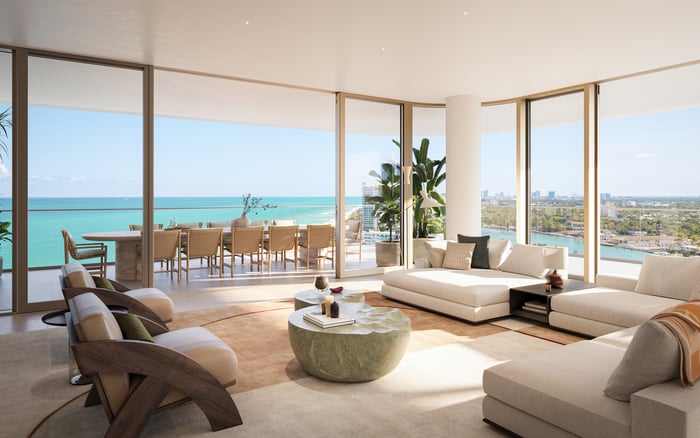
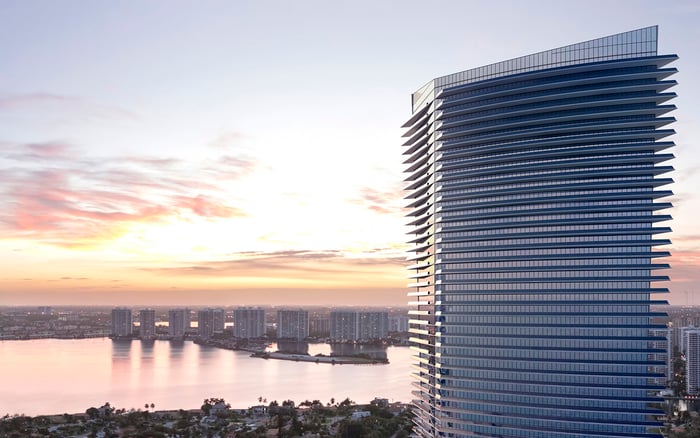
A collector-focused guide to selecting South Florida luxury buildings by humidity control, climate-conscious storage, service logistics, security, and acoustic privacy.

In South Florida, the best building for a serious collector is not simply the newest tower, the most recognizable address, or the residence with the largest gallery wall. It is the building that supports objects, people, and privacy with equal discipline. Art, wine, rare books, instruments, watches, couture, archives, and design objects each place different demands on a home. The common denominator is control.
Miami’s collector culture is amplified each year by Art Basel Miami Beach, but the real test begins long after the fair closes: how consistently a residence manages humidity, how securely it handles storage, and how quietly it allows private life to unfold. In a waterfront climate, ordinary comfort cooling is not the same as preservation-minded environmental planning. Buyers should treat mechanical systems, storage access, and acoustic assemblies as core purchase criteria, not afterthoughts.
The most collector-friendly buildings tend to fall into three profiles: full-service urban towers with serious service infrastructure, boutique ultra-luxury buildings with fewer residences and tighter control, and private-feeling waterfront properties where customization and discretion are easier to manage. The label matters less than the written specifications.
1. Full-service urban towers, for collectors who need infrastructure
Brickell and Downtown remain logical search corridors for collectors who want concierge depth, disciplined valet procedures, service elevators, loading access, and a staff culture accustomed to frequent deliveries. A residence near the cultural and financial core can make appraisals, installations, viewings, and dinners easier to coordinate, especially when the owner’s calendar is international.
In this category, buyers may compare addresses such as Baccarat Residences Brickell, The Residences at 1428 Brickell, and One Thousand Museum Downtown Miami as part of a broader due-diligence tour. The question is not whether a tower appears collectible from the outside. It is whether management can document freight routes, owner storage conditions, access policies, camera coverage, and the building’s approach to humidity management.
2. Boutique buildings, for collectors who value discretion
Boutique buildings can be especially practical when a collector wants fewer shared touchpoints. Fewer residences may make it easier to manage security, vendor access, and privacy during installations or private viewings. Boutique does not automatically mean better, but it can create a more controlled rhythm when the building’s service procedures are strong.
Bay Harbor, Surfside, Coconut Grove, and select Miami Beach enclaves often appeal to owners who prefer quieter arrivals and less lobby intensity. A buyer considering Onda Bay Harbor, for example, should still ask the same technical questions as a buyer in a major urban tower: Is storage conditioned? Are mechanical zones separated? Can handlers use the service elevator without exposing works to heat, rain, or lobby congestion? The boutique feeling is valuable only when the back-of-house systems are equally considered.
3. Ocean and resort-adjacent buildings, for collectors who prize calm
Miami Beach and Surfside can be compelling for collectors who want water, hospitality, and a residential pace suited to private entertaining. These buildings may offer a softer daily experience, but the waterfront climate makes humidity review even more important. Salt air, moisture, temperature swings, and strong light all require careful planning inside the residence.
For this profile, buildings such as The Perigon Miami Beach can belong on the conversation list, not as a substitute for technical review, but as an example of the type of address collectors often study when they want privacy and design presence near the beach. In Miami Beach searches, the buyer’s advisor should move beyond views and finishes and request the mechanical, glazing, door, and storage details that determine whether the residence can perform quietly over time.
4. New-construction opportunities, for collectors who want to customize early
New construction can be attractive because it may allow earlier conversations about wall reinforcement, lighting plans, separate HVAC zones, wine rooms, display corridors, safe rooms, closets, and private storage. The advantage is not guaranteed. It depends on timing, developer flexibility, association rules, and whether the building’s base systems are compatible with specialized needs.
Collectors should be cautious about assuming that a beautiful sales gallery translates into conservation-minded conditions. Written specifications should cover humidity control, HVAC zoning, storage-room conditioning, window and door performance, floor-ceiling assemblies, and service logistics. A collector’s purchase should include input from the art handler, cellar consultant, insurance advisor, and mechanical specialist before design decisions become expensive to change.
South Florida humidity makes active dehumidification essential for comfort, materials, and preservation. Many buyers know to ask about air-conditioning capacity, but collectors need to ask a more precise question: can the residence maintain stable relative humidity in the areas where sensitive objects will live?
A commonly used indoor relative humidity range is 30% to 50%, but the correct target can vary by collection type and professional advice. Paintings, works on paper, textiles, wood furniture, leather, books, wine, and musical instruments do not all react the same way. Stability is often more important than a dramatic single number. Repeated swings can be more damaging than a slightly imperfect but steady environment.
The best buildings for collectors support separate zones or dedicated systems for storage rooms, wine rooms, closets, vaults, and display areas. A single whole-unit setting may keep people comfortable while leaving a closed storage room too damp, a wine room improperly balanced, or a sunlit corridor vulnerable to environmental stress. Buyers should ask whether supplemental dehumidification is possible, where condensate can be routed, and how systems will be monitored when the owner is away.
For collectors, storage is not a leftover cage in the garage. Climate-controlled storage can matter for art, wine, documents, instruments, seasonal couture, archival materials, and family objects with long-term value. Square footage is only one variable. The better question is whether the storage area is secure, conditioned, accessible, and compatible with professional handling.
A serious review should include temperature stability, humidity control, 24/7 access policies, freight-elevator proximity, loading-dock logistics, camera coverage, staff protocols, and insurance compatibility. Buyers should confirm whether storage is private, assigned, shared, caged, enclosed, or separately conditioned. They should also understand whether outside handlers can access the area without unnecessary exposure to lobby traffic, parking heat, or service delays.
Wine deserves its own diligence. A wine room is not simply a decorative glass enclosure attached to a kitchen. It typically requires systems designed for controlled temperature and humidity, because wine storage has different needs from ordinary residential cooling. Collectors with serious cellars should involve a specialist early and verify that the building permits the necessary mechanical approach.
Acoustic privacy is often discussed as comfort, but for collectors it can be operational. Private viewings, appraisals, advisory meetings, music rooms, media rooms, and dinners all benefit from a residence that feels composed. Quiet walls allow a home to function as a salon, not just a display space.
The key is to focus on assemblies rather than adjectives. Buyers should ask for details on demising walls, floor-ceiling systems, glazing, balcony doors, entry doors, and any acoustic ratings that are available. Marketing phrases such as “quiet,” “private,” or “serene” are not enough. Sound moves through structure, glass, door gaps, mechanical penetrations, and corridors.
A collector who plans a listening room, piano room, private screening room, or advisory salon should go further. The residence may need supplemental acoustic design, upgraded doors, specialty treatments, or room-within-room planning. In high-rises, floor impact noise and elevator adjacency should be reviewed before purchase, not after the art is hung.
A collector-focused tour should be as technical as it is aesthetic. Ask for written information on HVAC zoning, dehumidification capability, storage conditioning, service elevator rules, loading areas, security coverage, access logs, and vendor procedures. Confirm whether the association permits specialized installations, additional mechanical equipment, reinforced walls, safe rooms, wine systems, or blackout and UV-control strategies.
For Brickell and Downtown buyers, the priority is often infrastructure: concierge depth, valet procedures, freight movement, and vertical living logistics. For Bay Harbor and Miami Beach buyers, discretion, waterfront humidity, and quieter circulation may matter more. For boutique and new-construction buyers, flexibility is the attraction, but flexibility should be verified in writing.
The right building will not replace professional storage for every object. High-value, fragile, or museum-level collections may still require off-site preservation environments for certain works. But a well-chosen residence can make daily collecting more graceful, reducing environmental stress while elevating the experience of living with important objects.
What is the most important building feature for an art collector in South Florida? Stable humidity control is often the starting point, followed by secure conditioned storage and careful service logistics.
Is ordinary air conditioning enough for a serious collection? Not always. Comfort cooling may not provide the stability or separate zoning needed for art, wine, documents, or instruments.
What humidity range should buyers ask about? A 30% to 50% indoor relative humidity range is a useful baseline, but specific collections may need specialist guidance.
Should storage be climate-controlled? Yes, for sensitive assets. Buyers should verify conditioning, security, access hours, freight routes, and insurance compatibility.
Why do quiet walls matter to collectors? Acoustic separation supports private viewings, appraisals, entertaining, listening rooms, and a calmer daily environment.
Are boutique buildings better for collectors? They can be, especially when fewer residences improve privacy and service control, but technical documentation still matters.
Are Brickell and Downtown good collector locations? Yes, especially for buyers who value concierge service, valet systems, freight access, and proximity to central Miami activity.
Is Miami Beach practical for art collectors? It can be, but waterfront humidity, light exposure, glazing, storage, and service access deserve careful review.
Can a wine room use the same HVAC as the residence? Serious wine storage usually needs dedicated temperature and humidity control rather than standard residential cooling.
What should buyers request before signing? Written details on HVAC zoning, humidity control, storage conditions, acoustic assemblies, service access, and building rules.
For a discreet conversation and a curated building-by-building shortlist, connect with MILLION.
If branded residences are on your mind — as a home or as an allocation — we would be glad to share what we are seeing, privately.
Begin a quiet conversation