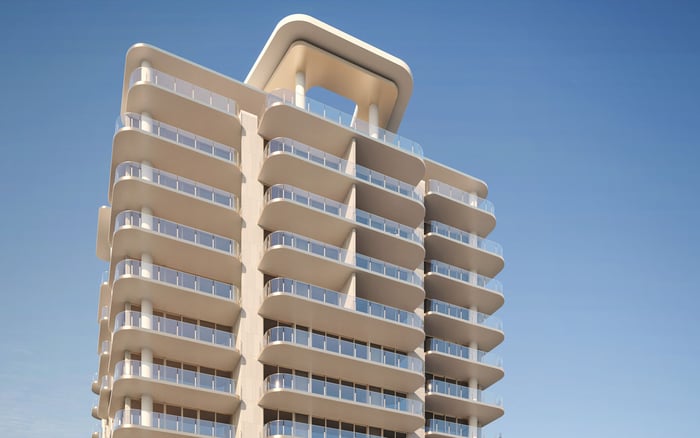
A private elevator is only as discreet as the access system behind it. Palm Beach buyers should examine credentials, visitor workflows, logs, biometric policies, outages, and deletion rights before closing.

A private elevator opening directly into a residence is among luxury design’s most persuasive gestures. Yet the architectural experience reveals little about the digital controls behind it. True privacy depends on who can call the elevator, which floors a credential can reach, when that permission is active, whether every event is logged, and how quickly access can be revoked.
Modern systems can integrate mobile credentials, facial recognition, RFID fobs, QR codes, and PINs within a single management portal. An elevator app may also support registration, device configuration, monitoring, and broader access control. Before buying, request a live demonstration using resident, guest, and service credentials. The objective is to assess the building as an operating environment, not merely a beautifully staged arrival.
This scrutiny belongs in every serious Palm Beach search, including a second-home purchase in which owners may manage arrivals remotely. It is equally relevant when evaluating established residences and new-construction offerings. Properties such as Palm Beach Residences can serve as starting points for a broader conversation with sales teams, association representatives, and counsel about the systems and policies contemplated or installed.
A private elevator is only as private as the permissions governing it.
Request a complete credential map covering the lobby, garage, elevator, residence vestibule, amenities, storage, service entrance, and any secondary points of entry. Determine whether one credential opens every area or permissions can be limited by door, floor, date, and time. The more precise the controls, the easier it may be to separate household access from vendor access.
Household employees, property managers, dog walkers, cleaners, chefs, nurses, and recurring contractors should ideally receive unique credentials rather than a shared code or unrestricted fob. Ask who creates and approves each credential and whether an owner can suspend it immediately. Confirm what happens when a phone is replaced, a fob is lost, an employee departs, or ownership changes.
Also examine the distinction between the main elevator and service circulation. A direct opening into the residence should not allow an authorized visitor to reach unrelated floors or return outside an approved schedule. In West Palm Beach, buyers comparing residences such as Forté on Flagler West Palm Beach should apply the same diligence to this operational review as they do to layouts, views, and finishes.
Visitor convenience can conceal consequential policy choices. Some systems allow an owner to preregister a guest and issue a temporary mobile permission or code, avoiding a physical card and exclusive reliance on front-desk approval. Remote onboarding may also involve identification data or facial verification before access is granted.
Ask management to demonstrate the entire journey. When does a guest credential activate? When does it expire? Can it be restricted to one entrance, one elevator destination, or a narrow time window? Can an owner revoke it instantly from outside the building? Does a recurring visitor receive persistent access-and, if so, who reviews that status?
Deliveries warrant a separate protocol. Clarify whether couriers enter the residential elevator, remain in a staffed area, use a service route, or receive temporary permissions. Apply the same questions to contractors carrying equipment. A polished building-app interface is not enough if registration grants excessive access or leaves responsibility unclear after a visit ends.
A smartphone platform may allow authorized users to unlock doors, admit visitors, review entry logs, and manage permissions across multiple locations. That can be highly useful for a seasonal owner, but the app deserves the same scrutiny as any essential building system.
Ask whether every owner and household member receives an individual account, whether multifactor authentication is available, and whether administrators can impersonate or override users. Determine which notifications can be enabled, how quickly records appear, and whether owners can view only their own unit activity. Establish who can review or export events involving the elevator, garage, amenities, storage, and service entrance.
The lifestyle benefit is strongest when convenience does not compromise discretion. During a comparison that includes Mandarin Oriental Residences, West Palm Beach, request the current or proposed access workflow in writing and verify it again near closing. Vendor capabilities do not establish that a particular property has enabled every available feature.
Facial recognition may be presented as hands-free access without a phone, card, or fob. The convenience of that approach should not supersede informed consent and documented governance.
Ask whether biometric enrollment is optional. A resident who declines should understand the available alternative, whether a fob, PIN, staffed entrance, mechanical key, or another method. Request the written policy detailing what data is collected, its permitted uses, who can access it, where it is stored, how it is secured, whether vendors receive it, how long it is retained, and how deletion is confirmed after a sale or credential revocation.
Because legal obligations can depend on the building, its governing documents, its contracts, and current law, buyers should not assume that technology alone provides adequate protection. Florida counsel can review the declaration, bylaws, relevant approvals, vendor agreements, consent procedures, and record-handling practices.
Request a controlled test involving a lost phone, internet interruption, power failure, app outage, camera failure, and malfunctioning reader. Confirm who responds after hours, how residents enter, how emergency personnel are admitted, and whether the elevator maintains safe access rules while disconnected. Backup procedures should work without requiring an owner to disclose a permanent master code.
Then review association minutes, relevant owner votes, technology contracts, insurance coverage, incident-response plans, and any prior access or data-security incidents disclosed during diligence. Determine whether biometric templates and access logs are stored locally or held by an outside provider. Ask whether the contract addresses portability and deletion when the association replaces a vendor.
A visit to The Ritz-Carlton Residences® West Palm Beach or any comparable property should therefore include operational questions alongside design considerations. Privacy is not a single amenity but a chain of permissions, people, policies, hardware, and fallback procedures.
Before the inspection period ends, obtain the credential matrix, visitor policy, biometric notice, retention and deletion terms, log-access rules, outage plan, and vendor-transition procedure. Test actual workflows rather than accepting a feature sheet. Confirm that household staff and recurring vendors can receive individually limited credentials, and identify who has the authority to issue, audit, suspend, and delete them.
The best result is quiet competence: the owner arrives effortlessly, guests are welcomed without confusion, staff access is appropriately bounded, and the building can explain exactly what it records. For a confidential review of Palm Beach and West Palm Beach residences, connect with MILLION.
If branded residences are on your mind — as a home or as an allocation — we would be glad to share what we are seeing, privately.
Begin a quiet conversationNo. Privacy depends on how credentials are assigned, limited, logged, shared, and revoked across the building.
A system may combine mobile credentials, facial recognition, RFID fobs, QR codes, and PINs within one management portal.
Buyers should seek unique credentials limited by permitted doors, floors, dates, and schedules rather than shared access.
Test activation, expiration, destination limits, recurring-visitor rules, and immediate revocation for guest permissions.
It may. Buyers should ask what information is collected, whether biometric enrollment is optional, and what alternative access method is available.
Systems may log elevator, garage, amenity, storage, and service-entry events, subject to the building’s configuration and policies.
Buyers should ask whether it is optional and identify a workable non-biometric alternative such as a fob, PIN, key, or staffed entrance.
It should address collection, permitted use, access rights, storage, security, retention, deletion, and disclosures to technology vendors.
Test power and internet failures, app downtime, lost phones, malfunctioning readers, and the transition to a replacement vendor.
Review relevant association minutes, owner votes, technology contracts, insurance coverage, incident plans, and disclosed security incidents.