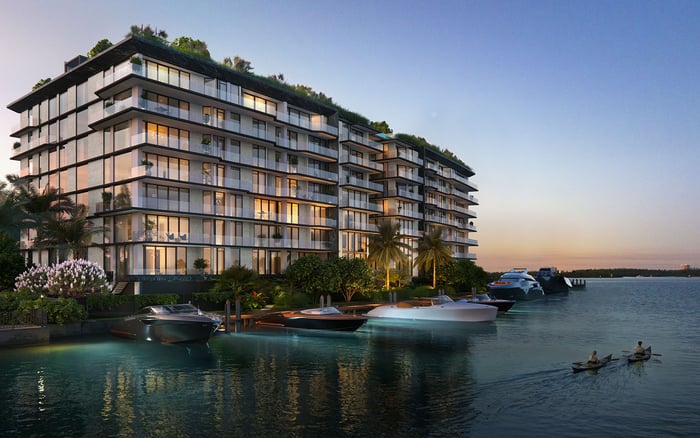
Buyers considering Alma Bay Harbor Islands should examine the complete delivery route, elevator specifications, reservation procedures, and vendor access before determining whether the building can support major moves, art installations, and private events.

Buyers evaluating Alma Bay Harbor Islands should look beyond the visual experience of arriving at a residence. A major move, art installation, appliance replacement, or catered gathering depends on the building’s complete circulation system, from the unloading point to the front door.
The central diligence question is not simply whether an elevator reaches the residence. Buyers need to understand which elevator vendors may use, how much it can carry, what dimensions it can accept, and whether the route remains workable when protective coverings, carts, crates, and installation equipment are added.
A refined arrival depends on an equally considered route behind the scenes.
Terms describing a private or direct arrival concern the resident experience at the destination. They do not, without supporting plans and specifications, establish the number of elevator cars, their dimensions, their rated loads, or how service activity is handled.
A buyer should therefore avoid drawing conclusions from a marketing phrase alone. The relevant evidence includes elevator schedules, architectural plans, clear-opening dimensions, load ratings, stop information, and written operating procedures. These materials help distinguish an attractive arrival feature from the practical capacity required for repeated deliveries or unusually large objects.
The same approach applies when comparing Alma with Mila Bay Harbor Islands. Proximity or a related design context should not substitute for project-specific documents. Each residence and building route should be evaluated independently.
Elevator-cab dimensions are only one part of the analysis. The controlling constraint could be an exterior door, loading entrance, corridor, ceiling condition, tight turn, elevator opening, landing, or private foyer. A piece that fits inside a cab may still be impossible to maneuver through the approach.
For furniture, art, and specialty equipment, buyers should work with the dimensions of the protected or crated object rather than the unwrapped piece. The review should account for width, depth, height, diagonal clearance, total weight, turning space, and any equipment needed by the installer. Door hardware, wall protection, floor coverings, and cart dimensions can further reduce usable clearance.
A practical route study follows the object step by step. It identifies where a delivery vehicle may stop, where items can be staged, which entrance vendors must use, how each turn will be made, which elevator is available, and how the object moves from the landing into its final room. Written confirmation from the relevant project representatives is preferable to an assumption based on a floor plan alone.
Art logistics can be more demanding than ordinary furniture delivery. Crates may be substantially larger than the works they protect, while installation teams may require carts, lifts, rigging tools, or temporary staging space. Weight distribution can also matter independently of whether the object clears the elevator door.
Collectors should provide the project team with actual crate dimensions, weights, handling instructions, and equipment requirements. The response should identify a viable internal route and any conditions governing access. If the normal route is unsuitable, buyers can ask whether another method may be considered and what written approvals would be necessary before relying on it.
This analysis should occur early enough to influence the purchase decision. A verbal assurance that an item will “probably fit” is not equivalent to a route verified against current dimensions and governing documents.
A household move involves repeated trips rather than a single object. Movers may need elevator protection, temporary floor coverings, staging space, loading access, and time to complete the work without interruption. Buyers should identify how those needs interact with resident circulation and building presentation.
The diligence package should address reservation procedures, permitted access periods, insurance documentation, deposits if applicable, protective measures, staffing requirements, and responsibility for damage. These are questions to verify, not policies to presume. Buyers should also determine whether a reservation affects access for residents or other vendors.
Comparable scrutiny can be applied to nearby options such as The Well Bay Harbor Islands and Origin Bay Harbor Islands. The goal is not to assume that the projects operate alike, but to use a consistent checklist when reviewing each one.
Private entertaining introduces a different circulation pattern. Caterers, florists, rental teams, audiovisual technicians, and cleanup crews may arrive at different times with carts and equipment. Even when every individual item fits, overlapping vendor activity can create operational pressure.
Buyers should ask where vendors arrive, whether staging is available, which entrance and elevator they may use, and how equipment reaches the residence or relevant amenity area. The review should also clarify reservation requirements, delivery windows, cleanup access, and any limits contained in the governing documents.
The most useful answer is a route and procedure that match the owner’s likely style of entertaining. Someone planning intimate dinners may have different needs from a buyer expecting elaborate installations or multiple vendor teams.
A broader South Florida search may include buildings with different scales, circulation plans, and service arrangements. For example, Rivage Bal Harbour may form part of a buyer’s comparison set, but its inclusion does not establish anything about Alma’s infrastructure.
A disciplined comparison uses the same categories for every property: elevator dimensions, clear openings, rated loads, unloading access, turning constraints, vendor routes, reservation procedures, and documentary support. This makes it easier to identify meaningful differences without relying on general impressions.
Buyers should also separate physical capability from operating permission. An object may fit mechanically while a proposed delivery method conflicts with building procedures. Conversely, a permitted delivery window does not prove that the route can accommodate a particular crate. Both questions require satisfactory answers.
Before treating service capacity as resolved, buyers can request the current elevator schedule, relevant architectural drawings, loading and circulation plans, draft or final condominium rules as available, and written responses to object-specific questions. Any discrepancy among marketing descriptions, technical plans, and governing documents deserves clarification.
The request should be precise. Which car may movers and vendors use? What are its interior dimensions, clear door opening, rated load, and stops? Where does the route begin? What is the narrowest point? Are there turns that reduce practical clearance? What protection, insurance, scheduling, or supervision requirements apply?
Legal counsel, an architect, an art logistics specialist, or an experienced mover can assist when a buyer’s possessions or event plans create unusual requirements. Their role is to test the actual route and documentation rather than infer capability from a general property description.
Service circulation remains relevant throughout ownership. Furniture changes, appliance deliveries, art rotation, repairs, and renovations all depend on the same route. A buyer should therefore evaluate not only whether current possessions can be delivered, but also whether the building can support foreseeable changes.
The objective is not to demand a particular infrastructure model. It is to establish what Alma provides, how that system may be used, and whether it suits the buyer’s household, collection, and hospitality plans. Documented answers allow the private residential experience to be assessed alongside the operational details that sustain it.
For confidential guidance on evaluating Alma and other exceptional South Florida residences, connect with MILLION.
If branded residences are on your mind — as a home or as an allocation — we would be glad to share what we are seeing, privately.
Begin a quiet conversationNo. Buyers should rely on current plans, specifications, and written operating procedures to determine the building’s service arrangement.
Request interior cab dimensions, clear door openings, rated loads, stops, and identification of the car available to movers and vendors.
A doorway, corridor, turn, landing, or foyer may be more restrictive than the elevator cab itself.
They should compare actual crate dimensions, total weight, handling equipment, and turning requirements against every part of the proposed route.
They should confirm access periods, reservation procedures, insurance documents, protective measures, staging arrangements, and any applicable deposits.
Rated load helps determine whether an elevator can safely carry an object together with handlers, carts, and necessary equipment.
Ask where vendors unload, which entrance and elevator they may use, where equipment can be staged, and what scheduling procedures apply.
No. A reliable review also requires clear-opening dimensions, vertical clearances, turning space, and the protected object’s actual measurements.
A specialist should be consulted before purchase when valuable art, unusually large furniture, or complex installation equipment creates specific access requirements.
Future furniture changes, appliance deliveries, repairs, renovations, and art rotations will depend on the same circulation route.