Rivage Bal Harbour is publicly described as pet-friendly, but the available language leaves consequential details unresolved. Buyers should use the contract period to secure the governing documents, define the large-pet restriction, and obtain written procedures for animal registration, service-animal accommodations, and elevator routing.

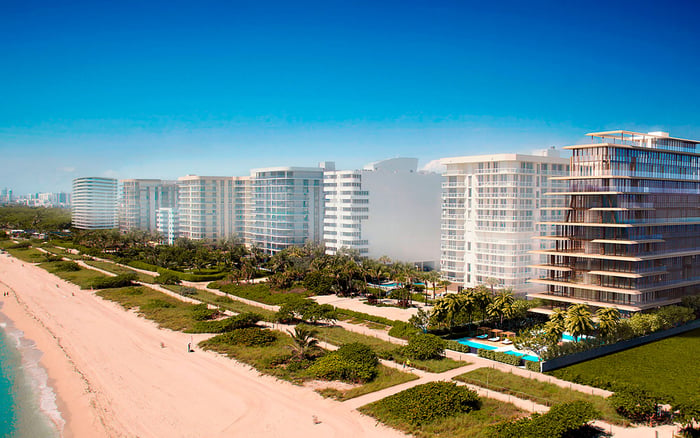
At 10245 Collins Avenue, Rivage Bal Harbour occupies a rarefied stretch of Bal Harbour, where privacy, service, and ease of arrival are central to the residential proposition. For buyers who live with an animal, however, the most consequential details are not captured by a broad pet-friendly label. They reside in the condominium documents, current house rules, management procedures, and the day-to-day administration of those provisions.
The building is described as pet-friendly. Available residence details further state that pets are permitted for owners, while large pets are not allowed for owners or renters. That language offers useful direction, but it lacks the precision required for a purchase decision. No numerical weight threshold or other published definition establishes what qualifies as a large pet.
In a staffed luxury condominium, the practical rule is the written rule plus its daily administration.
The available language is also silent on the maximum number of animals per residence. It does not identify breed restrictions, deposits, registration charges, or move-in pet fees. A buyer should therefore treat the description as an invitation to investigate, not as approval for a particular animal.
The distinction between owners and renters warrants careful review. The available language expressly permits pets for owners and prohibits large pets for owners and renters. On its own, it does not fully explain whether renters may keep smaller household pets, whether guests may arrive with animals, or whether separate restrictions apply to extended stays.
Before the contract deadline, request the current declaration, amendments, rules and regulations, house rules, and every animal-related form. Confirm in writing the number of animals permitted, any weight or size definition, and whether restrictions apply per animal or in aggregate. Buyers should also ask how management classifies dogs, cats, and any other household animals contemplated for the residence.
This level of review is particularly important when comparing nearby options. Oceana Bal Harbour may be part of the same geographic search, while The Delmore Surfside may enter a broader coastal shortlist. Yet animal rules are building-specific. A policy, approval, or routine at one condominium should never be assumed to apply at another.
The phrase “large pets not allowed” sounds straightforward until a buyer applies it to a specific animal. Without a published threshold, size might be interpreted by weight, height, breed profile, or another standard contained in documents outside the property description. The relevant definition should be obtained before the buyer’s ability to cancel or renegotiate expires.
Request a written response identifying the controlling provision and confirming how it applies to the buyer’s animal. Include the animal’s species, breed if applicable, approximate weight, and the number of animals in the household. If the answer is conditional, ask what documentation or approval remains outstanding and who has authority to issue the final determination.
Do not rely solely on a verbal assurance from sales personnel, a listing field, or an informal conversation. The objective is not simply to hear that an animal is “probably fine.” It is to establish which document controls, whether approval is required, and whether that approval will remain valid after closing.
A service-animal or other assistance-animal request should proceed through the building’s current accommodation process rather than be folded into an ordinary household-pet inquiry. That procedure is not publicly available, so buyers should request it directly from the association or on-site general manager.
Ask which forms are currently used, where a request is submitted, who reviews it, and what building-access instructions follow approval. The purpose is procedural clarity. Buyers should not assume that an ordinary pet restriction, charge, registration requirement, or elevator routine applies in precisely the same way to an accommodation request.
Privacy also matters. Determine which management contact receives the request and how building staff is informed of any approved access protocol. The buyer should seek a clear, written path that household members, caregivers, and staff can follow consistently, without unnecessary disclosure or confusion.
Rivage residences are described as having private elevators, including direct private elevator entry. That feature may shape expectations of discreet circulation, but the available information does not establish whether household pets may use private or passenger elevators or must follow a service route.
Ask management to map the complete journey: the approved entrance, lobby or back-of-house path, elevator bank, garage or valet connection, and route to any designated relief area. Confirm leash or carrier requirements and whether different procedures apply during move-in, maintenance visits, emergencies, or periods when an elevator is unavailable.
The same discipline applies across the wider oceanfront market. A buyer considering The Ritz-Carlton Residences® Miami Beach alongside Rivage should request each building’s written routing instructions. Private-elevator marketing does not, on its own, establish animal access.
Rivage has 24-hour security, valet service, an on-site general manager, and a mailroom with secure package technology. Together, these features create a staffed operating environment with a clear management point of contact, helping buyers translate broad policy language into practical instructions.
A well-framed request should cover both documents and an operational walkthrough. Who registers an animal? Is advance notice required? Are there identification records, recurring charges, or move-in fees? Which entrance and elevator should be used? What happens if staff members apply the rule differently? Who resolves a discrepancy after hours?
For a luxury buyer, this is not a minor lifestyle preference. Pets affect daily arrival, departure, staff interactions, guest protocols, and the residence’s suitability over time. The principle is simple: policies should be evaluated for both legal wording and lived convenience.
The strongest file contains the governing provision, current management guidance, completed forms, written approval where required, and a record of any charges. Keep the response specific to the animal and residence under consideration. If ownership will be through an entity or trust, ask whether that structure changes registration or occupancy procedures, without assuming that it does.
Before waiving contingencies, confirm five points: eligibility of the particular animal, permitted number of animals, definition of “large,” required registration or accommodation steps, and the approved elevator and entrance route. Also ask whether rules differ for owners, tenants, guests, household pets, and assistance animals.
Rivage Bal Harbour presents a highly serviced residential setting, but service works best when expectations are explicit. The refined approach is neither to dismiss the pet-friendly designation nor to overread it. It is to secure a written answer precise enough to support the household’s actual routine after closing.
For discreet guidance on Rivage and South Florida’s premier residences, connect with MILLION.
If branded residences are on your mind — as a home or as an allocation — we would be glad to share what we are seeing, privately.
Begin a quiet conversationPublic information describes Rivage as pet-friendly, and published residence listings state that pets are permitted for owners. Buyers should still verify the current governing documents and management rules.
Published listing language says large pets are not allowed for owners or renters. No public numerical threshold defines “large,” so written clarification is essential.
The public pet information does not specify a maximum number of animals per residence. Buyers should ask the association or on-site manager for the current limit.
Public-facing information does not state breed restrictions. The current condominium documents and animal forms should be reviewed for any applicable criteria.
The available language prohibits large pets for renters but does not fully explain whether renters may keep smaller household pets. Management should confirm the rule in writing.
Public information does not state pet deposits, registration charges, or move-in pet fees. Buyers should request a current fee schedule and animal forms.
Rivage residences are described as having private elevators, but public materials do not specify animal access or routing. Confirm the approved entrance and elevator path before closing.
The public services information does not publish an accommodation procedure. Buyers should request the current process directly from the association or on-site general manager.
The association or Rivage’s on-site general manager should provide current documents and operating instructions. Material answers should be obtained in writing.
Confirm the animal’s eligibility, number limits, the definition of “large,” registration or accommodation steps, charges, and the required entrance and elevator route.