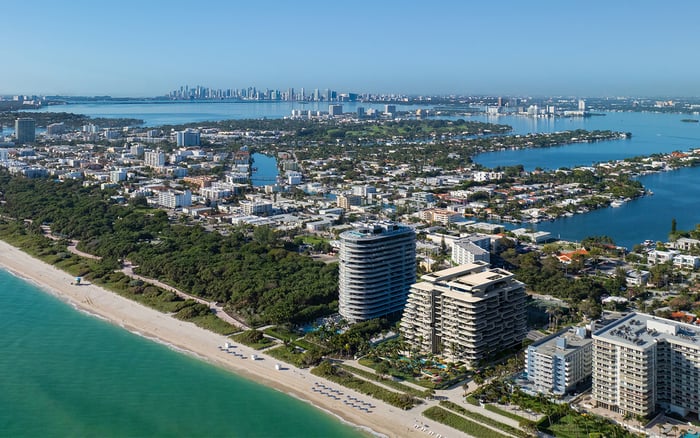
At Rivage Bal Harbour, a disciplined purchase separates construction financing, contract deposits and future association obligations. Understanding each payment calendar is essential to protecting liquidity and preserving resale flexibility.

At Rivage Bal Harbour, the financial decision extends beyond the residence itself. The oceanfront development at 10245 Collins Avenue places a substantial acquisition within a shared-ownership structure. The question is not simply what the home costs, but when cash must be available-and which obligations could still matter at resale.
No adopted Rivage association capital-project funding plan, current special assessment, final association budget or unit-specific reserve contribution is established here. That distinction is essential: evaluating how a future funding plan could affect ownership does not imply that an assessment exists.
The prudent approach is to separate three funding streams, model their timing independently and combine them in a single liquidity calendar before signing.
Rivage’s developers secured $424 million in construction financing from TYKO Capital. That financing belongs to the development side of the transaction. It is not an announced condominium-association loan and should not be treated as a measure of an individual owner’s future assessment exposure.
Purchaser deposits form a second stream. Governed by the purchase agreement, they represent cash committed toward the acquisition. Association operating charges, reserves and any capital-project financing form a third, governed by the applicable documents and law.
Each category answers a different question. Construction financing concerns project delivery; deposits concern acquisition liquidity; association funding concerns shared ownership costs. Reviewing one does not replace reviewing the others. In particular, a large construction loan does not establish that future association reserves are funded or that owners will have no additional capital obligations.
The February 2024 payment schedule specifies 20% at contract, 10% at groundbreaking, 10% at top-off and 60% at closing. This commits 40% of the purchase price before closing, excluding other costs.
Using the historical advertised starting price of $8 million, expressly subject to change, the schedule produces the following illustration:
| Payment milestone | Share of price | Illustrative payment | | --- | --- | --- | | Contract | 20% | $1.6 million | | Groundbreaking | 10% | $800,000 | | Top-off | 10% | $800,000 | | Closing | 60% | $4.8 million |
At a hypothetical $15 million purchase price, the same structure requires $6 million before closing and $9 million at closing. These are purchase-price calculations, not all-in ownership budgets or current price quotations.
Payment schedules differ: one places the second 10% installment 90 days after contract rather than at groundbreaking. Use the executed agreement to establish payment triggers, particularly when buying after a construction milestone has passed. Have counsel clarify what would be due immediately and what remains contingent.
Groundbreaking took place in September 2024; as of November 2024, the anticipated completion target was 2027. Neither establishes a guaranteed closing date. Model a later closing alongside the contractual schedule so acquisition funds do not depend on an assumed delivery month.
Florida’s 2025 condominium framework provides the legal baseline for this analysis. Section 718.112 requires budgets to include reserves for capital expenditures and deferred maintenance, including roof replacement, building painting and pavement resurfacing, subject to its provisions.
The structural integrity reserve study, or SIRS, framework generally requires studies at least every 10 years for condominium buildings with three or more habitable stories. Covered elements include roofing, load-bearing structural systems, fire protection, plumbing, electrical systems, waterproofing and exterior painting, and windows and exterior doors.
Required SIRS reserves are subject to restrictions on waiver or reduced funding. Buyers should not assume a future owner vote can simply eliminate these contributions. Florida condominium counsel should confirm applicable new-building deadlines, turnover requirements, exceptions, approvals and any changes since the 2025 baseline.
For a buyer also considering Oceana Bal Harbour, the useful comparison is documentary rather than cosmetic: examine each property’s budget, reserve assumptions and unit-level allocation. A headline monthly charge alone does not reveal the timing or completeness of capital funding.
Subject to applicable conditions and approvals, Florida’s 2025 framework permits qualifying structural-reserve funding through special assessments, loans and lines of credit. These mechanisms can produce different cash-flow patterns even when funding the same work.
Recurring reserve contributions
spread funding through the budget. Ask which components are covered, which cost assumptions support the contributions and whether projected balances match anticipated expenditure dates.
A special assessment
can concentrate the obligation into a lump sum or installments. If one is proposed or adopted, obtain the amount, purpose, approval status, payment dates and actual allocation to the residence. Distinguish discussion from an enforceable payment obligation.
Association borrowing
may spread payments over time, but its financing terms require review. Request the interest structure, maturity, repayment schedule, fees and any balloon payment. Determine how debt service would enter the owner’s charges and what, if anything, becomes payable upon a sale.
The January 2025 residence count for Rivage was 56, although counts vary. Confirm current specifications. A relatively small ownership base makes allocation especially important, but dividing a project cost equally by 56 is not a valid unit-level estimate unless the governing documents expressly support that method.
Before closing, an intended exit is first a contract question. Rivage’s assignment rights, consent requirements, assignment fees and resale restrictions are not established here. Do not let the purchase depend on transferring the contract unless counsel has confirmed the contractual route.
After closing, a funding plan can affect negotiations by changing the cash requirements a prospective buyer evaluates. Present a near-term assessment, ongoing reserve contribution and association-loan payment separately. Whether an amount must be paid, allocated between parties or otherwise addressed at closing requires review of the applicable documents and sale agreement.
No Rivage transaction evidence established here quantifies a reserve-related resale discount or marketing delay. Treat those outcomes as scenarios, not forecasts. Compare a sale before a payment date, a sale after payment and a longer hold, using actual obligations rather than assumed price penalties.
If the search extends to Surfside and Ocean House Surfside, apply the same questions independently. Neither location nor project positioning establishes equivalent funding obligations or transfer flexibility.
Request the proposed operating budget, reserve assumptions, available SIRS documentation, capital-work disclosures and any assessment or association-loan terms. Add the purchase agreement, governing expense-allocation provisions and written clarification of assignment restrictions.
Build one calendar showing deposits, the closing balance, projected recurring ownership charges and any documented capital payments. Keep hypothetical contingencies separate from confirmed obligations. The objective is not to predict every future expense, but to avoid needing a sale precisely when another payment becomes due.
For a discreet conversation about your Bal Harbour purchase priorities, connect with MILLION.
If branded residences are on your mind — as a home or as an allocation — we would be glad to share what we are seeing, privately.
Begin a quiet conversationAn adopted Rivage capital-project funding plan or current special assessment is not established here. Request current association and purchase disclosures before budgeting for a specific obligation.
No. It is developer construction financing from TYKO Capital, not an announced condominium-association capital-project loan.
The February 2024 schedule requires 40% of the purchase price before closing: 20% at contract and two subsequent 10% installments. The executed agreement should control cash-flow planning.
It produces $1.6 million at contract, $800,000 at groundbreaking, $800,000 at top-off and $4.8 million at closing. This is an illustration using a historical advertised starting price and excludes other costs.
Published schedules differ between groundbreaking and 90 days after contract for the second 10% payment. Confirm the actual trigger and any immediately due installments in the executed agreement.
No. The 2027 completion window was a historical target described in November 2024, not a guaranteed closing date.
Required SIRS reserves are subject to statutory restrictions on waiver or reduced funding. Counsel should confirm the provisions and timing applicable to the building.
Not unless the governing documents prescribe equal allocation. A unit-level estimate must use the condominium’s actual expense-allocation formula.
Assignment rights, consent requirements, fees and restrictions are not established here. Counsel should review the purchase agreement before a buyer relies on a pre-closing exit.
No established Rivage transaction evidence here quantifies a borrowing-related resale discount or delay. Evaluate actual debt-service obligations and sale terms without assuming a specific price effect.