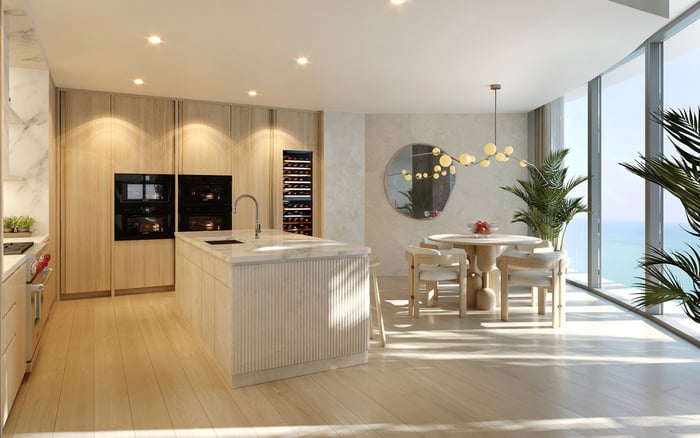
For Washington, D.C. families planning a move to Bal Harbour, a new residence and a new school year need separate timelines. Use Rivage’s estimated delivery window as a planning reference, then build temporary housing, contractual review, and school continuity around confirmed milestones.

A move from Washington, D.C. to Bal Harbour is more than a change of address. For a family purchasing new construction, it requires coordinating a residence, a school calendar, and the practical arrangements that make daily life feel settled. The starting principle is simple: a projected delivery year should not determine a child’s first day at a new school.
Maintain two schedules. One tracks the property purchase through contractual and practical milestones. The other protects the household’s preferred school transition. Temporary housing can connect them, but only if its duration, cost, and flexibility are considered before either schedule becomes binding.
Rivage Bal Harbour is an oceanfront condominium project at 10245 Collins Avenue, currently under construction. It broke ground in September 2024. The development brings together Related Group, Two Roads Development, and Rockpoint, with architecture by Skidmore, Owings & Merrill and interiors by Rottet Studio. Plans call for 61 residences across 24 stories.
The delivery estimate is 2027 and remains subject to change. It does not establish a unit-specific handover date and should not anchor a school enrollment decision.
Keep estimated completion, contractual closing, and practical move-in readiness distinct. Request written updates explaining what each milestone means for your residence. Construction progress can inform planning; it cannot, by itself, confirm when your family can occupy the home.
Miami-Dade County Public Schools’ approved 2026-2027 student calendar began Thursday, August 13, 2026, and ends Thursday, June 3, 2027. It contains 180 instructional days across four grading periods, with spring break scheduled for March 22-26, 2027.
These dates are useful reference points, but they do not establish the first day of the 2027-2028 school year. Do not reserve an August 2027 moving date on the assumption that the next calendar repeats this one. Confirm the relevant year directly with the selected school before making nonrefundable commitments.
Private and charter schools may follow different calendars. For a family leaving D.C., compare the current school’s departure options with the receiving school’s entry requirements. Ask about records, admissions or enrollment deadlines, and address documentation. Neither a property purchase nor a temporary lease should be treated as automatic confirmation of a school placement.
The first path is to remain in D.C. until a suitable school-year transition while managing the property purchase separately. This may preserve continuity, but it requires a plan for any closing obligation that arrives before the household is ready to relocate. Ask counsel how the purchase timetable interacts with that preference rather than assuming closing can wait.
The second path is to relocate earlier into temporary housing, allowing school and household routines to begin independently of the new residence. This separates the school move from the construction schedule but introduces another lease, storage decisions, and a second household move.
Neither path is inherently superior or guaranteed to work. Compare them against the child’s needs, the selected school’s requirements, adult travel obligations, and the cost of maintaining two residences. The right choice remains workable if the property schedule changes; it does not merely align with the earliest estimate.
Consider a furnished rental for three to six months as an initial planning scenario, not an established local norm or a promise of availability. Before signing, evaluate a semester- or year-long fallback. A short initial term offers little protection if an extension depends entirely on a future negotiation.
Bal Harbour, Surfside, and Bay Harbor Islands are areas to investigate. Keep the rental search distinct from the purchase search: considering Ocean House Surfside as a purchase alternative does not establish temporary accommodation there or comparable delivery timing.
The same distinction applies if Alana Bay Harbor Islands is on the ownership shortlist. Assess the interim address on its own merits, including the actual school journey and proposed lease terms.
Request written confirmation of permitted occupancy, building approval requirements, furnishings, parking, pet terms where relevant, and any extension or early-termination provisions. Verify school-related address requirements separately. A neighborhood or building name is no basis for assuming rental availability, rates, minimum terms, or school assignment.
Ask a Florida real-estate attorney to review the purchase agreement’s closing deadlines, notice provisions, extension rights, and any remedies or limitations relevant to delay. These are questions for review, not statements about Rivage’s actual contractual provisions. The operative language must come from the agreement governing your purchase.
Then examine the temporary lease alongside that agreement. What happens if the residence is ready earlier than expected? What happens if the lease expires first? Which costs would remain payable, and which dates require advance notice? Have counsel distinguish documented rights from flexibility that would require another party’s agreement.
Build a household contingency budget around those answers. Include potential housing overlap, storage, an additional move, and travel between D.C. and South Florida. Use actual quotations and proposed terms rather than assumed local pricing.
Treat the temporary residence as a functioning home, not a waiting room. Prioritize space for homework, reliable work arrangements, and manageable daily logistics over proximity to the construction site. Test the school journey at the relevant hours before committing to an address.
Separate belongings into what the family needs immediately, what can remain in D.C., and what can stay in storage until permanent occupancy is confirmed. Ask the moving team about staged delivery and rescheduling terms before booking.
For the new residence, seek confirmation of any remaining occupancy, inspection, or move-in arrangements before coordinating furniture deliveries. Establish whether planned furnishing or installation work should be completed before the family arrives. Track financial closing and a comfortable first night at home as separate household milestones, even if they ultimately occur close together.
Maintain a single decision sheet covering the school calendar, purchase agreement, temporary housing, and moving logistics. Give every unresolved item an owner and a next action. Update it when written information changes rather than allowing an optimistic construction estimate to become a fixed family deadline.
The objective is not to predict delivery perfectly. It is to preserve enough flexibility that a change in the building schedule does not force an avoidable change in the child’s school routine.
For a discreet discussion of your Bal Harbour purchase and relocation priorities, connect with MILLION.
If branded residences are on your mind — as a home or as an allocation — we would be glad to share what we are seeing, privately.
Begin a quiet conversationThe delivery estimate is 2027 and remains subject to change. It does not confirm a unit-specific move-in date.
Rivage is an oceanfront condominium project at 10245 Collins Avenue in Bal Harbour.
No. Track estimated completion, contractual closing, and practical move-in readiness separately, and request written updates specific to the residence.
The approved student calendar began Thursday, August 13, 2026, and ends Thursday, June 3, 2027. It contains 180 instructional days.
No. Confirm the 2027–2028 start date directly with the selected school before committing to a moving schedule.
They may use different calendars. Confirm dates and enrollment requirements with the selected school rather than relying on the district calendar.
A three- to six-month furnished rental is one planning scenario, with a semester- or year-long fallback worth evaluating. Availability and extension terms must be verified for the specific rental.
Bal Harbour, Surfside, and Bay Harbor Islands are suggested search areas. Verify each address’s lease terms, school-related requirements, and daily logistics independently.
It is one alternative to relocating earlier into temporary housing. Its feasibility depends on school requirements, household priorities, and purchase obligations that may arise before the move.
Counsel should review purchase closing deadlines, notices, extension rights, and delay-related provisions alongside the temporary lease. The review should address both early readiness and a longer-than-expected wait.