A buyer-focused look at how three South Florida residences approach arrival design: legacy retrofit, branded hospitality throughput, and low-density boutique privacy.
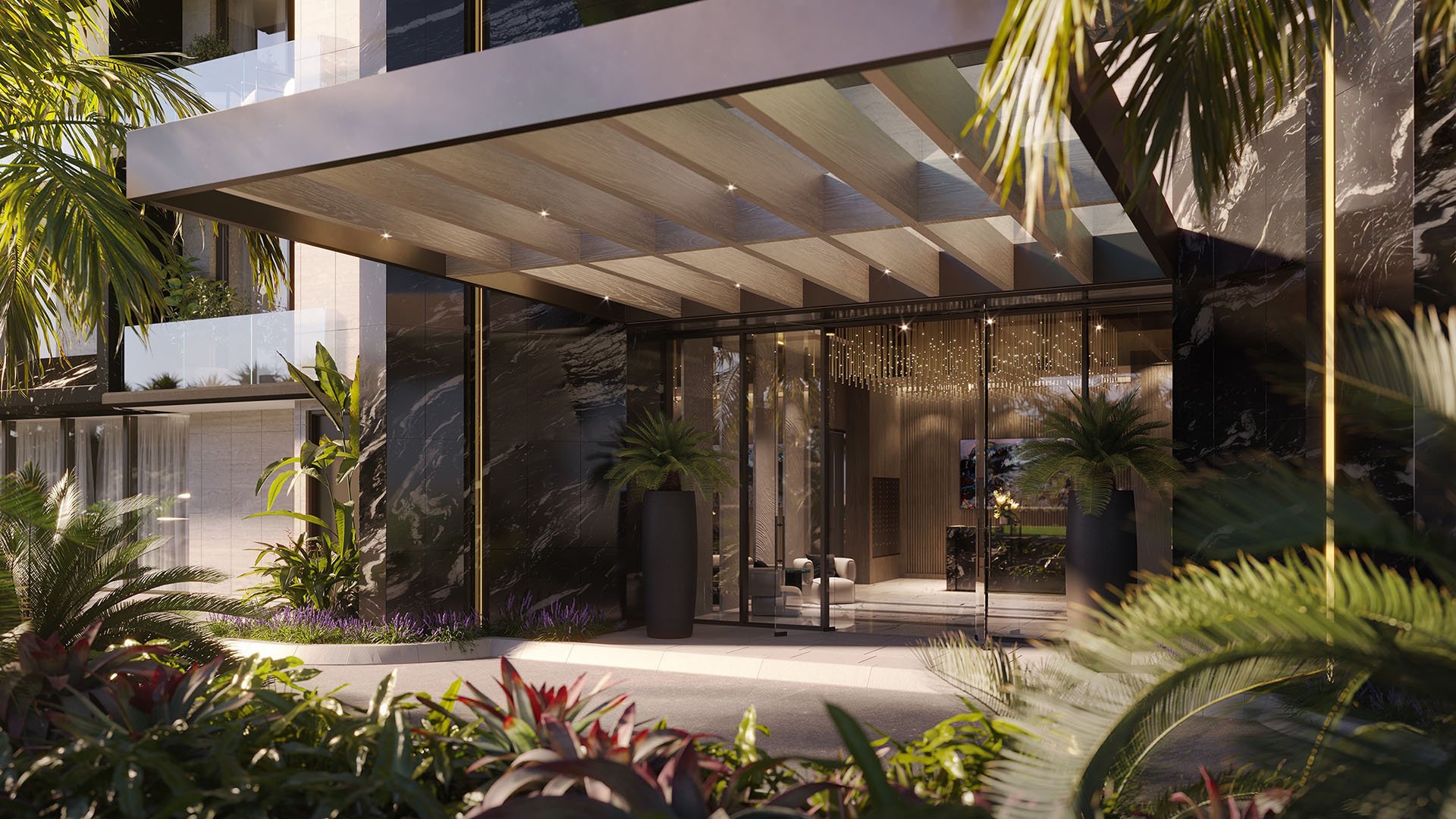
For many South Florida buyers, the first test of a condominium is no longer the terrace view. It is the moment a car turns in, the pause beneath the porte-cochère, the handoff to valet, and the transition from public curb to private lobby. That sequence reveals how a building understands discretion.
Lobby volume, porte-cochère privacy, and valet choreography are not decorative concerns. They shape daily life. A residence can offer generous interiors and refined amenities, yet still feel exposed if arrivals are crowded, if hotel guests and residents blur together, or if cars stack unpredictably at peak moments. The best buildings understand that privacy begins before the elevator.
Three properties clarify the spectrum. Bay Harbor Towers represents the legacy waterfront condominium condition, where arrival improvements must work within an inherited site and building envelope. Four Seasons Hotel & Private Residences Fort Lauderdale shows the branded hotel-residence model, where a public-facing hospitality engine must coexist with private residential expectations. La Maré Bay Harbor Islands offers the boutique, next-generation answer: reduce the number of simultaneous users, and the arrival experience becomes calmer by design.
Bay Harbor Towers is the most instructive case for buyers weighing established waterfront condominium value against contemporary arrival expectations. Its relevance is not that it behaves like a blank-slate hospitality tower. Its relevance is precisely the opposite: it illustrates the constrained-condition benchmark, where a building must manage modern expectations within an existing physical framework.
In a legacy waterfront condominium, the challenge is often choreography rather than reinvention. Lobby flow must become more intuitive. The porte-cochère must feel more discreet, even if its original geometry cannot be fundamentally reimagined. Parking and valet handling must be clarified so residents experience fewer points of friction. Bay Harbor Towers is useful because it frames arrival design as stewardship, not spectacle.
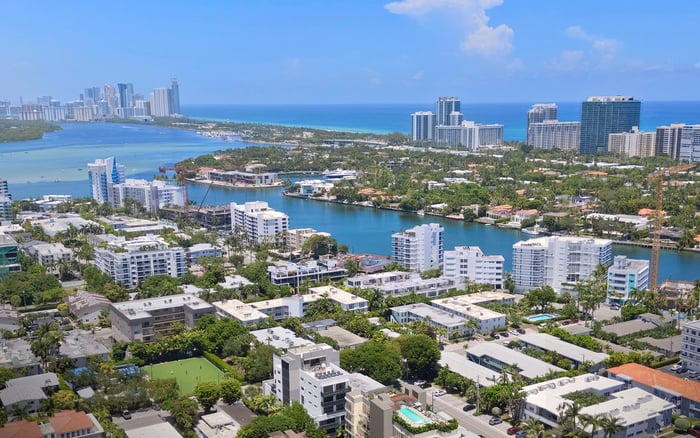
This is especially important in a Bay Harbor setting, where waterfront calm is part of the residential promise. Older South Florida buildings can face pressure from buyers who now expect smoother vehicle handling and more private transitions than many earlier layouts originally contemplated. A successful retrofit mindset does not pretend the building is new. It asks whether existing spaces can operate with greater grace.
The Four Seasons model asks a different question: how can a property welcome many kinds of users while still allowing residents to feel protected? Hotel guests, residents, restaurant patrons, car services, and valet operations can overlap. That makes it the highest-throughput example among the three, and the clearest test of operational sophistication.
The answer lies in separation and staffing. Distinct hotel and residential entries are central to the strategy because they prevent the resident arrival from becoming part of the hotel lobby theater. A branded hotel-residence can be vibrant and still feel controlled if circulation is layered correctly. Residents should not feel they are navigating a public lobby every time they come home.
At Four Seasons Hotel & Private Residences Fort Lauderdale, the arrival concept depends on differentiated lobby experiences and careful valet choreography. In practical terms, the building must manage not just cars, but identities: who is staying, who is dining, who is visiting, and who lives there. The Fort Lauderdale version of luxury is therefore operational as much as architectural.
This model appeals to buyers who value the energy and service culture of hospitality, but it demands a sharper eye during evaluation. The question is not whether the building is busy. It is whether that busyness has been absorbed into a disciplined sequence that preserves residential composure.
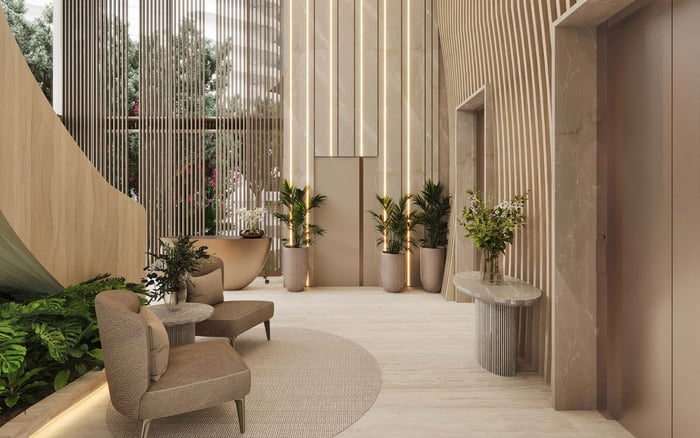
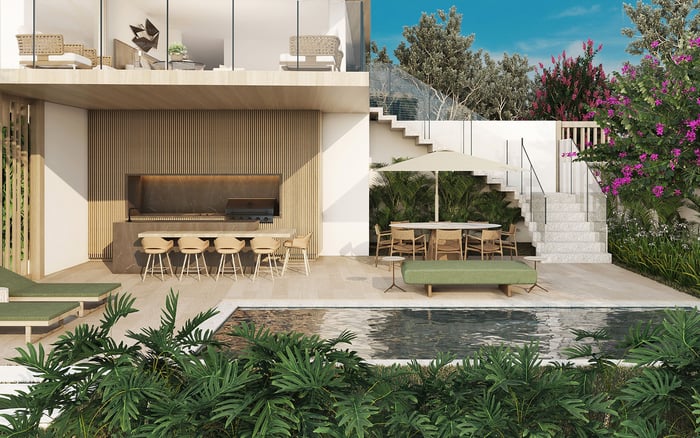
La Maré approaches the problem from the opposite direction. Rather than building a large operational system to manage constant overlap, it uses lower density as the first privacy tool. A limited number of oversized residences means fewer simultaneous residents, fewer vehicles, and less pressure on the lobby at ordinary moments.
At La Maré Bay Harbor Islands, the arrival experience is best understood as intimate and club-like. The goal is not to process a crowd efficiently. The goal is to avoid creating the crowd in the first place. That distinction matters to buyers who want a residential atmosphere that feels unhurried, familiar, and quietly managed.
This is one of the most important lessons in the current luxury market: privacy can be produced by scarcity of traffic, not only by architectural screening or staff intensity. A low-density condominium may need less elaborate valet choreography because the demand curve is naturally softer. The lobby can feel calm because fewer people need it at the same time.
The arrival sequence is a diagnostic tool. When touring a building, watch how the curb behaves. Is there a clear place for residents to arrive? Does the valet handoff feel immediate and discreet? Are visitors visually or physically separated from residents? Does the lobby invite lingering traffic, or does it move residents quickly toward private circulation?
For Bay Harbor Towers, the buyer question is whether an established building has adapted its inherited arrival condition with enough refinement. For Four Seasons Fort Lauderdale, the question is whether a high-throughput hospitality environment can maintain residential privacy through separation, staffing, and layered movement. For La Maré, the question is whether low density delivers the calm that boutique living promises.
None of these answers is universally superior. They are three different luxuries. The legacy waterfront building offers established presence and the discipline of retrofit. The branded hotel-residence offers service intensity and operational depth. The boutique condominium offers quiet by limiting demand at the source.
The most sophisticated buyer does not simply ask whether a lobby is beautiful. The better question is whether it will still feel composed at the busiest hour of the week. In South Florida, where car arrival remains central to daily life, the porte-cochère is not a secondary feature. It is the first room of the residence.
Why does lobby volume matter in a luxury condominium? Lobby volume affects privacy, waiting time, and the feeling of control when residents arrive or depart. A quieter lobby often creates a more residential atmosphere.
How does Bay Harbor Towers differ from a new luxury condominium? Bay Harbor Towers is best viewed as a legacy waterfront condominium with inherited physical conditions. Its arrival challenge is about refinement within constraints rather than ground-up reinvention.
Why is Four Seasons Fort Lauderdale considered the highest-throughput model here? It combines hotel guests, residents, restaurant patrons, car services, and valet activity. That mix requires more layered operations than a purely residential boutique building.
What is the main privacy strategy at Four Seasons Fort Lauderdale? Separate hotel and residential entries help protect the resident experience. Differentiated lobby environments and valet choreography further support that separation.
How does La Maré reduce arrival congestion? La Maré relies on lower density and a limited number of oversized residences. Fewer simultaneous users naturally reduce lobby and valet pressure.
Is a boutique condominium always more private? Not automatically, but lower density can make privacy easier to achieve. The execution of entry, lobby, and parking flow still matters.
What should buyers watch during a property tour? Buyers should observe the car approach, valet handoff, lobby traffic, and elevator transition. These details reveal how private daily life may feel.
Can an older building still offer a refined arrival experience? Yes, if the existing layout is managed and improved thoughtfully. The key is whether circulation and vehicle handling feel calm despite physical constraints.
Does branded hospitality compromise privacy? It can if circulation is not separated, but strong operations can make a busy property feel controlled. The resident path should feel distinct from public hotel activity.
Which model is best for the most discreet buyer? The most discreet buyer may prefer the low-density approach, but the right answer depends on lifestyle. Some buyers value hospitality energy, while others prioritize quiet.
For a discreet conversation and a curated building-by-building shortlist, connect with MILLION.
If branded residences are on your mind — as a home or as an allocation — we would be glad to share what we are seeing, privately.
Begin a quiet conversation