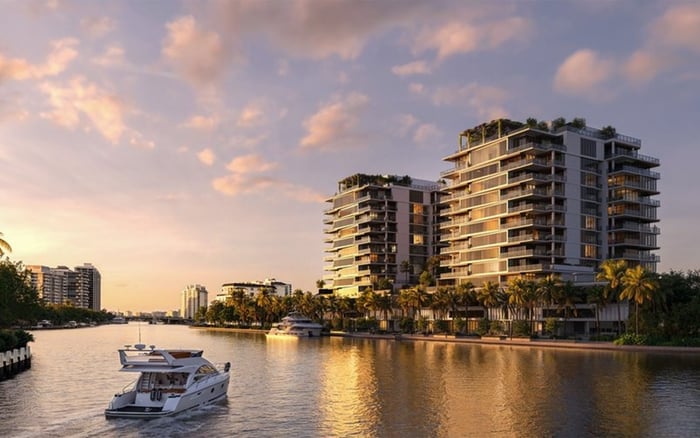
A buyer-focused look at how parking rights, EV readiness, valet circulation, and private-driver choreography shape the practical lifestyle contrast between Banyan Tree Residences West Palm Beach and St. Regis® Residences Bahia Mar Fort Lauderdale.

For ultra-prime South Florida buyers, the difference between two branded or design-led residences is rarely confined to architecture, views, or amenity photography. The more revealing contrast often sits at the ground plane, where a household arrives, transfers luggage, receives guests, charges vehicles, and coordinates private drivers without disrupting the day’s rhythm.
That is the proper lens for Banyan Tree Residences West Palm Beach vs St. Regis® Residences Bahia Mar Fort Lauderdale. This is not a contest of slogans. It is a question of operational fit. A buyer who keeps multiple cars, hosts often, uses a private driver, or expects electric-vehicle readiness should look beyond the residence itself and study how each building organizes mobility.
The distinction matters because parking rights, EV charging, valet procedures, and driver circulation are not decorative details. They determine whether a residence lives like a private home, a resort address, or a high-service urban condominium.
West Palm Beach and Fort Lauderdale are close enough to invite comparison, yet they ask different daily questions. A Palm Beach-oriented buyer may think in terms of seasonal arrivals, dinner reservations, family offices, club routines, airport transfers, and an understated sense of residential discretion. A Fort Lauderdale buyer may be equally focused on waterfront movement, guest arrival, resort service, and the choreography of a branded coastal address in Broward.
In practical terms, the buyer should not begin with assumptions. West Palm Beach, Palm Beach County, Fort Lauderdale, Broward, new construction, and St. Regis® Residences Bahia Mar Fort Lauderdale may all belong in the same conversation, but each points to a different operational reality. The right choice depends on how the building handles the transition from public street to private residence.
St. Regis® Residences Bahia Mar Fort Lauderdale can be discussed as an identifiable Fort Lauderdale project within this comparison. For Banyan Tree Residences West Palm Beach, the intelligent buyer stance is document-led. Review the condominium materials, sales-gallery disclosures, rules, parking exhibits, and management protocols before treating any mobility feature as settled.
In South Florida luxury real estate, the phrase “parking included” is too vague for serious analysis. Buyers should separate legal control from practical access. Is a space deeded, assigned, licensed, valet-managed, or subject to association rules? Can it be transferred with the residence? Can it be leased separately? Does a larger residence receive a different allocation than a smaller one? Are guest spaces controlled by staff, time limits, or reservation procedures?
The distinction can affect both daily comfort and long-term value. A deeded or clearly allocated space may support a sense of permanence. A valet-first arrangement may feel more effortless for a buyer who wants hotel-style service. A limited guest-parking structure may be acceptable for a seasonal owner, but frustrating for a household that entertains often.
The most sophisticated buyers review parking as part of the ownership bundle, not as a courtesy. That means asking for the parking schedule, garage plan, association language, valet rules, and any special conditions tied to penthouses, larger residences, or additional space purchases. In a market where cars remain central to lifestyle, the garage is a material part of the residence.
Electric-vehicle charging is now a baseline question for high-end buyers, even for households that have not fully transitioned to electric fleets. The issue is not merely whether a charger exists. It is whether the infrastructure supports private, reliable, scalable use.
A buyer should ask whether charging is available in assigned spaces, through shared stations, by valet request, or through an approved installation process. The next layer is capacity. Can the building handle future demand as more owners add electric vehicles? Are costs billed individually? Are there limits on charger type, installation timing, or vendor approval? Does the building reserve the right to modify charging policies as demand grows?
This is where a residence can feel future-proof or improvised. A polished lobby cannot compensate for a garage that treats charging as an afterthought. Conversely, clear EV procedures can quietly elevate daily ownership, especially for buyers who split time between properties and expect every residence to function without managerial friction.
Private-driver logistics are among the least photographed and most consequential aspects of luxury condominium life. A residence may have beautiful interiors, yet still feel awkward if the arrival court, valet desk, service elevator access, or waiting protocol creates congestion.
For a buyer with a private driver, the key questions are specific. Where does the driver wait? Is there a staging area or only curbside circulation? How are late-night pickups handled? Can staff coordinate luggage, pets, flowers, shopping bags, or multiple vehicles without calling attention to the owner? Are ride-share arrivals separated from resident valet? Can guests be received with discretion during events or peak evening periods?
The desired answer varies by household. Some owners want visible, high-touch service that resembles a five-star hotel arrival. Others want a quieter sequence with minimal exposure and fewer interactions. Neither preference is superior. The best building is the one whose operations match the owner’s personal rhythm.
The contrast between Banyan Tree Residences West Palm Beach and St. Regis® Residences Bahia Mar Fort Lauderdale should be framed less as a binary winner and more as a lifestyle calibration. One buyer may prioritize proximity to a Palm Beach social pattern, a restrained residential tone, and a schedule shaped by seasonal routines. Another may value the Fort Lauderdale setting, branded service expectations, and an arrival experience that feels more resort-adjacent.
Because the available project-specific footing is stronger for St. Regis® Residences Bahia Mar Fort Lauderdale than for Banyan Tree Residences West Palm Beach, the comparison should remain disciplined. Buyers should not infer that both buildings offer the same parking rights, charging capabilities, or driver protocols. They should request the governing documents and operating procedures for each property and compare them line by line.
The right questions are often more valuable than a premature conclusion. What exactly is conveyed with the residence? What is merely available by policy? What can change by association vote? What depends on staff discretion? What happens during holidays, storms, construction nearby, or major events? These questions reveal whether the lifestyle is durable or simply well presented.
Before reserving or purchasing, a buyer should obtain written clarity on parking allocation, EV charging availability, guest parking, valet costs, private-driver waiting procedures, loading access, delivery rules, and move-in protocols. The same review should include any limits on additional vehicles, motorcycle or golf-cart storage where relevant, and restrictions on installing private charging hardware.
For a second-home buyer, the emphasis may be simplicity. The car should be ready, charged, clean, and accessible when the owner arrives. For a full-time resident, the emphasis may be capacity and predictability. For a household with staff, the concern may be access control and clear service circulation. For a collector, the question may be whether the garage environment and rights structure support long-term confidence.
In the luxury tier, these details are not minor. They determine how the residence performs at 7:30 on a Monday morning, after a late flight, during a dinner party, or when a guest arrives with luggage. The best address is the one that makes those moments feel effortless.
Is parking the most important difference between these two residences? It may be one of the most important practical differences, especially for buyers with multiple vehicles, guests, or private drivers.
Should buyers assume parking rights are the same across both projects? No. Parking rights should be confirmed through the condominium documents, sales materials, and written project disclosures.
What is the key EV charging question to ask first? Ask whether charging is private, shared, valet-managed, or subject to future association approval.
Why do private-driver logistics matter in a luxury condominium? They shape privacy, timing, arrival comfort, guest handling, and the daily relationship between residents and staff.
Is St. Regis® Residences Bahia Mar Fort Lauderdale part of this comparison? Yes. It is the Fort Lauderdale project named in the topic and should be evaluated through its own project materials.
How should Banyan Tree Residences West Palm Beach be reviewed? Buyers should review primary project documents before relying on assumptions about parking, charging, or arrival procedures.
Can valet service replace clear parking rights? Not always. Valet may improve convenience, but legal allocation and transferability remain separate ownership questions.
Do guest parking rules affect resale value? They can. Buyers who entertain frequently often place a premium on predictable and discreet guest arrival procedures.
What should second-home owners focus on most? They should prioritize vehicle readiness, charging access, staff coordination, and frictionless arrival after travel.
What is the best way to compare the two residences? Compare written parking rights, EV policies, valet procedures, and driver logistics rather than relying on general impressions.
For a confidential assessment and a building-by-building shortlist, connect with MILLION.
If branded residences are on your mind — as a home or as an allocation — we would be glad to share what we are seeing, privately.
Begin a quiet conversation