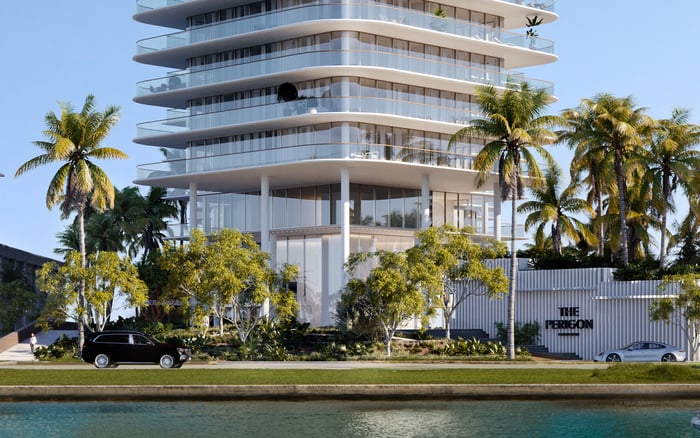
A buyer-focused look at how arrival sequence, lobby scale, porte-cochère privacy, and valet operations shape full-time livability at Banyan Tree Residences West Palm Beach and The Perigon Miami Beach.
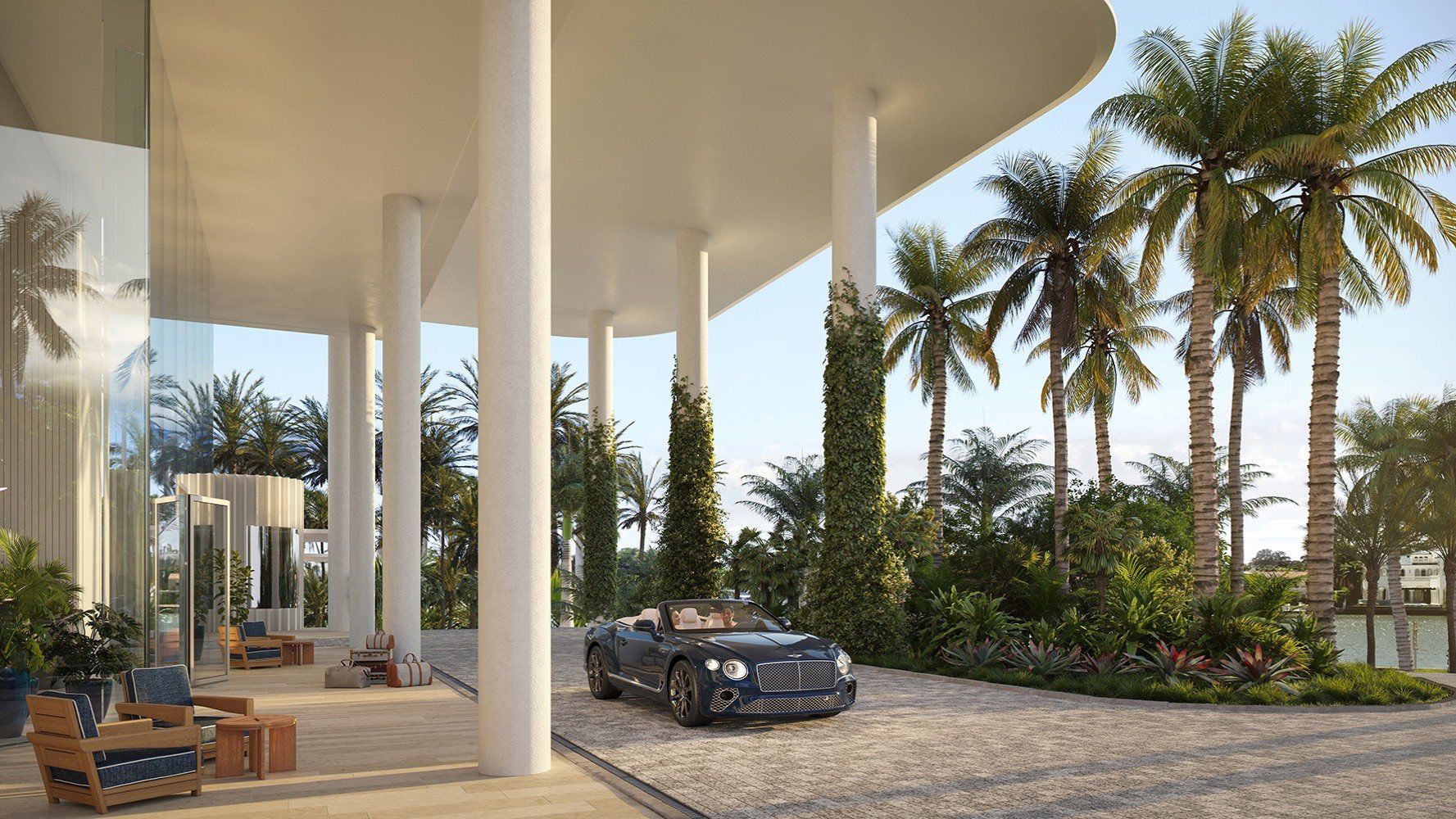
For a full-time owner, luxury is not confined to what happens after the elevator opens. It begins at the curb, continues through the porte-cochère, and settles into the lobby before the residence ever comes into view. That sequence can determine whether a building feels like a private home, a polished hotel, or something uneasily in between.
That is why Banyan Tree Residences West Palm Beach and The Perigon Miami Beach deserve to be studied through the choreography of arrival, not merely through finishes, views, or brand association. A buyer may visit a sales gallery once, review renderings several times, and tour a model residence carefully. An owner, however, will experience the drive-in, key handoff, lobby entry, and elevator approach hundreds of times a year.
At The Perigon Miami Beach, the most relevant buyer question is not only whether the arrival looks beautiful. It is whether the arrival feels controlled, discreet, and residential in ordinary use. For Banyan Tree Residences West Palm Beach, the same discipline applies: without relying on assumptions, buyers should test how the building intends to separate owners, guests, service, delivery, and seasonal traffic.
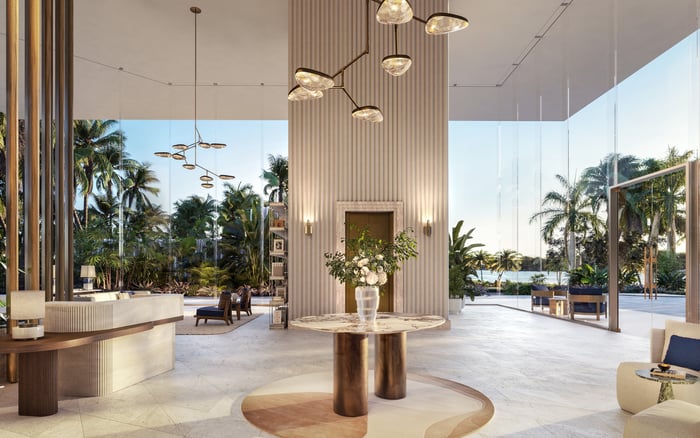
Lobby volume is often discussed as architecture, but owners experience it as atmosphere. A generous lobby can feel serene when traffic is light, yet impersonal if it becomes a place of constant movement. A more intimate lobby can feel residential, but only if circulation is well resolved and the desk or concierge presence does not crowd the entry experience.
For The Perigon Miami Beach, lobby volume belongs among the livability factors that can matter as much as the residence itself. The reason is straightforward. Full-time residents do not pass through arrival spaces as occasional guests. They pass through with groceries, luggage, pets, family, evening guests, visiting service providers, and daily routines that should not feel publicly performed.
Buyers should read lobby scale in three ways. First, as visual privacy: how much of the lobby is visible from the curb or motor court. Second, as acoustic comfort: whether voices, rolling luggage, valet radio traffic, and door movement carry into the residential entry. Third, as social density: whether owners are likely to encounter a calm sequence or a recurring cluster of guests, staff, drivers, and deliveries.
The most expensive lobby is not automatically the most livable lobby. The best one allows the owner to disappear gracefully.
The porte-cochère is where a building reveals its real etiquette. It can function as a private threshold, or it can become a small stage. The difference usually lies in sightlines, queuing, staff positioning, and whether the motor court is designed for owner priority rather than ceremonial arrival alone.
A full-time owner should ask what happens when two residents arrive at the same time, when a guest car is waiting, when a ride-share vehicle pauses too long, or when a delivery overlaps with a dinner-hour return. The question is not whether these moments can occur. They will. The question is whether the building absorbs them without making owners feel delayed, watched, or inconvenienced.
At The Perigon Miami Beach, the drive-in, key handoff, and lobby entry sequence should be evaluated as a single residential ritual. If the car stops cleanly, the door is opened without hesitation, keys are transferred discreetly, and the owner enters without navigating cross-traffic, the property begins to feel like a private residence. If the same sequence feels busy, performative, or dependent on chance staffing, the tone shifts toward hospitality.
For Banyan Tree Residences West Palm Beach, prospective buyers can apply the same test without assuming details not yet personally verified. Study the intended path from street to lobby. Ask how many residences share the arrival. Ask whether owner, guest, and service movements are separated or simply managed by staff in real time.
Valet service is often marketed as convenience, but in a full-time residence it is more accurately a logistics system. The most desirable version feels almost invisible. The least desirable version announces itself through waiting, congestion, uncertainty, or repeated explanations.
Valet choreography begins before the owner arrives. Staff need to anticipate peak patterns, coordinate vehicle retrieval, identify residents without creating awkward formality, and keep the motor court moving without rushing the experience. The result should be a calm transfer of responsibility, not a negotiation at the curb.
For year-round buyers, the key issue is consistency. A beautifully staffed weekend presentation may not reveal weekday delivery pressure, winter-season guest volume, holiday arrival surges, or the interaction between residents and outside drivers. A building can have refined design intent and still feel operationally thin if the valet plan does not match daily demand.
This is especially important in new-construction and pre-construction decisions, where buyers may be judging a future operating environment before living patterns have fully formed. In that context, a buyer should ask for specific protocols, not general assurances. How are keys tracked? Where do ride-share vehicles wait? How are guests identified? What happens when multiple owners request vehicles at once? Where are deliveries staged, and who keeps them away from the residential arrival sequence?
South Florida luxury buyers often compare buildings by waterfront position, residence size, ceiling height, and amenity program. Those elements remain important, but full-time ownership adds a quieter layer of judgment. The building must perform Monday morning, Friday evening, during peak season, and during ordinary midweek errands.
Market labels can be useful, but they are not the same as lived privacy. Buyers may encounter shorthand such as The Perigon Miami Beach, Miami Beach, West Palm Beach, oceanfront, new-construction, and pre-construction. Treat those terms as starting points. The more important exercise is to translate each label into daily questions: Who sees me arrive? Who handles my car? Where do my guests wait? How quickly do I move from public exposure to private calm?
The best buildings make this progression feel natural. There is no sense of theatrical arrival unless the owner wants it. There is no lobby bottleneck masquerading as energy. There is no valet congestion hidden behind polished uniforms. Instead, there is a feeling that the property understands the difference between service and spectacle.
Before signing, buyers should press for clarity on arrival operations with the same seriousness they bring to floor plans and view corridors. Ask how the motor court is staffed during ordinary days and peak season. Ask whether there is a separate guest drop-off pattern. Ask where ride-share vehicles are permitted to pause. Ask whether service providers and deliveries use the same visual path as owners.
In the lobby, ask how access is controlled, how visitors are announced, and whether residents can move directly and discreetly to elevators. Look for the location of seating, the concierge desk, mail and package handling, and any amenity traffic that crosses the main entry. The issue is not whether a lobby is active. The issue is whether activity compromises the feeling of residence.
At The Perigon Miami Beach, targeted due diligence on the motor court and lobby operations is a rational part of the purchase process. For Banyan Tree Residences West Palm Beach, the prudent buyer should use the same framework and request project-specific answers from the appropriate sales and ownership channels. In both cases, the goal is to understand how the building behaves when it is no longer an image, but a daily address.
Why does lobby volume matter for full-time owners? It shapes noise, visual exposure, and the transition from public street to private home. A lobby should feel composed in daily use, not only impressive on arrival.
What should buyers study at The Perigon Miami Beach? Buyers should focus on the drive-in, key handoff, lobby entry, and valet sequence. These elements influence whether the property feels residential or hospitality-led.
How should Banyan Tree Residences West Palm Beach be evaluated? Buyers should ask project-specific questions about arrival flow, guest handling, service routing, and owner privacy. Unsupported assumptions should be replaced with direct operational clarity.
Is a larger lobby always better? Not necessarily. Scale is valuable only when it supports calm movement, privacy, and acoustic comfort.
What makes a porte-cochère feel private? Privacy comes from controlled sightlines, limited queuing, discreet staff positioning, and minimal cross-traffic. A covered drive alone is not enough.
Why is valet choreography important? Valet is a daily logistics system for full-time owners. Delays, crowding, or unclear handoffs can erode the sense of luxury.
Should buyers visit at different times of day? Yes, if access is available. Morning, evening, weekend, and peak-season conditions can reveal different operational pressures.
What questions should be asked about ride-share vehicles? Ask where they wait, how long they may remain, and whether they share the owner arrival path. Poor staging can quickly affect privacy.
How do service and deliveries affect arrival quality? If they overlap with owner entry, the building may feel less private. Separate routing and clear staging support a more residential atmosphere.
What is the best way to shortlist comparable options for touring? Start with location fit, delivery status, and daily lifestyle priorities, then compare stacks and elevations to validate views and privacy.
For a tailored shortlist and next-step guidance, connect with MILLION.
If branded residences are on your mind — as a home or as an allocation — we would be glad to share what we are seeing, privately.
Begin a quiet conversation