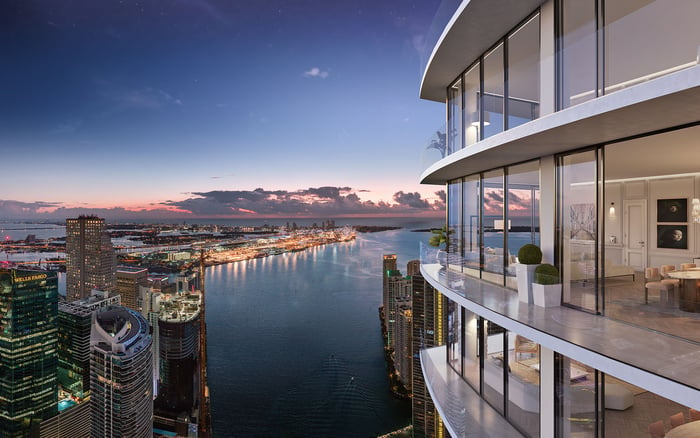
A buyer-focused comparison of Baccarat Residences Brickell and Shell Bay by Auberge Hallandale through the practical lens of household staff, laundry placement, service access, and daily residential choreography.

In South Florida’s ultra-premium market, the most polished residences are judged not only by finishes, views, and arrival sequences, but by how gracefully they support the private machinery of daily life. A household with a housekeeper three days a week, a nanny, a private chef for dinners, a personal assistant, or rotating seasonal staff has very different needs from a lock-and-leave couple using the residence on weekends. That distinction becomes especially clear when comparing Baccarat Residences Brickell with Shell Bay by Auberge Hallandale.
Baccarat Residences Brickell belongs to the urban glamour of Brickell and Downtown Miami, where the choreography is vertical, compact, and highly visible. Shell Bay by Auberge Hallandale belongs to a resort-club culture in Hallandale, where household life extends across wellness, club use, guest visits, valet routines, and owner services. Both can be luxurious. They simply require different questions.
For sophisticated buyers, the service corridor is not a technical afterthought. Laundry placement, trash access, package handling, staff arrival, chef access, and house rules determine whether a residence functions beautifully from Monday morning through Friday afternoon, not just whether it photographs well on a Saturday evening.
Baccarat Residences Brickell should be read as an urban branded-residence case study. The public areas may deliver a glamorous city experience, but a high-functioning private household still needs practical answers behind the scenes. In a vertical tower environment, staff logistics depend heavily on elevator strategy, loading access, package movement, in-unit utility planning, and how efficiently a worker can move from entry to kitchen, laundry, secondary bedrooms, and trash or service areas.
This is where floor-plan selection becomes deeply personal. A buyer who expects a housekeeper to arrive daily, a nanny to stay late, or a private chef to prepare frequent dinners should study the residence as a working environment. Is the laundry room conveniently placed, or does every wash cycle require crossing primary living zones? Can groceries, luggage, flowers, and catering supplies move discreetly? Is there a den, secondary bedroom, or service-adjacent space that can support a rotating staff member or assistant without intruding on the family’s main retreat areas?
Brickell buyers often compare branded and service-oriented buildings, including St. Regis® Residences Brickell and Cipriani Residences Brickell, through the language of amenities. The more refined question is how each residence handles the invisible side of ownership: private-chef arrivals, deliveries during peak elevator periods, cleaning staff access, and the transition between formal entertaining and household operations.
At Baccarat, laundry placement deserves particular attention because high-floor urban residences may rely on compact in-unit laundry rooms unless a selected plan provides more generous utility space. For a lightly used pied-à-terre, compact may be sufficient. For a family with children, staff-handled laundry, fine linens, uniforms, and frequent wardrobe changes, the difference between a true utility room and a small laundry closet can shape daily ease.
Shell Bay by Auberge Hallandale represents a different residential culture. It should be understood as a resort-club case study, where staff logistics intersect with privacy, hospitality programming, owner services, guest patterns, recreation, and the movement of people across a broader lifestyle environment.
In this setting, service expectations can increase precisely because the lifestyle is more expansive. Housekeeping may be more frequent. Linens and towels may accumulate faster. Sportswear, guest laundry, pool items, and club attire can create more wash cycles. Family visits may last longer. Seasonal owners may arrive with guests, children, luggage, and a desire for seamless coordination from valet to residence to amenities.
For Shell Bay buyers, the diligence question is not merely whether the residence is large enough. It is whether the household operating model fits the building culture. Is staff support expected to be daily and rotating, or live-in and highly present during longer stays? How do residence access, club or resort amenities, valet, deliveries, and household-service circulation remain separated from owner leisure spaces? When owners are moving between dining, wellness, golf and club activities, and guest entertainment, the best service design is the kind that remains discreet.
Buyers comparing the Hallandale market may also consider 2000 Ocean Hallandale Beach for a different expression of waterfront residential life. The key is to avoid assuming that all luxury buildings operate the same way. A resort-club environment can feel relaxed, but its household logistics may be more intensive than a conventional second home because the residence supports more people, more programming, and more seasonal rhythm.
Laundry is one of the most underestimated rooms in ultra-luxury residential selection. In sales presentations, the eye naturally goes to the view, terrace, primary suite, and kitchen. Yet for staffed households, the laundry room is often the operational center of the home.
At Baccarat Residences Brickell, the buyer should examine whether the selected plan’s laundry arrangement can handle the household’s actual use. An urban apartment may have a beautiful living sequence and still create friction if staff must move through formal zones with hampers, linens, uniforms, or children’s clothing. The more vertical and compact the building environment, the more important it becomes to understand how wash cycles, trash movement, dry cleaning, groceries, and deliveries intersect with shared infrastructure.
At Shell Bay by Auberge Hallandale, the laundry question expands. Resort-style ownership may generate more towels, sheets, sportswear, guest garments, and staff-handled cycles. A residence that works for an owner couple during a quiet week may feel strained during holidays, family visits, or longer seasonal stays. Buyers should ask whether laundry placement supports efficient back-of-house movement and whether storage is sufficient for the volume of linens and household goods that resort living can produce.
The best luxury floor plans separate activity without making a home feel compartmentalized. They allow a housekeeper to reset bedrooms while the owner takes a call, a chef to access the kitchen without disrupting guests, and a nanny or assistant to occupy a secondary area without compromising privacy.
In Baccarat’s Brickell context, discretion is especially important because residents, guests, workers, and deliveries are more likely to share compact vertical infrastructure. Elevator timing, package handling, day-staff arrival, and private-chef access all deserve early discussion before a buyer commits to a line or floor plan.
In Shell Bay’s Hallandale context, staff movement may need to coordinate around owner recreation, wellness areas, dining, valet routines, and visiting guests. The issue is less about city compression and more about resort choreography. A household may feel more open and leisurely, yet the operations behind that leisure can be more complex.
New-construction buyers should resist the assumption that branding automatically solves household operations. The brand may shape service culture, but the chosen floor plan, building rules, loading routines, trash access, and staff policies shape daily life.
For households accustomed to live-in or highly present staff, the question is whether a den, secondary bedroom, or adjacent support space can function discreetly. For owners using day staff, elevator access, arrival protocols, and package coordination may matter more. For privacy-oriented buyers, the separation between family zones, guest zones, and worker circulation can be central to comfort.
The strongest buyer question is simple: can this residence support the way the household actually operates? If the answer is not obvious from the plan, it is worth slowing down before selecting a line.
Why does building culture matter for household staff? It determines how workers, owners, guests, deliveries, and amenities interact during ordinary days, not only during formal entertaining.
How is Baccarat Residences Brickell different from Shell Bay by Auberge Hallandale? Baccarat is best evaluated as an urban vertical residence, while Shell Bay is better read through a resort-club and hospitality lens.
Should buyers assume either building has dedicated staff corridors? No. Buyers should verify corridors, staff access, elevators, loading areas, and building policies through current plans and documents.
Why is laundry placement so important at Baccarat? Urban high-floor residences may rely on compact in-unit laundry unless a specific plan provides more generous utility space.
Why is laundry placement different at Shell Bay? Resort-style households may create more linens, towels, sportswear, guest laundry, and staff-handled wash cycles.
What should staffed households study in a floor plan? They should trace the path from entry to kitchen, laundry, bedrooms, storage, trash areas, and any service-related access points.
Can a den or secondary bedroom help with staff needs? Yes, if it can support a nanny, housekeeper, assistant, or rotating staff member without disrupting primary family zones.
Are valet and delivery routines part of luxury diligence? Absolutely. Package handling, chef access, groceries, luggage, and staff arrival can define whether a residence feels effortless.
Is Shell Bay better for live-in staff than Baccarat? Not automatically. The right answer depends on the selected floor plan, household pattern, rules, privacy needs, and confirmed access details.
What is the best way to shortlist comparable options for touring? Start with location fit, delivery status, and daily lifestyle priorities, then compare stacks and elevations to validate views and privacy.
To compare the best-fit options with clarity, connect with MILLION.
If branded residences are on your mind — as a home or as an allocation — we would be glad to share what we are seeing, privately.
Begin a quiet conversation