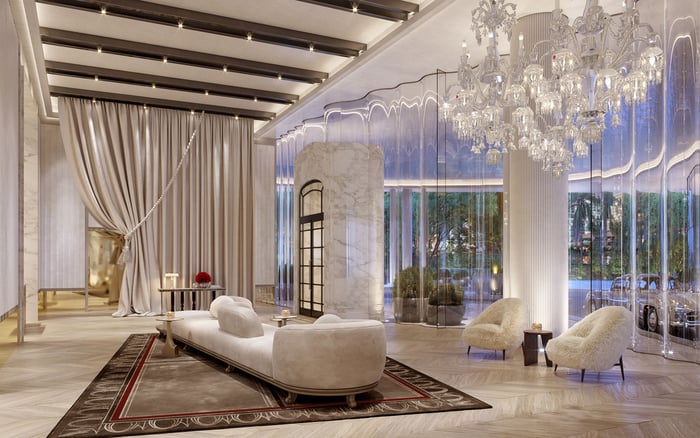
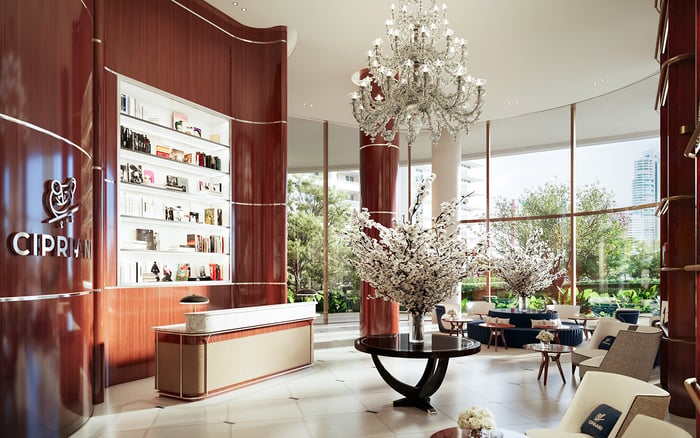
A buyer-focused comparison of Baccarat Resididences Brickell and Four Seasons Hotel & Private Residences Fort Lauderdale, centered on service structure, elevator privacy, and the distinction between owner sanctuary and hotel-backed resort infrastructure.

For buyers evaluating Baccarat Residences Brickell and Four Seasons Hotel & Private Residences Fort Lauderdale, the meaningful distinction is not purely aesthetic or geographic. It is structural. One model is an urban branded residential condominium with hospitality management layered into the ownership experience. The other is a hotel-plus-private-residence model, with private ownership positioned beside an operating resort hospitality platform.
That difference affects almost everything a sophisticated buyer will notice after closing: how arrivals are choreographed, how elevators are controlled, how amenities are shared or protected, and how deeply service can be delivered without compromising residential quiet. Both models appeal to buyers who expect refinement, discretion, and professional management. Yet they answer different versions of the same question: do you want the cleaner privacy profile of an all-residential branded tower, or the broader service machinery of a hotel-backed resort environment?
Baccarat Residences Brickell is best understood as a Miami condominium model shaped by brand, service, and riverfront urbanity. Its setting on the Miami River at the entrance to Brickell places the ownership experience within one of South Florida’s densest mixes of residential, financial, dining, and hospitality uses. The daily rhythm is metropolitan rather than resort-secluded.
For many buyers, that is precisely the attraction. Baccarat Residences Brickell reads as an all-residential, hospitality-managed ownership structure rather than a hotel-plus-residence resort. Service is central, but it is not driven by a fully integrated operating hotel. The result can be a more direct residential identity, where the privacy proposition depends on how clearly owner circulation, elevator access, and amenity use are separated from any broader mixed-use components around the project.
In this model, diligence should focus less on the romance of the brand and more on operational boundaries. A buyer should ask how residential elevators are programmed, whether keycard controls restrict access to owner floors, and whether amenity spaces are reserved exclusively for residents. Elevator privacy is not a marketing phrase. It is a system of access points, permissions, staffing protocols, and rules that determines whether a resident feels known, protected, and separate from nonresidential traffic.
Four Seasons Hotel & Private Residences Fort Lauderdale represents the more resort-oriented ownership model. Here, private residences are paired with an operating Four Seasons hotel, creating a deeper service platform than a purely residential branded tower. That can be highly compelling for owners who want the atmosphere, staffing depth, and hospitality infrastructure associated with a full-service resort environment.
The tradeoff is clear: broader service can introduce more circulation complexity. Hotel guests, residence owners, service teams, and back-of-house operations all need to coexist without eroding the private residential experience. For that reason, a buyer should evaluate how guests and owners are separated across entries, elevators, amenity areas, and service corridors.
The Fort Lauderdale asset should not be flattened into generic condo-hotel shorthand. The more precise question is how the private residence component is protected within a live hospitality environment. If the answer is strong, the owner benefits from resort-level support while retaining a sanctuary. If the answer is vague, the brand may feel less private in daily life than it appears in a brochure.
In both buildings, elevator privacy should be treated as an operational issue, not merely a floor-plan issue. A private elevator vestibule may be elegant, but the larger question is who can reach the elevator bank, which credentials activate which floors, how guests are escorted, and whether hotel or public users ever share the same vertical circulation path.
At Baccarat Residences Brickell, the buyer’s priority is confirming that the residential tower functions as a protected environment within its urban context. At Four Seasons Hotel & Private Residences Fort Lauderdale, the priority is confirming that private owners are not merely adjacent to hotel service, but insulated from hotel guest movement where it matters.
A serious buyer should request and study the relevant condominium declarations, shared-facility agreements, amenity-use rules, elevator-access plans, and service or management agreements. These documents are where the lifestyle becomes enforceable. The most beautiful arrival sequence has limited value if the governing documents leave owner-only access ambiguous.
The Baccarat model may appeal to a buyer who wants branded service, a refined residential identity, and immediate connection to the Brickell urban environment. It is a compelling fit for someone who values access to Miami’s core but does not necessarily want the flow of hotel guests as part of the ownership setting.
The Four Seasons model may appeal to a buyer who wants the comfort of a resort-service ecosystem. For second-home owners, that can be especially attractive: the building can feel staffed, alive, and ready even when the owner is away. Yet this same depth makes owner-only amenities, private entries, and protected elevator cores more important, not less.
Investment logic also differs. In an all-residential branded tower, long-term value may be tied to residential scarcity, privacy, and the appeal of a service-managed urban address. In a hotel-backed residence, value may also reflect the perceived strength of the hospitality platform and the success of separating owners from resort activity. Neither structure is inherently superior. The right answer depends on how the buyer intends to live, arrive, entertain, and retreat.
The strongest diligence begins with practical questions. Are owner amenities exclusive, or are some spaces shared? Are private residential elevators fully separated or access-controlled within a broader core? Are guests escorted, credentialed, or self-directed? Does the service agreement define what the brand provides to residents, or does it rely on broad language? Are back-of-house routes planned to preserve quiet arrival and departure for owners?
A new-construction buyer should be especially careful not to equate brand prestige with governance clarity. The brand may set expectations, but the documents establish rights. For the ultra-premium buyer, the most valuable luxury is not abundance. It is controlled access, predictable service, and the confidence that the owner experience will remain protected as the property matures.
Choose Baccarat Residences Brickell if your priority is urban residential hospitality, a Brickell address, and a privacy profile that may be cleaner because it is not centered on a fully operating hotel. Choose Four Seasons Hotel & Private Residences Fort Lauderdale if your priority is a fuller resort-service platform and you are comfortable performing deeper diligence on owner-only protections.
The decision is not about which brand is more desirable. It is about which ownership model best aligns with your use pattern. A daily Miami owner, a seasonal resort owner, and a lock-and-leave international buyer may each reach a different conclusion for perfectly rational reasons.
Is Baccarat Residences Brickell a hotel-residence model? It is best framed as a branded residential condominium with hospitality management, not as a fully integrated hotel-plus-residence resort.
Is Four Seasons Hotel & Private Residences Fort Lauderdale more service-driven? Yes. Its model pairs private residences with an operating hotel, creating a broader resort-service ecosystem.
Which property is more urban in character? Baccarat Residences Brickell is the more urban comparison point because the experience is shaped by Brickell’s dense mixed-use setting.
Which property is more resort-oriented? Four Seasons Hotel & Private Residences Fort Lauderdale is the more resort-oriented model because it includes an operating hospitality component.
Why does elevator privacy matter so much? Elevator privacy determines who can access owner floors and how residents are separated from guests, visitors, and service traffic.
What documents should buyers review? Buyers should review condominium declarations, shared-facility agreements, amenity rules, elevator-access plans, and service agreements.
Are owner-only amenities guaranteed by branding alone? No. Exclusivity depends on the governing documents, access controls, and amenity-use rules rather than the brand name by itself.
Which model is better for a lock-and-leave owner? Either can work, but hotel-backed residences may offer deeper service while branded residential towers may offer a cleaner privacy profile.
Should buyers treat shared facilities as a legal issue? Yes. Shared facilities should be reviewed carefully because they define how owners, guests, and service teams use the property.
What is the best way to shortlist comparable options for touring? Start with location fit, delivery status, and daily lifestyle priorities, then compare stacks and elevations to validate views and privacy.
If you'd like a private walkthrough and a curated shortlist, connect with MILLION.
If branded residences are on your mind — as a home or as an allocation — we would be glad to share what we are seeing, privately.
Begin a quiet conversation