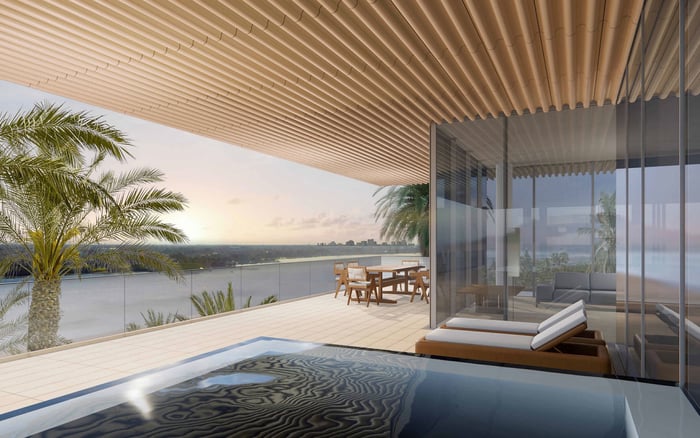
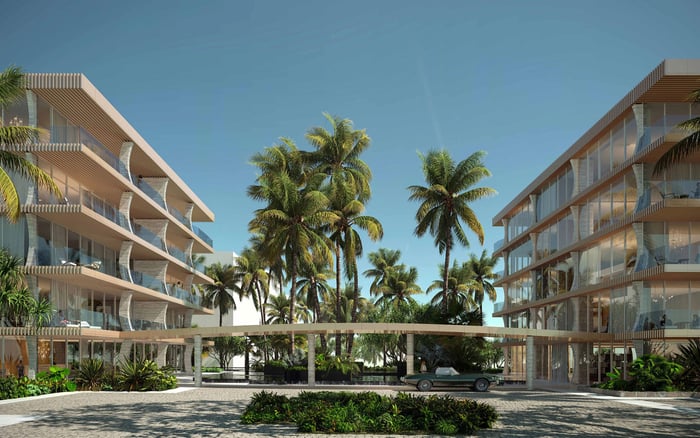
At The Berkeley Palm Beach, dedicated mail and package chutes are best understood as an operational luxury: a system that supports security, convenience, and discreet service in an ultra-prime setting. Their value is meaningful for daily living and building efficiency, even if it is not easily isolated as a separate price premium.

In ultra-prime residential real estate, value is not always expressed through spectacle. More often, it shows up in the quiet systems that protect privacy, preserve order, and make service feel seamless. That is the right lens for evaluating the dedicated mail and package chute system at The Berkeley Palm Beach.
The Berkeley is positioned for Palm Beach’s ultra-luxury market. In that context, its dedicated package infrastructure is best viewed less as a headline amenity and more as part of the modern operating framework expected in a highly serviced building.
For residents, the practical case is straightforward. Deliveries have become a larger part of daily life, and buildings without purpose-built handling systems often shift that burden into the lobby, concierge desk, or improvised storage areas. At a property aiming for exceptional calm and discretion, that friction is not minor. A dedicated system integrated into back-of-house operations helps keep the visible experience polished while making the invisible logistics more efficient.
This is especially relevant in Palm Beach, where buyers at the top end are not simply purchasing square footage or views. They are also buying reliability in the day-to-day experience. Systems that reduce interruption can matter as much as finishes when it comes to how a residence actually lives.
The strongest case for dedicated mail and package handling at The Berkeley is operational and experiential. It supports convenience by streamlining delivery workflows and reducing the need for residents to navigate manual retrieval processes that depend on desk staff availability. It supports security by keeping packages out of public common areas, where exposure, confusion, or loss becomes more likely. And it supports service quality by freeing staff attention for more resident-facing tasks.
Those gains may sound modest on paper, but in practice they shape the texture of daily life. A cleaner arrival sequence, less congestion in shared spaces, and a more orderly back-of-house system all contribute to the sense that a building is run with discipline. For a new-construction luxury property, that discipline is part of the product.
There is also an important staffing dimension. When concierge teams are not consumed by repetitive sorting, logging, and handoff work, they can devote more energy to guest arrivals, resident requests, and the higher-touch interactions that define luxury hospitality. In an era when buyers increasingly expect residential service to feel closer to a private club or boutique hotel, that matters.
For sophisticated buyers, the key distinction is between useful value and separable value. The Berkeley’s package system clearly offers the former. It improves building operations, supports a more polished resident experience, and helps avoid the inefficiencies associated with manual package handling. But that does not mean a buyer can isolate the feature and assign it a clear independent price premium.
In today’s South Florida luxury market, advanced package handling is increasingly a baseline expectation in new upscale projects. Its absence would be notable. Its presence, however, is more often read as evidence that a building meets contemporary standards rather than exceeds them in a way that dramatically changes valuation on its own.
That framing matters because it keeps the discussion precise. At The Berkeley, dedicated package chutes are best understood as part of the infrastructure that protects the building’s overall quality proposition. They help the project avoid operational shortcomings that could weaken buyer perception. They reinforce the standard of living the property is promising. They are necessary, meaningful, and increasingly non-optional.
Across South Florida, delivery and service infrastructure has become part of the broader language of premium residential living. Buyers considering properties such as The Berkeley Palm Beach are also evaluating how newer developments address operational detail, not just aesthetic appeal.
That is true in West Palm Beach as well, where projects like Forté on Flagler West Palm Beach, The Ritz-Carlton Residences® West Palm Beach, and Mr. C Residences West Palm Beach exist in a market where buyers increasingly expect thoughtful back-of-house planning to support front-of-house elegance. It is also evident farther south in projects such as Rivage Bal Harbour, where luxury positioning is inseparable from the quality of residential operations.
The point is not that every building uses the same technical solution. It is that package management, service circulation, and logistical discretion have become part of the competitive standard for high-end residential product. In that regard, The Berkeley is aligned with where the market already is.
One of the least discussed yet most meaningful benefits of dedicated package infrastructure is architectural rather than technological. It protects the lobby from becoming a staging ground for cardboard, carts, and transactional clutter.
In an oceanfront building designed for an elevated arrival experience, the lobby should function as a threshold of calm. If that space begins to absorb routine package overflow, the visual and emotional quality of entry changes. A building may still be beautiful, but it feels less composed.
This is where package systems deliver a form of luxury that is easy to underestimate. They preserve the distinction between service areas and resident areas. They keep logistical activity where it belongs. They allow the building’s public-facing spaces to remain gracious rather than improvised. For buyers prioritizing oceanfront living, that separation is not cosmetic. It is part of what makes the property feel expensive in the right way.
For a buyer assessing whether this feature matters, the right question is not whether a dedicated package chute can independently raise resale value by a measurable amount. The better question is whether the absence of such infrastructure would create operational drag in a building competing at the top of the market.
In most cases, the answer is yes. Rising delivery volumes have made purpose-built package systems more important in luxury multifamily and condominium operations. Buildings that rely heavily on manual concierge handling may face more congestion, more staff burden, and greater exposure to misplaced or damaged items in common areas. In a premium environment, those frictions are felt quickly.
So the value at The Berkeley is best understood as protective and compounding. It protects the resident experience from everyday inconvenience. It supports security and discretion. It compounds the effectiveness of staffing by redirecting labor toward service instead of repetitive logistics. And it helps the property maintain parity with what discerning buyers now consider standard.
Dedicated mail and package chutes at The Berkeley are not a theatrical amenity. They are a quietly intelligent system that helps the building function at the level its market position demands.
What is the main benefit of dedicated mail and package chutes at The Berkeley Palm Beach? The primary benefit is smoother building operations, with greater convenience, stronger security, and less visible delivery clutter.
Do these systems directly increase property value? They add meaningful practical value, but not typically as a clearly separable price premium on their own.
Why do luxury buyers care about package handling? Because daily convenience, privacy, and orderly service are central to the experience of top-tier living.
How does the system help the concierge team? It reduces manual sorting and handoffs, allowing staff to focus more on higher-touch resident service.
Does dedicated package infrastructure improve security? Yes. Keeping deliveries out of public common areas can reduce exposure to loss, confusion, or theft.
Is this feature unusual in the Palm Beach luxury market? Not especially. In the current market, it is increasingly viewed as a baseline expectation in newer luxury buildings.
What happens if a new luxury tower lacks modern package handling? Buyers may view that omission as a drawback relative to newer competitors with more refined operations.
Does this system affect lobby design and experience? Yes. It helps preserve the lobby as a polished arrival space rather than a package overflow zone.
Why is this important in a new-construction residence? New-construction buyers expect contemporary building systems that support both efficiency and discreet service.
How should buyers evaluate this amenity at The Berkeley? As an operational essential that strengthens convenience and service quality rather than as a flashy differentiator.
For a confidential assessment and a building-by-building shortlist, connect with MILLION Luxury.
If branded residences are on your mind — as a home or as an allocation — we would be glad to share what we are seeing, privately.
Begin a quiet conversation