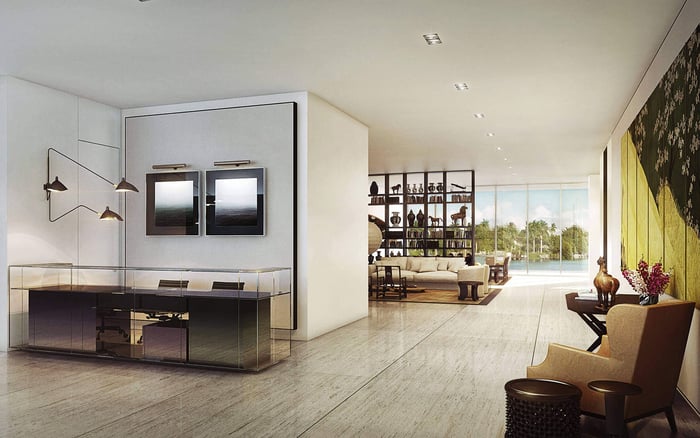
Art Week tests whether a luxury residence can manage guests, vendors, security, waterfront access, and an owner’s immediate departure with equal precision.

For South Florida residence buyers, Art Basel Miami Beach offers a useful framework for evaluating how a property may handle concentrated guest traffic, private entertaining, deliveries, security personnel, and last-minute schedule changes.
The phrase “lock and leave” may imply effortless ownership, but buyers should examine what happens between locking the door and boarding a flight. The due-diligence review should address access control, approved vendor coordination, incident response, post-departure inspections, and documentation.
That distinction matters to second-home owners and anyone whose residence may remain vacant for extended periods. A polished lifestyle proposition should be supported by written rules, defined responsibilities, and a repeatable operating process.
Buyers should request current written policies governing residential events, guests, caterers, deliveries, loading, elevators, insurance documentation, and reception procedures. Requirements outside a private property should not be treated as a substitute for the building’s own operating documents.
For buyers considering Shore Club Private Collections Miami Beach or Setai Residences Miami Beach, Art Week provides a practical due-diligence scenario: ask management how an owner-hosted gathering would be approved and supervised, then how the residence would be secured if the owner departed the following morning.
A condominium access review should extend beyond the principal lobby. Buyers should ask how the property manages service corridors, loading areas, garages, elevators, secondary doors, staff entrances, and other routes into residential areas.
Camera coverage, exterior lighting, controlled entry, and physical barriers should be considered together. The objective is discreet control, clear responsibility, and minimal ambiguity for residents, guests, vendors, and staff.
A buyer evaluating The Ritz-Carlton Residences® Miami Beach should seek an operational explanation rather than rely on a project name alone. Who receives a vendor, which entrance is used, who confirms departure, and who retains the access record if the owner is away?
Waterfront buyers should separately review docks, seawalls, waterside approaches, cameras, lighting, barriers, and access procedures where applicable. A controlled lobby or vehicle gate does not answer every question about the property’s full perimeter.
Buyers should also determine where building responsibility ends and private-residence responsibility begins. Before departure, shared-property procedures should align with any owner-controlled exterior areas, access points, or monitoring systems.
An owner planning to use outside security should ask how personnel will be credentialed, where they may operate, what information they may receive, and who will coordinate with the building team. Responsibilities and escalation procedures should be established before the event.
This inquiry also applies beyond Miami Beach. Buyers comparing Frida Kahlo Wynwood Residences and Kempinski Residences Miami Design District can ask how management adjusts access, vendor, and staffing procedures during periods of major-event activity.
Before an event, owners should establish an approved guest and vendor framework, confirm applicable documentation requirements, define delivery windows, and identify who may authorize exceptions. Any private security plan should be reconciled with building procedures before personnel arrive.
After the event, the residence needs a defined closeout. Management should explain who may enter, inspect, secure, and document the home after the owner leaves. The process may address vendor departure, access permissions, doors, private exterior areas, and any issue requiring the owner’s attention.
The strongest lock-and-leave operation is repeatable. Buyers should request the current written process, identify the responsible person or team, and test a realistic scenario in which the owner departs Miami immediately after hosting.
Ask management to walk through one complete event cycle, from advance approval to post-departure inspection. Request specific answers about guest registration, vendor access, loading, elevators, outside security, camera scope, service areas, and waterfront approaches where applicable.
Then ask what changes during a major event and who has authority to approve exceptions. A useful answer should explain staffing, credentialing, communication, documentation, and escalation in practical terms.
Do event conditions determine a condominium’s private rules? No. Buyers should obtain the property’s current written operating rules and review any separate requirements that may apply outside it.
What written policies should a buyer request? Request current rules for guests, vendors, catering, loading, elevators, insurance documentation, receptions, and private events.
Is a controlled lobby enough for residential security? Not necessarily. Buyers should also review service areas, garages, secondary entrances, perimeter points, and principal arrival routes.
What should waterfront buyers inspect? Review applicable dock access, waterside approaches, cameras, lighting, barriers, and the division of responsibility between the owner and management.
Can an owner bring outside security to a private event? The owner should first confirm the building’s rules and agree on credentialing, positioning, communication, and coordination procedures.
Why is Art Week useful for due diligence? It provides a realistic scenario for asking how a property would handle guests, vendors, security, schedule changes, and a rapid owner departure.
What should happen after guests and vendors leave? The closeout process should address access permissions, security checks, relevant inspections, and documentation of any exception.
Who should be allowed to inspect an empty residence? The owner should identify authorized personnel in writing and understand how entry and findings will be recorded.
Do cameras replace lighting and physical controls? No. Buyers should evaluate surveillance alongside controlled entry, appropriate barriers, and exterior lighting.
What lock-and-leave scenario should a buyer test? Ask who can enter, inspect, secure, and document the residence if the owner leaves immediately after Art Week.
When you're ready to tour or underwrite the options, connect with MILLION.
If branded residences are on your mind — as a home or as an allocation — we would be glad to share what we are seeing, privately.
Begin a quiet conversation