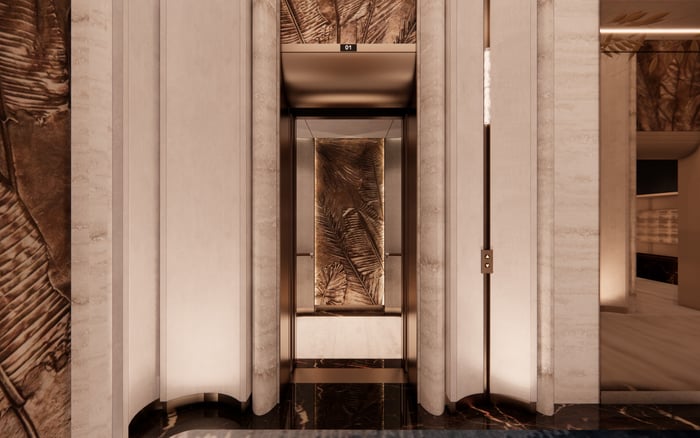
A buyer-focused guide to reviewing ceiling conditions, lighting, structure, approvals, and installation logistics before placing large-scale art in contract at Alina Residences Boca Raton.

For collectors, the most consequential design decisions often occur before the decorator enters the room. At Alina Residences Boca Raton, a buyer considering large-scale art should treat the ceiling plane as part of the acquisition itself. The question is not simply whether a painting, textile, sculpture, or suspended work will fit. It is whether the residence can support the art physically, visually, mechanically, and procedurally without compromising the architecture or disrupting a closing plan.
Large art changes how a home is read. A tall canvas can make a room feel gallery-like, but only if ceiling height, lighting, and surrounding openings allow it to breathe. A suspended work can create an extraordinary arrival moment, but only if the slab, anchors, sprinklers, and building approvals support the installation. The more valuable the art, the more disciplined the review should be.
For a Boca Raton buyer, the right approach is discreet but exacting: verify conditions, document questions, and make art requirements part of contract diligence. This review may intersect with buyer lenses such as Alina Residences Boca Raton, Boca-ratón, New-construction, High-floors, Penthouse, and Balcony, but the central issue remains the same: the ceiling must perform.
The first measurement to confirm is not the most dramatic ceiling height discussed in conversation. It is the finished clear height in the exact rooms where art is intended to live. Finished height can be affected by dropped ceilings, soffits, linear diffusers, recessed lighting, sprinkler heads, speakers, shade pockets, and mechanical runs. A room may feel open overall yet still have localized interruptions that matter for a 96-inch work or a sculptural installation.
Before contract, a buyer should request the most complete available ceiling information for the residence under consideration. The reflected ceiling plan is especially important because it shows how the overhead plane is organized. Electrical and lighting plans can clarify fixture positions. Window and door elevations can reveal where the ceiling meets glass, millwork, and drapery conditions.
The goal is not to redesign the home before ownership. It is to understand the constraints early enough that the purchase decision is informed. If the most important wall is interrupted by a soffit, or if a ceiling feature prevents ideal lighting, that issue belongs in diligence rather than after move-in.
A ceiling is never just drywall. In a luxury condominium residence, it is a coordinated system that may include structure above, acoustic separation, fire protection, mechanical distribution, lighting, technology, and finish detailing. Large-scale art can interact with all of these elements.
For wall-mounted works, the ceiling still matters because it governs sightlines and lighting. A large canvas may require a precise wash of light that cannot be achieved if fixtures are too close, too narrow, or positioned around an obstruction. For sculpture, the ceiling may affect shadows and circulation. For hanging installations, the ceiling becomes structural territory, and assumptions are dangerous.
A prudent buyer should ask where attachment is permitted, what substrate exists behind visible finishes, and whether supplemental backing or engineered support is possible. If the work is especially heavy, fragile, suspended, or mechanically complex, the review should include an art installer and a qualified design professional before the contract contingency period expires.
Collectors often focus on dimensions first, but lighting can determine whether a major piece succeeds. Ceiling height influences beam spread. Fixture placement determines whether the work is evenly lit or compromised by glare. Recessed downlights may be beautiful for daily living yet inadequate for a textured painting, a reflective work, or a dark photograph that needs controlled illumination.
The buyer should map intended art locations against the lighting plan. Key questions include whether fixtures can be adjusted, whether the ceiling has capacity for added art lighting, whether dimming is compatible with the intended program, and whether natural light must be filtered. In residences with expansive glass, the conversation should extend to shades, UV protection, and time-of-day exposure.
The most elegant solution is often the least visible one. A clean ceiling can still support sophisticated art presentation if the infrastructure is coordinated early. Conversely, a visually impressive ceiling can become difficult if every light, vent, and sprinkler head competes with the art.
If the collection includes suspended sculpture, ceiling-mounted objects, heavy lighting associated with artwork, or custom display systems, structure becomes central. Buyers should avoid informal assurances and seek written clarity on what can and cannot be attached to ceilings or slabs. Condominium buildings typically have rules governing penetrations, sound transmission, waterproofing, fire safety, and contractor access.
The review should also distinguish between what is technically possible and what is approvable. A ceiling may be able to accept an engineered solution, yet the building may require drawings, insurance certificates, licensed contractors, working-hour limits, protective coverings, or board-level approvals. These steps are manageable when anticipated. They become costly when discovered after contract, after closing, or after a piece has been shipped.
For highly valuable art, the installation plan should align with insurance requirements. Documentation may include condition reports, transit protocols, installation certificates, and evidence that qualified handlers performed the work. The ceiling evaluation is therefore part of a broader risk-management exercise.
A ceiling can be perfect, yet the artwork may still fail the path of travel. Before contract, large art should be evaluated from loading area to residence entry, then through elevator dimensions, corridors, door openings, foyer turns, and room approaches. Oversized works can be restricted by a single turn, a low header, or a protective protocol that limits maneuvering.
For buyers planning monumental works, a mock path can be as important as a wall elevation. Confirm whether the piece can be crated, uncrated, tilted, or assembled on site. If the intended art is not yet acquired, establish a maximum safe envelope for future acquisitions. This allows the residence to be evaluated as a platform for collecting, rather than as a one-time display.
Inside the home, ceiling height affects how art is experienced from seated areas, dining positions, and circulation zones. A piece that looks extraordinary in isolation may feel compressed if mounted too close to the ceiling or forced above furniture. Scale should be judged in relation to the room’s architecture, not only the artwork’s dimensions.
The best time to address ceiling concerns is before contract terms are final or while diligence rights still have practical value. Buyers can request plan review, access for consultants when appropriate, confirmation of alteration procedures, and written responses to specific installation questions. The objective is not to burden the transaction with design minutiae. It is to prevent avoidable surprises.
If a residence is being purchased with a significant collection in mind, the buyer’s team should create a concise art due diligence memo. It can identify intended art zones, required ceiling conditions, open questions, and any approvals needed after closing. That memo can then guide counsel, the design team, the art advisor, and the installer.
For ultra-premium buyers, this is where taste meets discipline. A residence should not merely contain art. It should respect it, illuminate it, protect it, and allow it to be installed without drama.
Should I verify ceiling height before signing a contract? Yes. Confirm finished clear heights in the exact rooms where major art will be installed.
Is a reflected ceiling plan important for art buyers? Yes. It helps identify soffits, lighting, sprinklers, speakers, and other overhead conditions.
Can large paintings be affected by ceiling design? Yes. Ceiling height, lighting angles, and nearby soffits can change proportion and presentation.
What if I want a suspended sculpture? Ask for structural and building-approval guidance before assuming any ceiling attachment is permitted.
Should an art installer review the residence before closing? For valuable or oversized works, early installer input can prevent expensive placement mistakes.
Do lighting plans matter as much as wall dimensions? Often, yes. A perfect wall can underperform if the ceiling lighting cannot properly illuminate the work.
Can balcony exposure affect interior art decisions? Yes. Bright openings near a Balcony may require shade, UV, and glare-control planning.
Are High-floors different for art logistics? They can be. Elevator capacity, access timing, and protective procedures may matter more for oversized pieces.
Is a Penthouse automatically better for large art? Not automatically. The specific ceiling, structure, access path, and approval process still need review.
When should the art advisor join the process? Ideally before contract, so art priorities can be translated into practical residence questions.
For a tailored shortlist and next-step guidance, connect with MILLION.
If branded residences are on your mind — as a home or as an allocation — we would be glad to share what we are seeing, privately.
Begin a quiet conversation