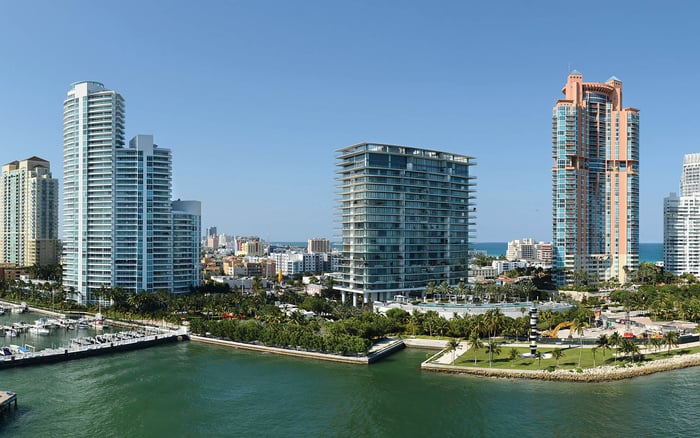
At Apogee South Beach, staffed service is part of the ownership experience, but buyers should distinguish present practice from documented obligation. This closing guide examines concierge, valet, security, engineering, housekeeping, amenity staffing, management responsibility, and the costs that may sit outside regular assessments.

At Apogee South Beach, an ultra-luxury condominium in Miami Beach’s South of Fifth neighborhood, staffed service is central to the ownership experience. Yet a polished arrival does not, by itself, establish precisely what the association is obligated to provide after closing.
Buyers should translate every service impression into practical questions: Who performs the work? During which hours? Is it included in regular assessments? Can the level of coverage change? The answers affect convenience, privacy, carrying costs, and the ease of managing a second home from afar.
This is especially important in a neighborhood near South Pointe Park, the ocean, Government Cut, dining, and nightlife. The surrounding energy makes disciplined access control and consistent building operations particularly relevant. In market shorthand, the enclave may appear as SoFi or South of Fifth, but resale buyers still need current, building-specific documentation rather than assumptions based on location.
“Concierge” can describe anything from front-desk reception to a broader resident-services function. Before closing, confirm the desk’s operating hours and the exact requests personnel are authorized to handle. Buyers should also ask how coverage works outside regular hours and whether association employees or outside contractors fulfill requests.
The key distinction is between customary assistance and an enforceable obligation. A service residents presently enjoy may be governed by a policy, staffing decision, or vendor arrangement that can later change. Governing documents and current association policies should therefore be read alongside the practical description provided during a tour.
Buyers comparing service models across Miami Beach might also tour Continuum on South Beach, Five Park Miami Beach, or The Ritz-Carlton Residences® South Beach. The purpose is not to assume equivalence, but to identify the operating details that matter most to a particular household.
Valet service should be evaluated as an operating system, not treated as a generic amenity. Clarify staffing hours, resident and guest procedures, vehicle limits, fees, tipping expectations, and liability. A household with several cars, frequent visitors, private drivers, or long periods away may require different answers than a full-time resident with one vehicle.
Security diligence should be equally granular. Determine whether coverage is continuous, which common areas are monitored, and how residents, guests, vendors, deliveries, and household staff are screened. Ask how authorization is recorded and what happens when a visitor arrives after hours.
Privacy depends on the entire chain of entry, from vehicle arrival to elevator or residence access. Buyers should seek a clear explanation of who controls each point and how exceptions are handled. Verbal summaries are useful for orientation, but current written policies provide a more durable reference.
Engineering coverage can become decisive when an urgent issue arises. Confirm staffing hours, emergency-response procedures, the boundary between common-area and in-unit work, and whether assistance inside a residence incurs a separate charge. Buyers who travel frequently should also understand who may authorize access in their absence.
Housekeeping requires similar precision. Determine whether any support is association-provided, offered as an optional paid service, or performed solely by outside vendors retained by the owner. Then review vendor admission, scheduling, insurance, supervision, and key or access procedures.
Amenity staffing should not be assumed. Establish which amenities have dedicated attendants, their operating hours, and whether staffing levels vary seasonally. An amenity can remain physically available even when its service component follows a narrower schedule.
Building management, the condominium board, association employees, and third-party contractors have distinct responsibilities. Buyers should identify which party supervises each service, handles complaints, negotiates contracts, and approves operating changes. This division matters when a request crosses from hospitality into maintenance, security, or association policy.
The distinction also clarifies what assessments include. Regular staffing may be budgeted as a common expense, while certain in-unit, housekeeping, valet, guest, or usage-based services may generate separate charges. Request the current fee schedule rather than relying on broad descriptions of “included” service.
For buyers evaluating Miami Beach ownership, the central principle is simple: service quality is simultaneously operational, contractual, and financial.
The closing file should include the current budget, recent board minutes, governing documents, association policies, staffing information, relevant service complaints, pending vendor changes, and notices of proposed assessments. These materials can reveal whether staffing costs, contract renewals, or service changes may affect future assessments.
Counsel should determine whether any service level is contractually guaranteed or remains subject to board, budget, policy, or vendor decisions. The buyer’s objective is not to freeze the building in time, but to understand which expectations are documented, which are discretionary, and which could carry an additional cost after title transfers.
Is concierge service necessarily available at all hours? No. Buyers should confirm current operating hours, after-hours coverage, and the precise scope of assistance before closing.
What should buyers ask about valet service? Ask about staffing hours, guest handling, vehicle limits, fees, tipping expectations, and liability procedures.
How should security coverage be evaluated? Confirm whether coverage is continuous, which areas are monitored, and how residents, guests, vendors, and deliveries are screened.
Can building engineering assist inside a residence? It may, but buyers should verify the scope, response process, staffing hours, and any separate charges for in-unit work.
Is housekeeping included in regular assessments? Do not assume so. Distinguish association-provided support from optional paid services and owner-retained outside vendors.
Are all amenities staffed whenever they are open? Not necessarily. Confirm which amenities have attendants and whether staffing or operating hours vary by season.
Who controls changes to staffed services? Responsibility may be divided among management, the board, association employees, and contractors, depending on the service and governing framework.
Can current service levels change after closing? They may change unless protected by governing documents or another binding obligation. Association policies, budgets, and vendor terms deserve careful review.
Which financial records matter most? Review current budgets, vendor arrangements, proposed assessments, and recent board minutes for possible staffing or contract changes.
Should a buyer rely on the service observed during a tour? A tour is only a snapshot. Confirm the operating model through current documents and review it with Florida condominium counsel.
For a discreet conversation and a curated building-by-building shortlist, connect with MILLION.
If branded residences are on your mind — as a home or as an allocation — we would be glad to share what we are seeing, privately.
Begin a quiet conversation